Benjamin Nicholas, Director of the Choir of Merton College Oxford and the Girl Choristers of Merton College Oxford reflects on Benjamin Britten’s extraordinary youthful genius, the troubled times that shaped his works, and why he’s England’s greatest composer since Purcell.
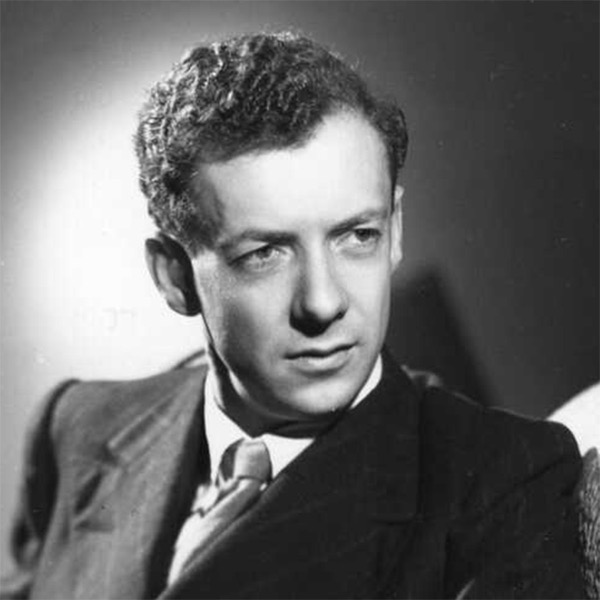
Benjamin Britten
Aged only 16, Benjamin Britten composed his A Hymn to The Virgin on paper he hand-ruled himself, while stuck in the school sanatorium in 1930. Despite these straitened circumstances, the music he produced has stood the test of time, showing such impressive maturity that it stands alongside some of the finest works of English choral music from the twentieth century. Now, 100 years on, as we have rehearsed the piece for our latest recording, I have been struck by the poignancy of the Girl Choristers of Merton College bringing to life a work composed by someone their own age.
His ingenuity becomes all the more evident when we look at the masterpieces of choral music from around that time. Think of Herbert Howells’ A Spotless Rose from 1918, Peter Warlock’s Bethlehem Down from 1927, and then Hymn to the Virgin in 1930. Structurally, it feels that Britten is looking much further back to Renaissance composers with his use of the double choir. Going through it in detail with the Choir of Merton College alongside the girl choristers, I am struck afresh by the beautiful construction of his musical phrasing and the cadences which powerfully combine ancient and modern tonality.
Of course, Britten was building on an extraordinary musical inheritance. Though when you look at the line of the great English composers – those who really achieved international recognition – it’s also striking that it leaps a couple of centuries from Tallis, Byrd and Purcell to Elgar and then to Britten. As a young man, he was quite disparaging of Elgar, and his musical influences extended well beyond England. So his relationship with that tradition was far from straightforward.
This was in part due to Frank Bridge, one of the most important figures in his development, whose music he first heard at the Norfolk and Norwich Festival. Bridge instilled within him a tremendous sense of discipline, yet also encouraged him to listen widely, for instance, to composers like Schoenberg and Berg from the Second Viennese School. This extraordinary confluence of the traditions of English music and the most radical ideas of the time shaped the works we know today.
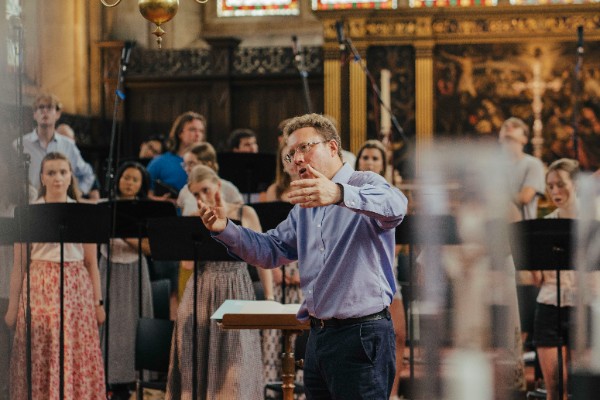
Session Photography (Will Coates-Gibson – foxbrush)
While this breadth of listening undoubtedly helped, his genius also, of course, stems from a remarkable innate musicianship. One of the most extraordinary works on the album is A Boy Was Born, which he wrote at age 19. It’s difficult to fathom how someone that age could produce something so structurally brilliant, not just in his development of the four-note motif on which the work is based, but in the way he’s arranged the poems and matched the music to the drama. I think the only reason it’s not put on more often is because it’s so difficult. You’re perilously close to the edge as you’re performing it; one false move and the whole thing will collapse like a house of cards. For our young singers, the youngest of whom are only eight years old, mastering music of this complexity is an immense achievement.
Britten’s passion for his country was never a matter of blunt nationalism; in fact, as Europe descended into war, he found himself torn between his love for his homeland and his deeply held pacifist convictions. Horrified by the shadow of fascism spreading across Europe, he and Peter Pears left for the USA in April 1939, six months before World War II broke out. Pears later recalled that they were denounced as ‘Cads and cowards … deserters even, if you will’.
Today, as we witness the spread of far-right politics around the world, we can perhaps imagine quite clearly the intensity of the turmoil Britten experienced as he wondered what the most honourable course was to take, and the pain of having his convictions questioned so publicly. It’s a testament to his courage that he chose to remain true to his principles, despite the considerable personal cost.
Famously, he was spurred to return when he read an article by the novelist E M Forster about the poet George Crabbe. After tracking down Crabbe’s work, the poet’s descriptions of Aldeburgh and the Suffolk coast would eventually inspire Britten’s opera, Peter Grimes. But its most immediate impact was to make Britten desperately homesick. Britten and Peter Pears booked a passage on the Swedish ship MS Axel Johnson in 1942, making their crossing of the Atlantic at a time when it was infested with German U-Boats.
The cramped and noisy cabin, and constant threat of danger became the setting in which Britten would write A Ceremony of Carols, which opens our album. I find it remarkable that music of such delicacy and radiance could have emerged from circumstances so fraught with uncertainty. Christmas clearly held a particular significance for him throughout his life, inspiring a significant body of music, from A Hymn to the Virgin and Christ’s Nativity to A Boy Was Born and the great cantata St Nicolas. Even in his final years, he was planning a Christmas opera based on the Chester Mystery Cycle, although he never lived to complete it.
Part of the enduring appeal of all of these works lies in the way Britten drew on centuries-old traditions while making them sound entirely his own. He had an exceptional gift for understanding the relationship between words and music, and an equally remarkable empathy for the performers for whom he wrote.
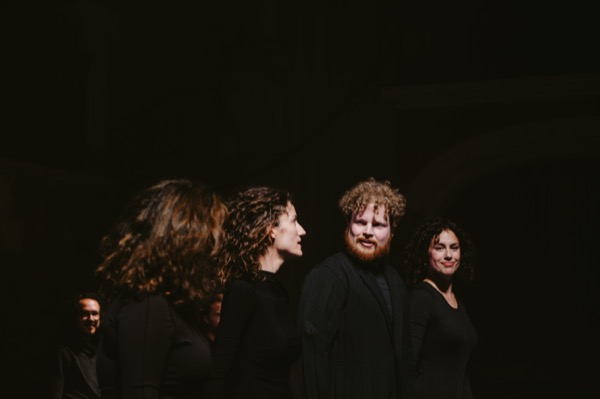
That’s been particularly apparent as we’ve prepared this album with the Choir of Merton College and the Girl Choristers of Merton College. Alongside the challenges of A Boy Was Born and A Ceremony of Carols, we’ve been working on pieces such as the Festival Te Deum, with its fabulously virtuosic organ writing and stunningly shaped phrasing for the singers. There’s a tremendous satisfaction in seeing young musicians grow into this repertoire and discover what it asks of them.
This album is being released ten years after we established the Girl Choristers of Merton College, the first choir of its kind in Oxford for school-age girls. When we founded the choir, we deliberately decided that it should be for girls alone, partly because boys had been so well catered for within the choral tradition for the previous 600 years. Many churches and cathedrals have since moved towards mixed choirs, and I can see the significant merits of that approach, but our model has worked wonderfully well.
The girls range in age from eight to 16, and there’s a lovely richness and maturity to the vocal colour of the older singers, which blends very cohesively with the younger voices. What’s especially gratifying now is that the choir is no longer defined by its novelty. It has developed its own shared history, its own repertoire and its own musical identity.
In a sense, that’s what makes recording Britten’s music at this moment so appropriate. We’re celebrating not only the extraordinary achievements of one of England’s greatest composers, but also the continuing vitality of the choral tradition to which he contributed so much.
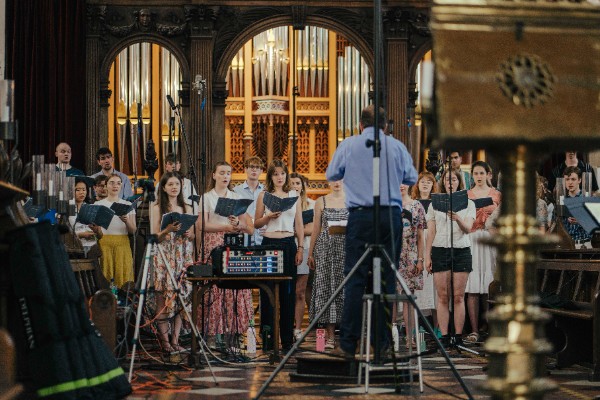
Session Photography (Will Coates-Gibson – foxbrush)
Britten himself was a young musician who inherited a rich musical past and found the confidence to make something entirely new from it. Generations later, in a political landscape that perhaps feels alarmingly similar to Britten’s, young singers are encountering that same music, discovering its challenges and making it their own.
For me, that is perhaps the most compelling testament to his genius. The music endures not simply because of its structural brilliance or its unmistakable individuality, but because it continues to speak so directly to the musicians who perform it. There is something particularly fitting about hearing the extraordinary imagination of the young Britten brought to life by young voices today.
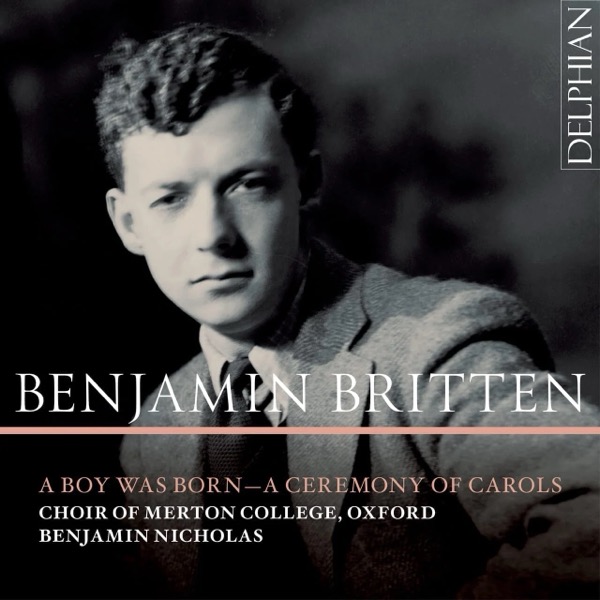
Britten: A Boy Was Born / A Ceremony of Carols (Delphian)
Benjamin Nicholas is Director of Music at Merton College, Oxford, and has been Music Director of the Oxford Bach Choir since 2018. He has conducted the BBC Singers, City of Birmingham Symphony Orchestra, City of London Sinfonia, Holst Singers and Royal Philharmonic Orchestra. At Merton, he founded the annual Passiontide Festival and the College’s Girls’ Choir, and oversaw the installation of the Dobson Organ. He has also toured with the College Choir across the USA and Europe and made a series of recordings for Delphian, the first of which was a Gramophone Editor’s Choice. A champion of new music, he has premiered works by Judith Weir, Charlotte Bray, Hannah Kendall and Dobrinka Tabakova, and commissioned Birtwistle, Dove, MacMillan, Jackson and Joubert.
For more of the best in classical music, sign up for our E-Newsletter