When I interview opera singers, I often ask them about the crowds they perform to, hearing stories of various opera houses and festivals, perhaps something about their favourite role or cherished orchestra to perform with. Never before, however, has one of the crowds been a stadium audience of thousands of mixed martial arts (MMA) fans, minutes before a major fight.
I last interviewed Tobias Greenhalgh ten years ago, when he already mentioned martial arts as a way to unwind between performances. Little did I know that he would go on to become one of the most in-demand ring announcers for fights ranging from boxing to MMA, and everything in between. He does this alongside his work at the Aalto-Theater in Essen, where he is based these days.
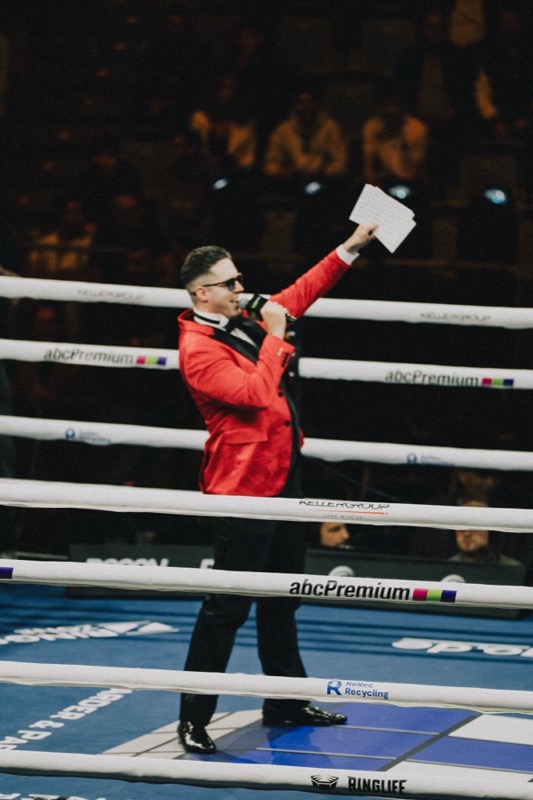
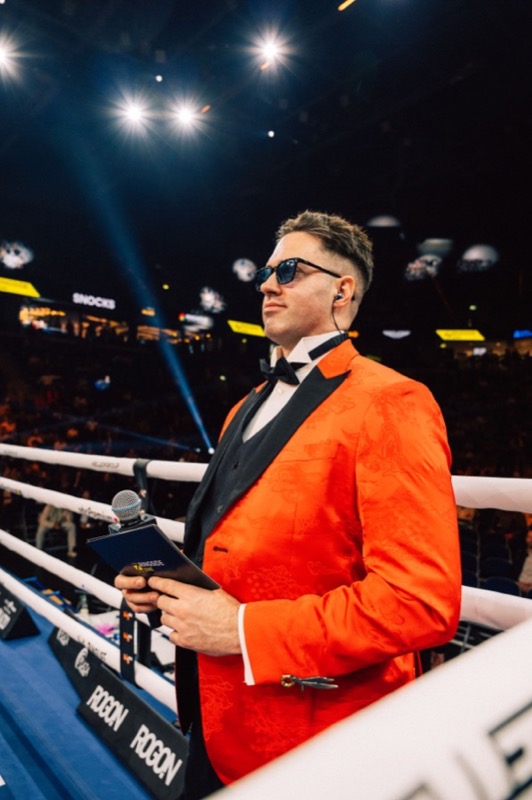
Tobias can be found singing at the Aalto-Theater during the week, then at the weekend donning his red jacket and sunglasses to travel to a stadium in Germany or the Netherlands, jumping into the ring to announce a fight — with a twist.
What makes Tobias’ brand of announcing so unique is that he doesn’t turn his back on his operatic background when he enters the ring. Rather, the opposite: he blends announcing with singing excerpts from the operatic repertoire live in front of the fans, and the result has been a resounding success.
Tobias has performed at fights in stadiums that seat thousands, such as a recent engagement in May this year, which saw him perform Nessun Dorma to a crowd of 13,000 in Mannheim’s SAP Arena. He was featured on the recent Netflix show The Cage, the first season of which was number 1 for two weeks on Netflix’s non-English series global chart. The show returns for a second season, premiering this month.
This unique branching of Tobias’ career coincides with a fundamental transition in his voice as an opera singer, moving from baritone to the higher, more powerful heldentenor Fach (voice type). As he embarks upon operatic roles with this new voice type, we discuss the similarities between the opera singer and ring announcer, his journey to announcing, and what each world can perhaps learn from the other.
Tobias Greenhalgh
How did you find your way to ring announcing?
I’d been into sports and fitness and so on, and after I graduated from Juilliard, I started training in martial arts. I became fascinated with martial arts for a variety of reasons, partly for self-defence but also because I wanted a better awareness of my body on stage and to better control my nerves.
I was practising aikido when I moved to Vienna, a certain martial art focused on zen and similar aspects, but then I started to get more into the combat sports like boxing and kickboxing, and I’ve just been fascinated by them. I’ve always had positive experiences with them — they help me grow as a person, and it really helps me as a singer and actor. It raised my game, and it’s also been a reliable stress reliever!
With that, I got into the gym culture. You go from city to city as an opera singer, and you meet people, which is really nice because you always have a social network. When I moved to Essen, I wanted to learn boxing, and there was a really good boxing academy in Essen called Brooklyn Finest: a New York City-themed boxing gym.
They were fascinated with me there because I was from New York but also because I’m an opera singer. They were like, ‘Who is this guy and why does he want to learn boxing?’ but I took it seriously, earned their respect and had a great time. Some time later, the owner [of the gym] was having a fight night, and he knew I was a singer, so he asked me to be the announcer.
How did you feel the first time you announced?
I was really excited about it, and it was kind of tongue-in-cheek. I asked some of my friends from the opera to come along and root for me. I went and did the gig, and as soon as I started speaking, the audience started screaming. I got really excited, and it was really fun. I was high on adrenaline, and so I told myself afterwards that I want to find a way to do more.
Ring Announcer Sizzle Reel | Tobias Greenhalgh
Did any similarities strike you between singing and ring announcing in these early days?
I was thinking about the duty of the ring announcer. He uses his voice to create epic moments for thousands of people. I thought, ‘Wait, that’s kind of like opera singing, like heldentenor singing’. He wears a goofy costume and is an over-the-top presence. I thought, ‘Well, I definitely do that!’ I thought that maybe I could try it. It sounded really interesting, and I like being positive and inspiring people.
Is it hard to balance the work in the opera house with your announcing?
For the past few years, a weekend for me was to sing Ping in Turandot at the Aalto-Theater in Essen on Friday, travel to Frankfurt on Saturday and do a boxing event, and then come home.
I was able to build my routine at the piano. I would go from a rehearsal or performance and go directly into the ballet studio or practice room, and it immediately felt like I was bringing my performance style from the opera into this kind of new creative announcing style.
What has the reception been to you, including opera singing, in your announcing work?
I pushed to get some opera performances at these events. I’ve sung O Fortuna, Nessun Dorma, as well as ACDC’s Thunderstruck! The great part about this is that people know me now. All these fight fans come up to me before the event, ask for a photo, and say, ‘Are you going to sing? We came just to hear you sing!’
I think to myself, ‘This is amazing.’ These guys are about 19 years old; they’re MMA fans; they’ve never heard an opera singer, and they know me as the orange-suited ring announcer guy who sings opera.
They are so excited to hear opera, and while they might not buy a ticket to go to the opera, I still think it’s an interesting way to expose people to it in an interesting format.
There could be one person out there who hears it, sees it, and thinks, ‘Wow, I want to do that, I want to be involved.’
O Fortuna live at Ringside Zone SAP Arena Mannheim
Tobias Greenhalgh
This announcing work has come alongside a vocal transition for you — how has it been navigating these two things simultaneously?
I am changing from baritone to heldentenor, and somehow the announcing and the heldentenor go together well, because when I announce I use the full scope of my range. I’m announcing how a heldentenor would sing; it’s a very interesting artistic exploration for me.
I have two world premieres coming up, one in Essen and one in America, and the roles are written for my voice. They are essentially just between heldenbaritone and heldentenor: very high for a baritone but quite low for a tenor, so I’m making that transition at the same time, and these interesting things are happening.
I was at a transition point mentally and in my career. I loved certain roles in opera productions but I felt like there was more out there. I speak German now; I like Wagner; I like dramatic German repertoire and dramatic repertoire in general, like Peter Grimes or Pagliacci. I felt that if I trained my voice correctly I could really portray those roles well and sing them well if I put the time and energy into it.
I started to learn the Wagner arias and work on them with German coaches, and I went to a Bavarian Wagner academy last summer and worked with a real heldentenor for a week. Everybody there said that I needed to make the change to heldentenor.
Siegmund | Die Walküre | Wagner
Every professional I speak to in the opera world says it’s the logical next step — but that I need to be careful! I’m just going with the flow a little bit as a singer and seeing what comes, while still practising every day and having intention, listening to recordings, working with coaches and teachers.
What’s the reception been like on the opera side of the fence?
The performers themselves respect it because there’s a lot of struggle with being a singer, and they see that it’s something that uses the voice as the main instrument in a different way — but I’m still singing opera, so it’s a good balance.
I spoke to the CEO of the opera company a few times, and I’ve said that the announcing has opened me up to hundreds of thousands of people, where I’m singing opera to them, and from an opera business perspective that checks the box.
Tobias Greenhalgh
How do the fighters and promoters you work with feel knowing there is a trained opera singer announcing their fights?
They love it. It’s an American cliché — the ring announcer is influenced by this kind of 1940s radio voice. I’ve studied this voice as a singer and tried to make it my own. It hearkens back to that while still using my opera instrument. I do the American thing, but then I speak German, I go back to English, then I sing, and I really try and pump the fighters and the crowd up.
I have fun with the fighters, as a performer. They really appreciate it, the level of care. They always say to me, ‘We just want something new, as an announcer.’ Everybody is just trying to imitate the two famous announcers, Michael and Bruce Buffer.
This cliché has only lasted for 40 years, so I see myself as the new generation. In opera you can’t break tradition too much, but with ring announcing it’s an unexplored art form. It’s like live performance art mixed with sport, and it’s unexplored.
All I hear from promoters is that all they want is to be unique and get eyeballs. They are interested in anything I do to raise the quality and get people to watch. That’s why singing ACDC’s Thunderstruck with singers and dancers and fireworks and then opening the show is exactly what they want. It’s a blank canvas.
ACDC ‘Thunderstruck’ cover at Levels Fight League 20
I take the work with great responsibility. It’s not just about me as a performer, because the guys really do risk their health and their whole reputation as fighters. I’m the last person, the last thing they experience before they fight. I’m the last one to leave the ring or the cage. Because I train, I also know what goes into their training, and I take it with great responsibility to give them a moment where the heavens part and the spotlight is on them.
So often when I announce them in this operatic way […] they write to me afterwards saying, ‘Thank you so much for that moment. I’ll never forget that moment,’ and that really means a lot to me.
You clearly have a natural ability for this — what has it been like exploring and developing this new skill set?
Since I started announcing I really got into stoic philosophy. Every morning I read a few pages of philosophy — Seneca, Epictetus, Marcus Aurelius, Cicero, these types of characters. I found the philosopher Quintilian a year ago — he wrote Institutes of Oratory, which is a 650-page manual. He was a student of Cicero’s and he kind of compiled all of Cicero’s teachings together.
The first pages of that book relate being a good public speaker. To be a good public speaker you have to be a good human, in order to be authentic. You could be a manipulator as a public speaker, but really in order to get and make positive change you have to be a good person.
This has totally changed my life, actually. It changed my whole perspective on everything, and I try and look for Roman oratory devices to use, the gestures and things, having studied that a little bit. It’s such an interesting pursuit.
This cliché of this guy [the ring announcer] who’s speaking with this voice, existed back then. I’m really fascinated by that. I have some natural ability and it’s refined by my operatic stage time and voice, but I really want to understand where that guy came from and what his role is in the society.
I think what I’m doing now is like the modern iteration of that, in the most modern of senses: with the microphone, on television, in sport, so that’s about as deep as it goes for me.
Are there any similarities for you between watching an opera and a boxing match?
I presented a boxing match at the opera house. I did a concert series, a kind of ‘getting to know you’ smaller concert series at the Aalto-Theater, where I sang songs from Les Misérables and other war songs, fighting songs, and another baritone sang Wotan, that kind of thing, and I brought in a referee friend of mine with two of his trainee boxers. We presented a shortened boxing match to give the opera people the sights and the sounds of a match, with the commentator, the bell, and so on.
It really is like a musical experience when you’re there. It’s a kaleidoscope of sounds. It’s a lot of energy, and you really feel it — it’s very visceral. I just gave a shortened 1- minute presentation with me as the announcer and the house was full of opera season ticket holders, mostly older people, and they were thrilled. They loved it — they were clapping, they were laughing, gasping, and I think that a lot of people, especially with boxing — boxing is a little more formal in the culture — they’re pretty open to it, actually.
Tobias Greenhalgh
Perhaps there are more similarities to these events than people first realise, then?
I’m doing a huge boxing event in Germany at the end of November with a company called Ringside Zone, and they’re one of the top new boxing companies in Germany. We did an event in May at the SAP arena in Mannheim which seats 13,000 people. (My mind was blown when I was in the ring!)
This event in November is my next big one, and they’re doing it in a theme park called Europa-Park. They have an Epcot-style bubble where they present concerts and things there, and they’re going to do the fight in this bubble. They’re doing a programme called ‘Symphony of the Ring’, and it’s a classical music boxing match. I think that that’s a step in this direction!
For more of the best in classical music, sign up for our E-Newsletter