The basic design of a stringed instrument such as a violin has been established for centuries. That hasn’t prevented musical instrument inventors from realising their wild string dreams.
When the age of recorded sound began in the late 19th century, people quickly discovered that some instruments were easy to record and others were more difficult. One of the difficult ones was the violin. To record the violin successfully, it needed a more focused sound, and in 1898, German watchmaker Johannes Matthias Augustus Stroh found a way to achieve it. He added a horn to the violin that boosted and focused the sound produced at the instrument’s bridge.
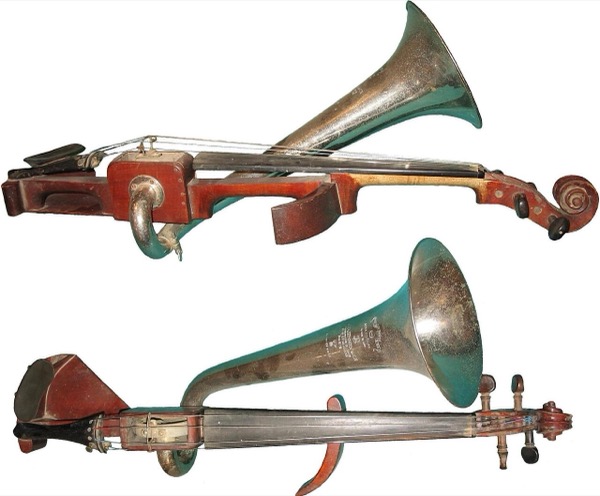
The Stroh Violin with horn
Stroh Violin, jazz x classical | Richard Tognetti | Australian Chamber Orchestra
Sometimes musical instrument makers play with the shape of the instrument.
In this violin, the top section has been abbreviated, the waist elongated, and the bottom corners eliminated. The net result is a violin that looks not unlike Darth Vader’s helmet and that its owner has named the “Vader” violin.
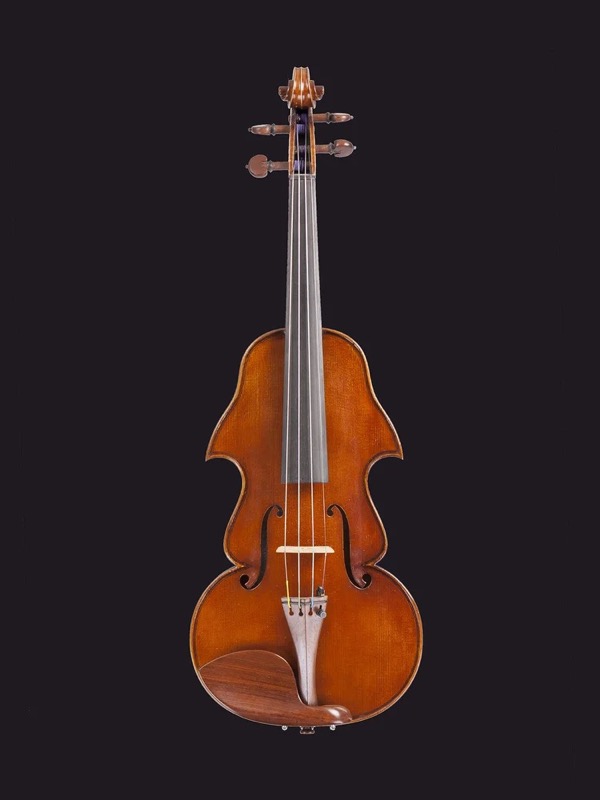
The “Vader” Violin (Baroque Violin Shop)
It’s actually a viola d’amore made in 1701 by Giovanni Grancino. This very early one does not have the sympathetic strings (resonating but not touched) of later viola d’amore. The viola d’amore appeared in the last quarter of the 17th century and was said to have a ‘sweet’ sound. This was called the ‘festoon’ shape.
MONAD Studio created an update on the violin in 2015, reducing it to two strings and creating the entire body on a 3-D printer.
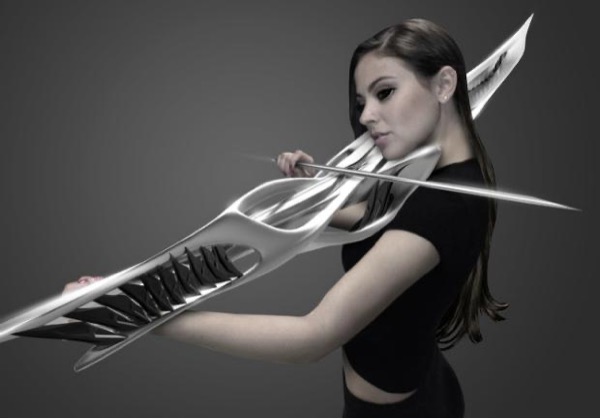
The 2-string Piezoelectric Violin (MONAD Studio)
A 19th-century violin/viola made in France by Chanot & Lete removes all pointed edges and changes the decorated f-holes to a simple slit.
Compared with a regular violin, we can see how much it has been simplified.
This is the classic form of the Stradivari:
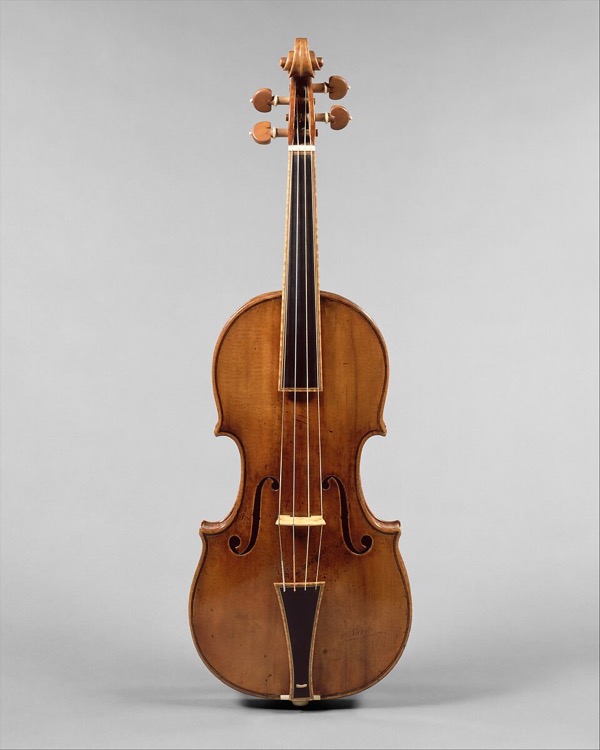
Antonio Stradivari: Gould Violin, 1693 (Metropolitan Museum of Art)
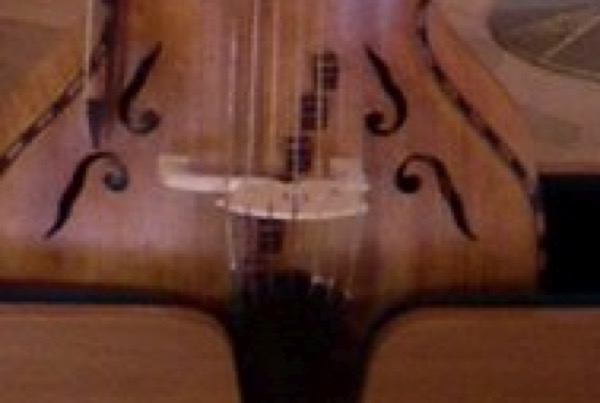
It now has 5 strings instead of 4; the outline is smooth; the strings are attached in a guitar style rather than a violin style; and the F-holes are now slot-shaped curves. On this instrument, the holes are lined in ebony and ivory, with the inside edge varnished dark brown. Although the instrument looks simplified, the maker spared no effort in its decoration. The purfling (the edge decoration on the face of the instrument) is actually five alternating ebony and ivory strips.
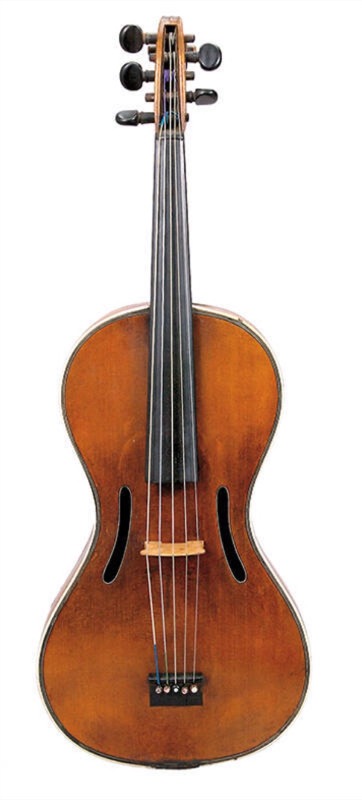
Chanot & Lete: Violin, 1801 (Vermillion, SD: National Music Museum)
The Austrian instrument maker Thomas Zach created his stringed violin in the shape of an amoeba for a specific acoustic purpose. His Violino Harpa starts with the basic form of a violin, but the soundbox has been enlarged to increase the sound.
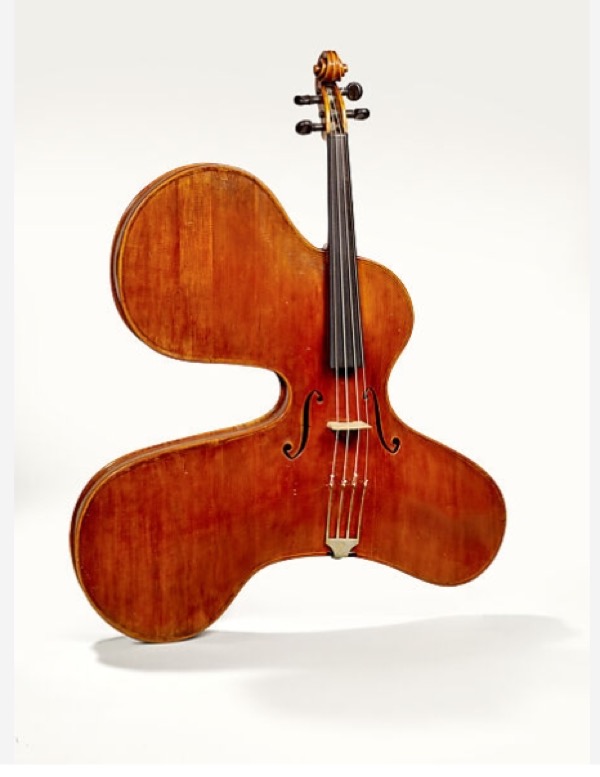
Thomas Zach: Violino Harpa Forma Maxima, 1872 (Musée de la Musique)
The instrument was made at the behest of Prince Grigori Sturdza, with a total of 6 instruments. They were played as a quartet at the 1873 World’s Fair in Vienna but were not well received. Although the cello sounds fine, as per the video below, the violins were said to be ‘nasal and unclear’.
The cellist Raphaël Pidoux plays the cello from the set:
Violoncelle Thomas Zach joué par Raphaël Pidoux, Humoresque, D.Popper – Musée de la musique
Other instruments in the set:
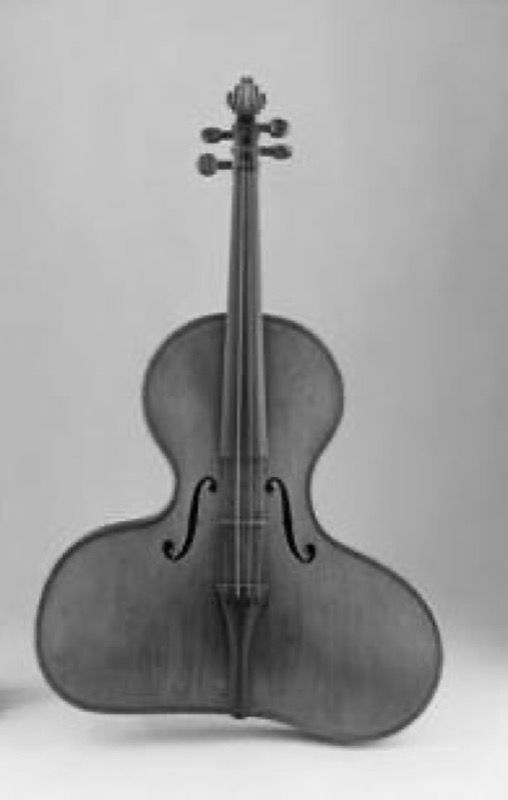
Thomas Zach: Violon irrégulier “violino harpa”, 1872 (Musée de la Musique)
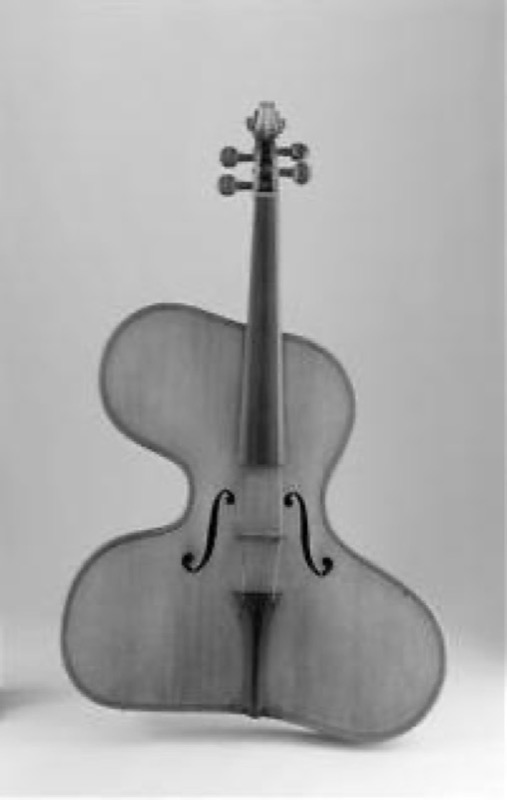
Thomas Zach: Violon irrégulier “violino harpa”, 1872 (Musée de la Musique)
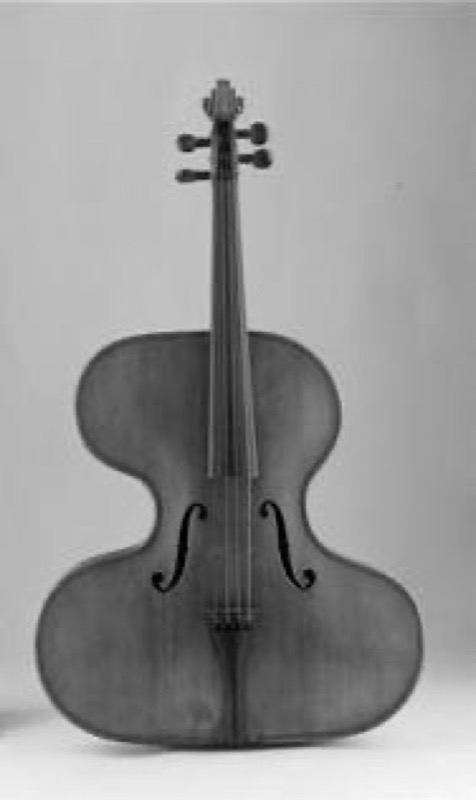
Thomas Zach: Violon irrégulier, 1872 (Musée de la Musique)
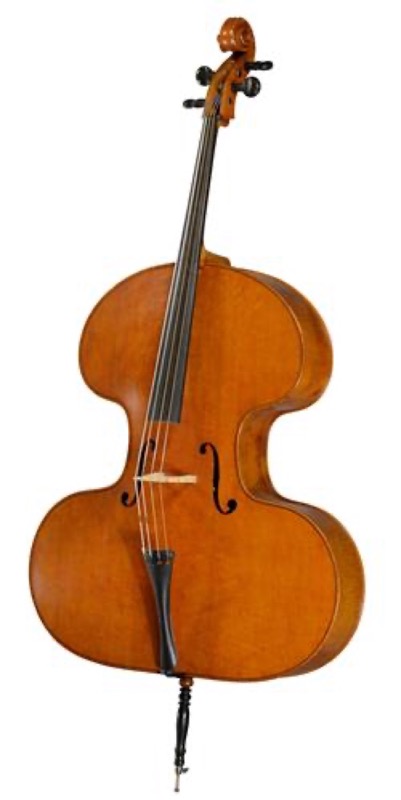
Thomas Zach: Violoncello, 1872 (Musée de la Musique)
When you want to take an instrument and gentrify it, you try to tie it to classical ideals. In the lyre guitar, two side arms were added so that the instrument looked like the lyre as played by Apollo.
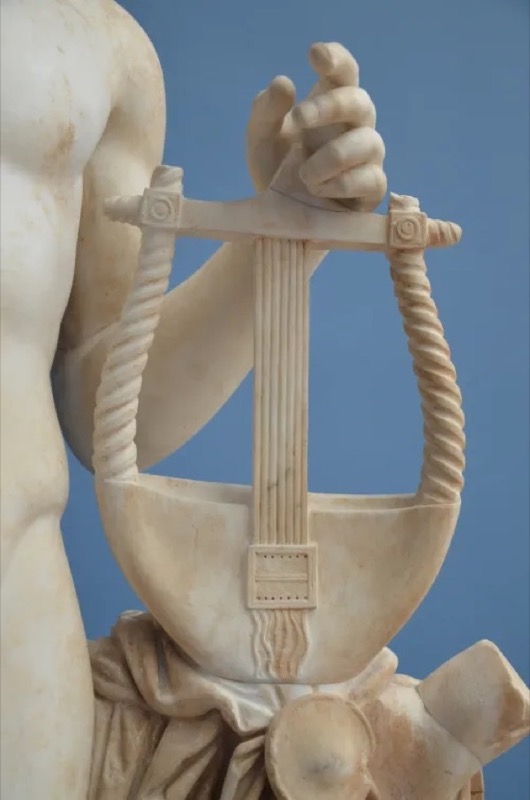
Apollo’s lyre
But your instrument is the guitar, and you create the lyre guitar. Invented around 1785, the instrument, like the guitar, had a fingerboard and strings. The instrument maker Edward Light sold his as the ‘Apollo’ lyre in 1811, and Angelo Benedetto Ventura sold his as the ‘Imperial Lyre’.
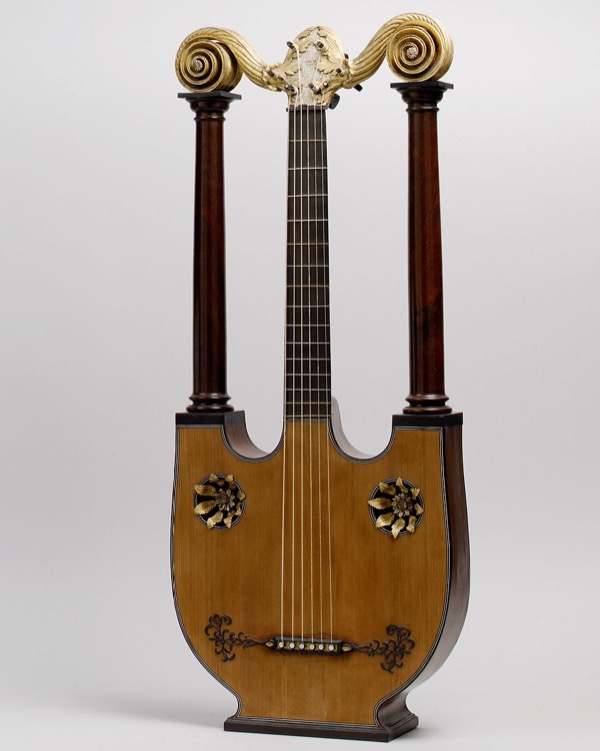
Lyre Guitar, possibly by Joseph Pons, ca. 1805 (Metropolitan Museum of Art)
FRENCH LYRE, c. 1790 | RARE guitars from the Spencer Collection
In a modern vein, Cheap Trick guitarist Rick Nielsen, recognisable by his long-billed cap and checkerboard dress, had many guitars made in his image.
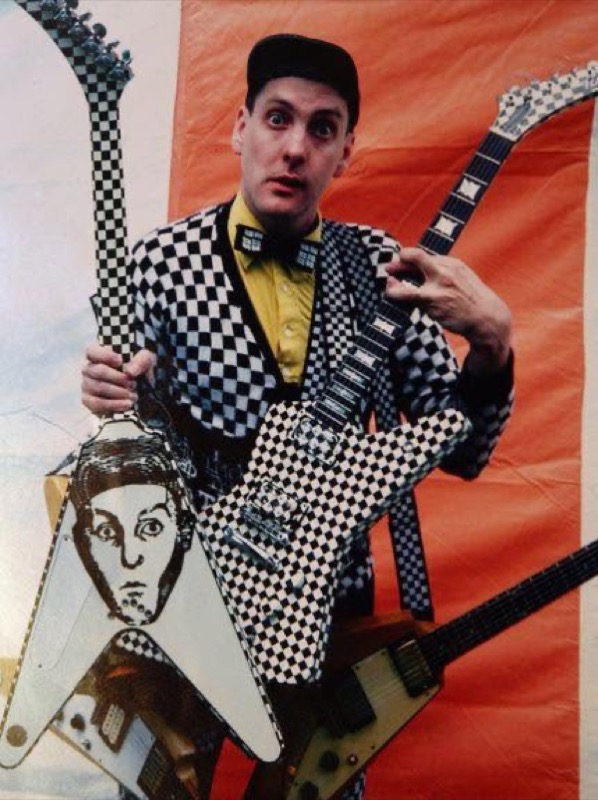
Rick Nielsen and single guitars in his image
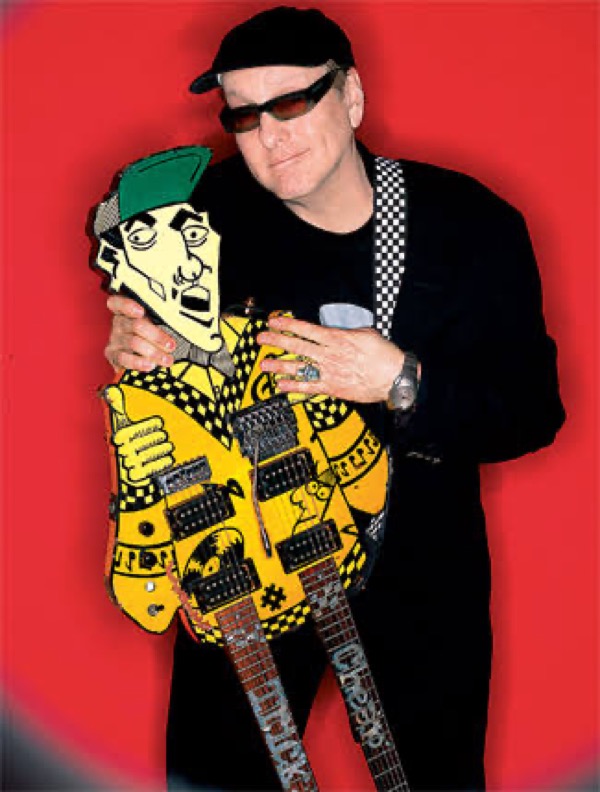
Rick Nielsen and a two-necked guitar in his image
The original idea Nielsen brought to Hamer Guitars was for a circular guitar that he could spin from neck to neck — this proved to be unwieldy due to weight and ‘logistical issues’. This checkerboard guitar was the second Hamer made for him after the top neck snapped off his first ‘orange Quint neck’.
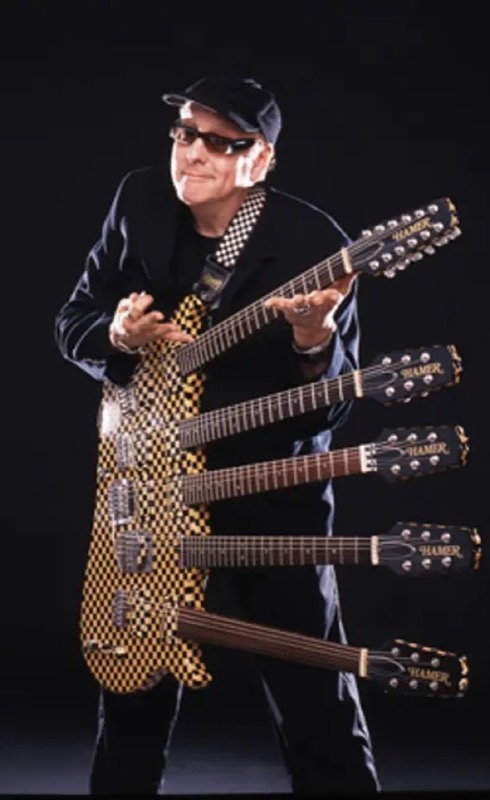
Rick Nielsen and his 5-neck guitar made by Hamer
With the advent of electric guitars, the guitar body wasn’t needed as a resonant area anymore, enabling solid-body guitars that could take more abuse and, in a step in the other direction, no-body guitars such as the Chapman Stick.
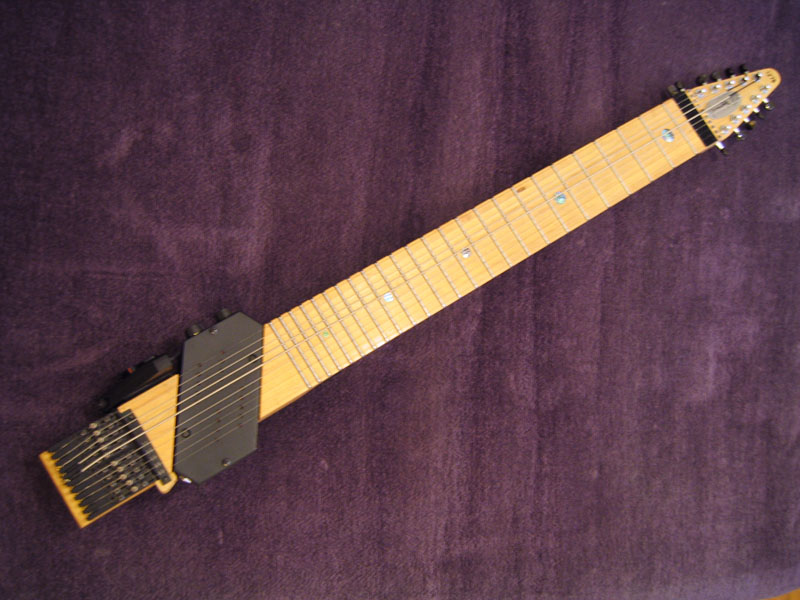
Emmett Chapman: The Chapman Stick (image by Matt Perry)
Tony Levin’s Chapman Stick -King Crimson BEAT
The Chapman Stick isn’t so much a guitar as it is a combination of a ‘guitar, a bass, a piano, and percussion’. Developed in the early 1970s by jazz musician Emmett Chapman, it has 8, 10, or 12 strings and, according to its inventor, can be used to play ‘bass lines, melody lines, chords, or textures’.
Another inventor who stripped down the electric guitar was Allan Gittler, who developed his Gittler in New York between the mid-1970s and early 1980s. His goal was a guitar that was ‘purely functional, with no unnecessary shapes or decorations.’
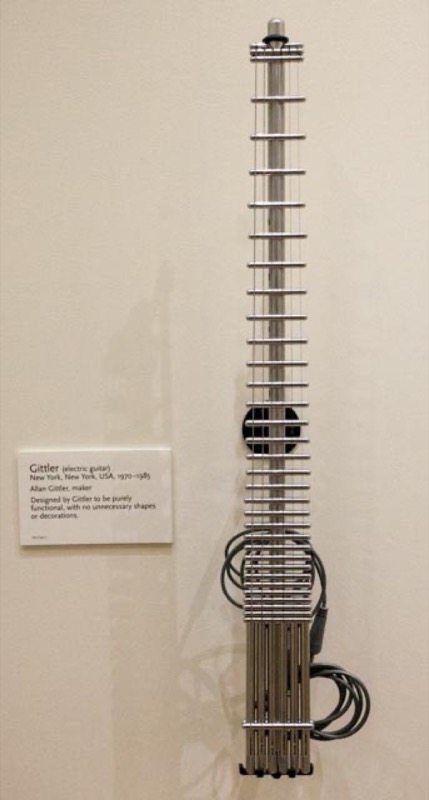
Gittler
Samira Saygili & Peter Autschbach – “Holobiont” on the Gittler guitar
The Pikasso guitar was developed by luthier Linda Manzer in the 1980s for jazz guitarist Pat Metheny, who wanted a guitar with ‘as many strings as possible’. The 42-string instrument features a wedge back (deeper at the bottom than the top) so the guitarist can look down the instrument at an angle. The name Pikasso is an homage to the strangely formed guitars in Picasso’s paintings.
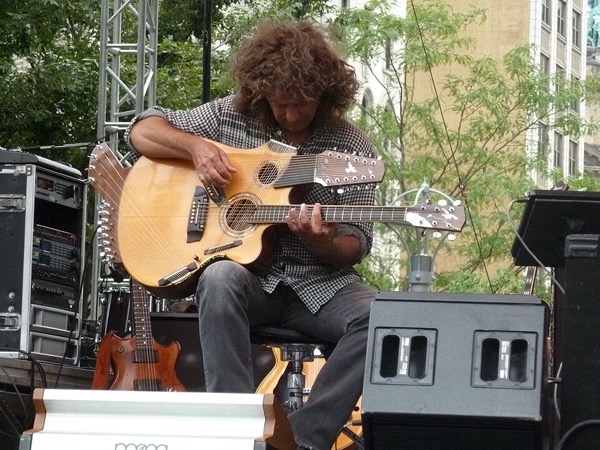
Pat Metheny and his Pikasso
Pat Metheny Pikasso 42-string guitar
The Argentinian musical comedy group Les Luthiers were famous for their inventive instruments. Their name ‘luthiers’ refers to musical instrument makers, and so they made their instruments from everyday objects or in unique combinations.
The Latin, or tin violin, used a ham can for the resonant body.
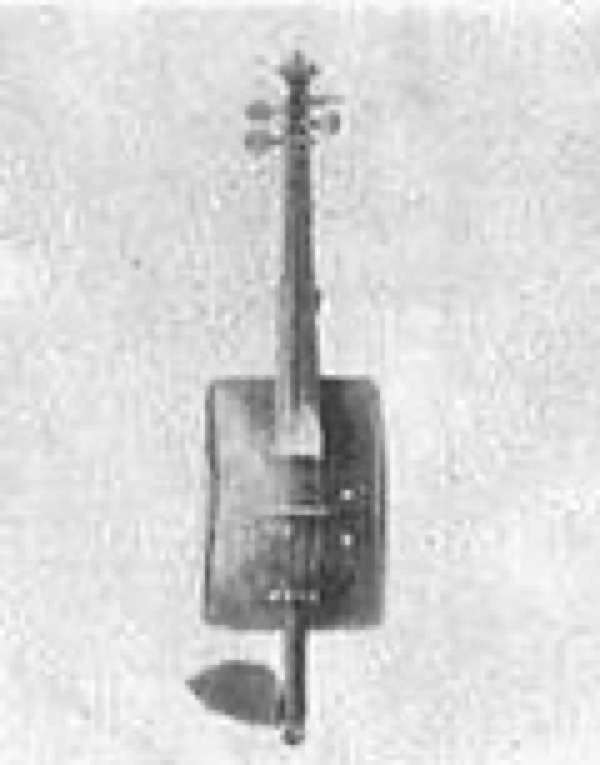
Latin
The Violata, or Tin Viola, used a paint can.
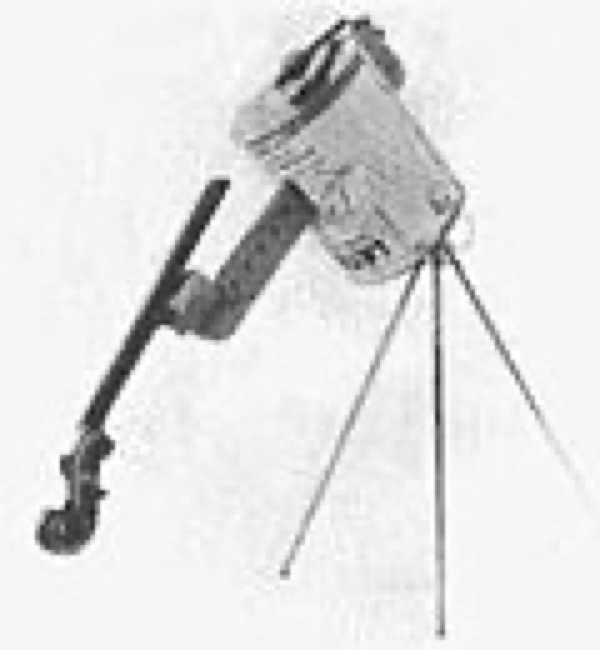
Violata
The Contrachitarrone da gamba combined a cello and a guitar.
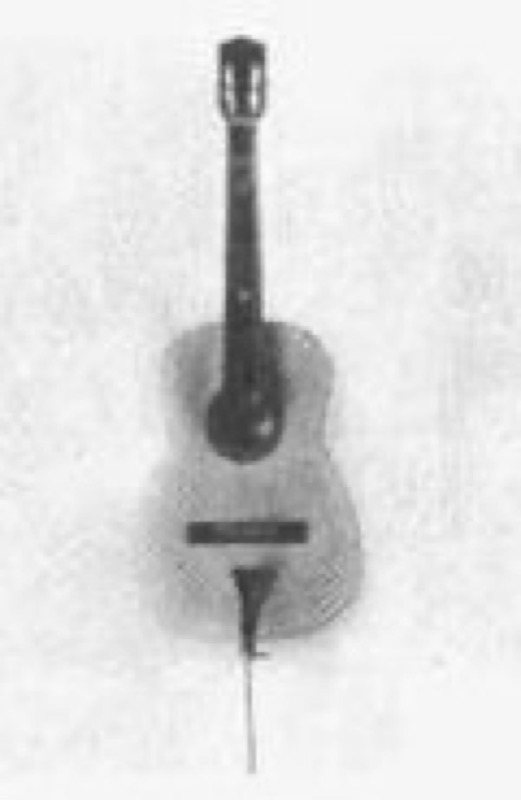
Contrachitarrone da gamba
Your imagination can take you anywhere, particularly if you have a musical instrument in your hand!
For more of the best in classical music, sign up for our E-Newsletter