When Frédéric Chopin published his Études, Op. 10, in 1833, he redefined what a piano etude was – and what it could be.
Traditionally, etudes are technical exercises. But Chopin refused to sacrifice expression for soulless drills. He aimed for something bigger: an etude that would meld technique and expression.
Across the twelve works of his Op. 10, scales, arpeggios, chromatic passages, octaves, wide stretches, and intricate finger patterns all become the raw materials for some of the most imaginative piano music ever written.
Here’s a guide to all twelve of Chopin’s Études, Op. 10, including the technical problems they present and the fascinating stories behind them.
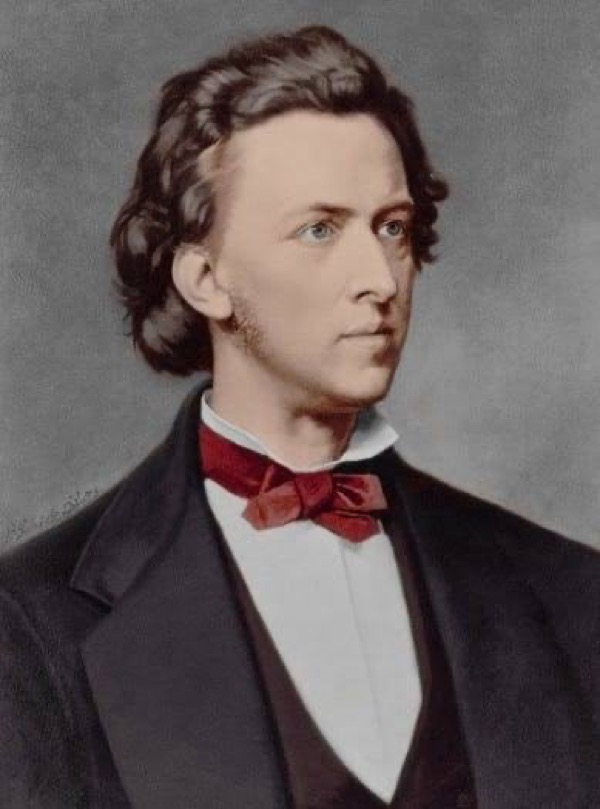
Frédéric Chopin
No. 1 in C major
Nickname: Waterfall
Date of composition: 1829
Technical challenges: Flexibility in the right hand
- Musicologists have noted that this etude shares harmonic similarities with the famous C major prelude of Bach’s Well-Tempered Clavier. Despite the work’s revolutionary nature, Chopin pays deliberate homage to tradition.
- Chopin’s tempo marking is quarter note = 176, which is very brisk. In fact, Hans von Bülow (1830–1894), a leading pianist of the generation after Chopin’s, suggested a tempo of 152, claiming that the original speed would rob the piece of its “grandeur.”
- It should be remembered that the pianos Chopin wrote for featured lighter action than modern pianos, so a faster tempo would have been easier to pull off in the 1820s.
- Vladimir Horowitz, who arguably boasted one of the greatest piano techniques of the 20th century, refused to play this etude publicly, finding it too difficult to do justice to.
No. 2 in A minor
Date of composition: November 1829
Technical challenges: Independence of the 3rd, 4th, and 5th fingers in the right hand
- After the first etude, which focused on stretching and flexing the right hand, this one addresses compressing the right hand.
- To do so, Chopin emphasises chromatic scales (i.e., notes that are half-steps, right next to each other on the keyboard), with fingers often crossing under or over each other.
- The result makes the right hand look like a crab gliding up and down the keyboard.
- In this etude, Chopin wrote out which finger to use for nearly 800 individual notes.
- He requests that the left hand accompaniment be played staccato (crisply), and the right hand legato (smoothly). Separating the character between the hands like this is another challenge of this etude.
- Going from expanding the hand in the first etude to compressing it in the second etude – all within the matter of a few minutes, with no time to reset in between – is extremely difficult.
- In fact, great pianist Sviatoslav Richter (1915–1997) would sometimes skip the second etude when playing the set.
No. 3 in E major
Nickname: Tristesse (Sadness) or L’Adieu (Farewell)
Date of composition: 1832
Technical challenges: Sustaining a melody and accompaniment together in the right hand
- According to his pupil and copyist Adolph Gutmann, Chopin believed that this etude’s melody was the most beautiful he’d ever written. Once, when Gutmann played it for Chopin, the composer raised his clasped hands and declared, “O, my fatherland” – suggesting he connected it to Polish freedom and his painful exile.
- Many people know this etude by the nickname Tristesse or L’Adieu, but those names were attached to the etude after Chopin’s death; he never agreed to them.
- Chopin initially envisioned this etude as being played Vivace (lively), later editing the instruction to Vivace ma non-troppo (lively, but not too much). But he ultimately landed on Lento ma non-troppo (slow, but not too much): a striking evolution in character.
- The 1950 pop song “No Other Love” is based on this etude.
No. 4 in C-sharp minor
Date of composition: 1830
Technical challenges: Speed and left-hand dexterity
- This etude is a perpetuum mobile with a presto con fuoco (fast, with fire) tempo marking. In many piano perpetuum mobiles, the right hand – which is usually more dexterous – carries the melody. But here, Chopin demands that the left hand plays the melody, too.
- Musicologist Hugo Leichtentritt memorably describes the etude’s “fascinating interplay of rushing, roaring, murmuring, rumbling, flowing, climbing, jumping, crashing, falling, all this without a single point of rest.”
No. 5 in G-flat major
Nickname: Black Key Etude
Date of composition: 1830
Technical challenges: Velocity with a focus on the black keys
- This is one of Chopin’s most popular etudes – but it has also been dismissed as trite. Chopin himself called it “the least interesting for those who do not know that it is intended for the black keys.” Hans von Bülow dubbed it a “ladies’ salon etude.”
- As its nickname suggests, its right-hand melody, save for one note, is written for all black keys.
- Played together with no white keys, the black keys split an octave up into five parts, creating a pentatonic scale, a device often employed in folk music traditions.
- The final passage is in octaves. Vladimir Horowitz and Moritz Rosenthal both made cheeky alterations here, such as turning the octave passage into a glissando.
No. 6 in E-flat minor
Date of composition: 1830
Technical challenges: Emotional expression
- The challenge in this etude comes from wringing the most emotional expression out of meandering chromatic lines.
- Its Andante tempo – walking speed – is unusual in the Op. 10 etudes.
- The churning chromatic voice underneath the melody and above the bass can make the etude sound muddy. A pianist must figure out how to balance the etude’s voices to keep it effective.
- In his 53 Studies on Chopin’s Etudes, pianist Leopold Godowsky wrote a transcription of this etude for the left hand alone.
No. 7 in C major
Date of composition: 1830–1832
Technical challenges: Rapidly changing from thirds to sixths in the right hand
- This is a tiny little etude, clocking in at around ninety seconds long.
- It switches back and forth between thirds and sixths, requiring remarkable fluidity in the right hand. This creates an unusual texture and melody.
- Liszt thought it was a great exercise for maintaining technique.
- It is among the least popular of Chopin’s etudes and rarely heard unless someone is performing or recording the entire set.
No. 8 in F major
Date of composition: October–November 1829
Technical challenges: Creating a loud legato
- This etude’s left-hand part carries the melody, with the right hand playing the accompaniment loudly and legato.
- The pianist has to keep the tone quality consistent even as the fingers go up and down the keyboard, without drowning out the melody in the right hand.
- The flurry of notes in the right hand is incredibly difficult to pull off.
No. 9 in F minor
Date of composition: 1829
Technical challenges: Left hand endurance, including wide stretches and wrist rotation
- This etude has the mysterious air of a Chopin nocturne. As in a nocturne, the left hand covers a wide range and plays a rocking accompaniment. But this etude is taken at a brisker tempo than a nocturne would be.
- Taken together, the etude requires wrist flexibility and built-up endurance, especially on modern pianos with heavier action.
No. 10 in A-flat major
Date of composition: October–November 1829
Technical challenges: Variation in touch
- This etude features a right-hand part with several repeating elements, just with accents or articulations placed in shifting spots. These shifting accents make the etude challenging to interpret while still sounding flowing and cohesive.
- The pianist also has to stay extremely aware of a consistent tempo while changing articulations.
- Presuming the pianist can pull off those subtleties, the etude’s character is charming and buoyant.
No. 11 in E-flat major
Nickname: Guitar or Arpeggio
Date of composition: 1829–1832
Technical challenges: Large rolled chords
- This whole etude features enormous rolled chords, each of which needs to be calibrated so that the melody can shine through.
- There are also intriguing inner-voice harmonies that need to be voiced correctly to be heard by listeners, adding another layer of challenge.
No. 12 in C minor
Nickname: Revolutionary
Date of composition: c. 1831
Technical challenges: Left-hand dexterity while the right hand plays a powerful melody
- According to legend, this etude was written after Chopin heard that the Russians had crushed Polish forces in the 1831 November Uprising. He was travelling in Stuttgart at the time and felt helpless.
- As the left hand rumbles below, creating a stormy atmosphere, the right hand uses agonised octaves and chords to cry out.
- It is not only one of Chopin’s most famous etudes, but one of his most famous works, period.
Conclusion
Taken together, Chopin’s twelve Op. 10 Etudes demonstrate just how dramatically he expanded the possibilities inherent in the piano etude.
Op. 10, however, was only the beginning of his work. Chopin would return to the etude genre several years later with another collection of twelve pieces: the Etudes, Op. 25 – and those present an entirely new set of technical challenges that are just as fascinating.
For more of the best in classical music, sign up for our E-Newsletter