Franz Schubert only lived for 31 years, but he left a massive, astonishing body of music: countless songs, symphonies, chamber works, sacred compositions, and even operas.
His life held unique and fascinating contradictions. A devoted circle of friends celebrated him, but he never experienced the public acclaim his peers did. He was enormously prolific, even as his music remained unheard and unpublished. He was one of the greatest composers of his generation, but only one all-Schubert concert was performed during his lifetime.
Here are 13 facts about the life and career of Franz Schubert that reveal the man behind those contradictions – and some of the most beloved music of the 19th century.
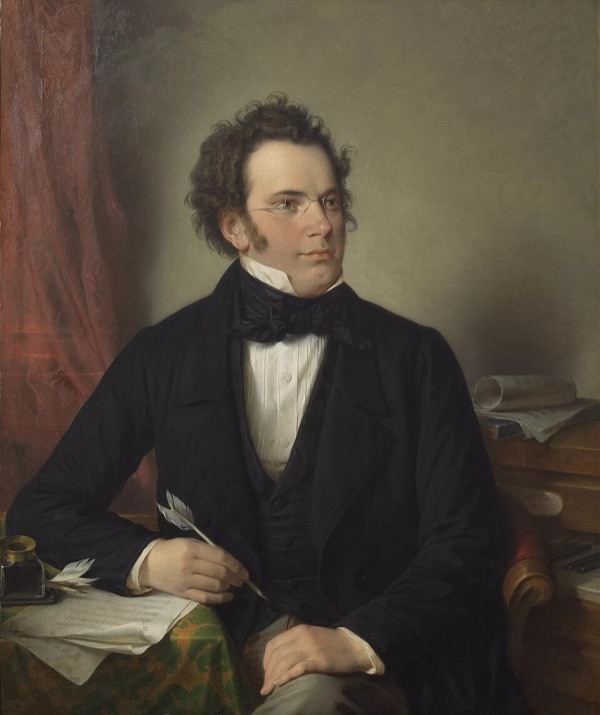
Franz Schubert
1. Schubert was the twelfth of fourteen children. He grew up close to his brother Ferdinand – who would go on to claim credit for some of Schubert’s music.
Franz Schubert was the twelfth of fourteen children born to Franz Theodor and Elisabeth Schubert. Only five of those children survived past infancy.
As a child, Franz grew especially close to his brother Ferdinand, three years his senior. Ferdinand was a musician and schoolteacher, and he helped mentor his younger brother.
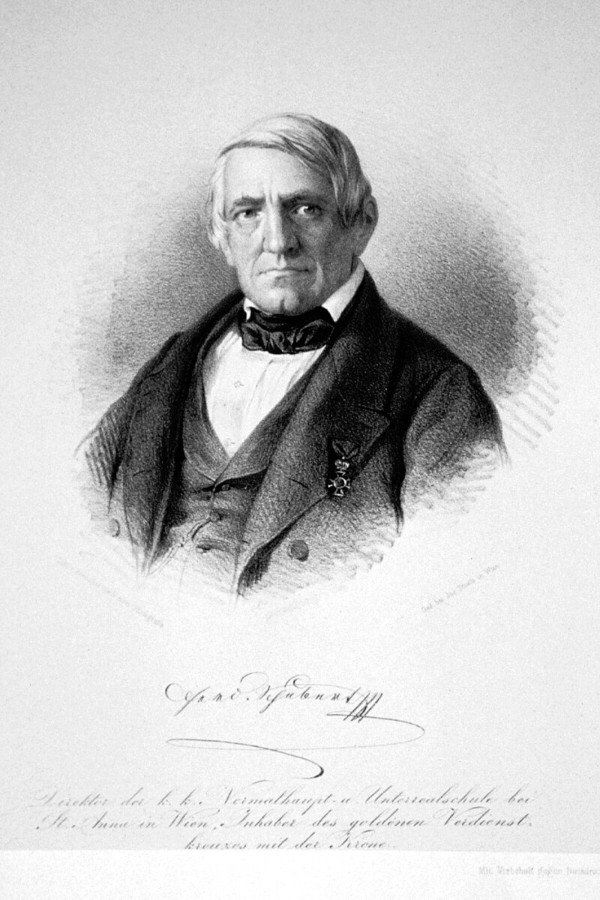
Ferdinand Schubert
Ferdinand also claimed some of Franz’s works as his own, especially while searching for musical jobs. (For what it’s worth, there’s no record of Franz objecting.)
After Franz died in his apartment, Ferdinand inherited Franz’s papers, including his unpublished manuscripts. He navigated the publication and distribution of the works after Franz’s death.
We wrote about Ferdinand Schubert’s story here: https://interlude.hk/ferdinand-schubert-the-composer-who-stole-his-brothers-music/.
2. Schubert composed “Erlkönig” at 17 or 18. It became one of the most famous songs ever written for piano and voice.
Schubert’s “Erlkönig”
Goethe’s spooky ballad recounts the story of a father racing on horseback through the night, seeking aid for his feverish son who is hallucinating a supernatural force – the Erlking, a malevolent spirit from German folklore – following them.
The piano part gallops under a vocal line that shifts character between narrator, father, son, and the Erlking himself.
It’s a work of shocking maturity for a teenager: tightly constructed and dramatically expressive. It remains one of the most performed and analysed songs in the entire German Lied tradition.
3. Schubert never held a traditional full-time job past his mid-twenties. Instead, he relied on intermittent teaching and the generosity of friends and family.
After a brief, unenthusiastic stint teaching at his schoolmaster father’s school, Schubert essentially opted out of conventional employment and chose to spend his time composing instead.
He survived on piecework: giving intermittent piano lessons, collecting modest fees from publishers, and accepting financial help from his admiring circle of friends.
This economic precarity colored the rest of his life and career and left him with few means to do things like pay professional musicians to mount large-scale performances.
4. Schubert was so close to his friend Franz von Schober that they referred to themselves using a mashup name: “Schobert.”
Schubert’s Alfonso und Estrella
Franz von Schober – a poet, actor, lithographer, and general dilettante – became one of the composer’s closest and most enduring friends. More than once, he offered him lodging when Schubert ran short of money.
Schober collaborated with Schubert on the 1822 opera Alfonso und Estrella, writing the libretto. They couldn’t mount a performance. (Liszt was the first to do so in 1854; the reception was cool, in part due to Schober’s uneven libretto.)
5. Schubert was only around five feet tall, making him one of the shortest of the great composers.
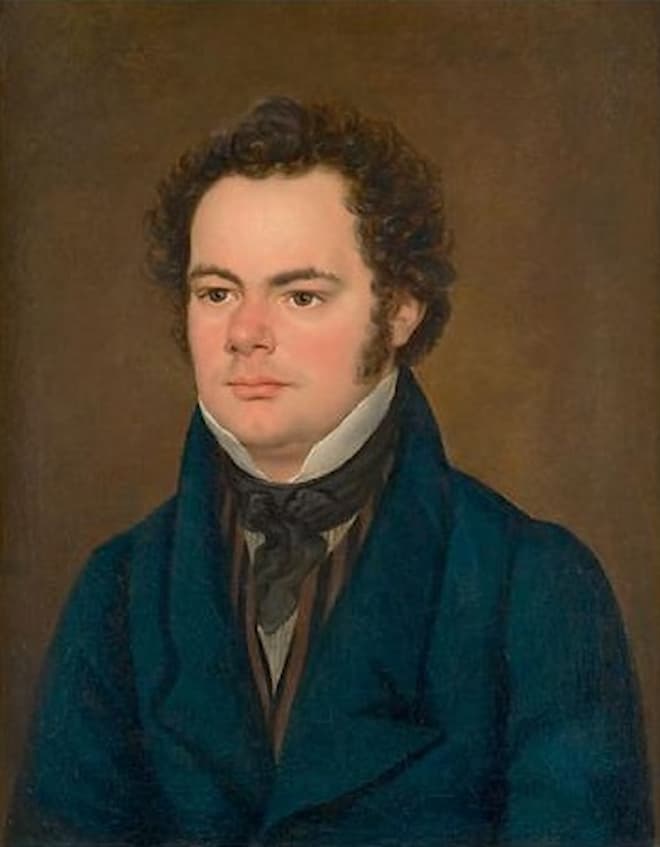
Franz Schubert, c. 1827
He was so petite and round-faced that his friends nicknamed him “Schwammerl” (“little mushroom”).
He also wore spectacles to help correct his intense nearsightedness. He was never seen without them – and even slept in them so that he didn’t have to struggle finding them if he woke up in the middle of the night with a musical idea.
6. He never married and had no known long-term romantic partner – but did frequent brothels.
The musical life of the 19th century was populated by composers who ran off with married women (for example, Wagner and Liszt) or had cinematic years-long love stories that culminated in happy marriages (the Schumanns).
Schubert’s biography has none of that romantic drama. Indeed, in 1815, a potential groom could not get a marriage license in Vienna without proving he could support not only himself, but a household. Schubert would have had to change lifestyles to marry completely.
We do know that he visited Viennese brothels, a common practice among unmarried men of his generation. He is believed to have contracted syphilis around 1822, when he was in his mid-20s.
7. Schubert abandoned his eighth symphony in 1822, after writing just two movements. He never explained why, and the work wasn’t performed until decades after his death.
Schubert’s Symphony No. 8
The “Unfinished Symphony” is one of classical music’s great mysteries. It consists of two complete, fully orchestrated movements – and that’s it, even though symphonies of this era have four movements. No sketches survive beyond an abandoned third-movement scherzo, and no letters explain why he stopped.
Theories as to what happened range in seriousness from “fatal illness kept him from continuing” to a simple “he just got distracted by new projects.” But nothing is confirmed.
It remained unperformed until 1865, nearly forty years after Schubert’s death. When it finally premiered in Vienna, it was admired, despite its brevity.
8. Only one public concert of Schubert’s work was given during his lifetime.
On 26 March 1828 – the first anniversary of Beethoven’s death, which may have been a deliberate scheduling choice – a concert was held in Vienna devoted entirely to Schubert’s music.
It was a modest success, well attended and warmly welcomed by a composer who badly needed the money. But it also was the only event of its kind in his lifetime, and Schubert would die less than eight months later.
In the end, any career momentum this concert might have brought Schubert was overshadowed by the arrival of sensational virtuoso violinist Niccolò Paganini in Vienna.
9. His friends often gathered to hear his new songs and chamber music; these gatherings became known as “Schubertiades.” They included food, drink, dancing, and performances by Schubert himself.
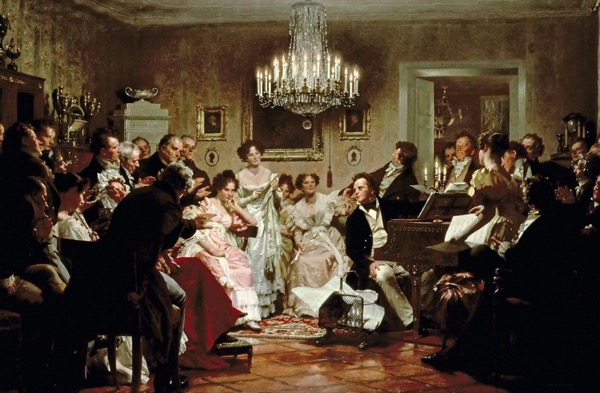
Schubertiade
Held in the homes of supportive friends and patrons, these informal evenings became the closest thing Schubert had to a regular public for his music. A rotating cast of poets, painters, singers, and civil servants all gathered regularly to hear whatever songs or piano pieces Schubert had been working on.
They weren’t stiff recitals, either; accounts describe charades, dancing, wine, and general conviviality alongside the music. It was a blend of salon and party that suited Schubert’s shy temperament much better than the concert hall ever could.
The Schubertiades were also important for the encouragement they brought him, as one of the few occasions when his talent could actually be witnessed and celebrated.
10. He was arrested in early 1820 because the Austrian secret police, alarmed by the aftermath of the French Revolution and the Napoleonic Wars, were aggressively investigating groups of young people and activists.
In 1820, Austria was deeply paranoid about tamping down revolutionary sentiment among students and intellectuals.
That March, the paranoia caught up with Schubert’s circle. His rebellious poet friend Johann Senn was arrested for his defiant conduct toward authorities. Schubert too was swept up, briefly detained, and questioned by police before being released with a reprimand. Senn fared far worse: he spent months in prison and was deported from Vienna.
The story reminds us that the same artistic, tight-knit social circle that nurtured Schubert’s music also existed under very real political surveillance – and not all of Schubert’s friends escaped it unscathed.
11. While composing songs, he set poems by his own friends, not just famous poets.
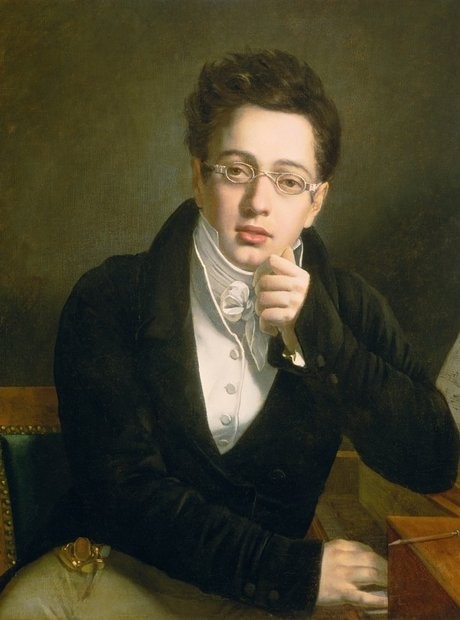
The young Schubert
Yes, Schubert set poetry by legendary masters like Goethe, Schiller, and Heine.
But his appetite for poetry was insatiable, and his inspiration endless. He also set music to poems by his poet roommate Johann Mayrhofer, Franz von Schober, and others who attended the Schubertiades.
Mayrhofer in particular is worth noting; Schubert set dozens of his poems to music over the years.
This breadth of material says something about what inspired Schubert. He didn’t need the most celebrated works by the most celebrated poets to be inspired.
12. We don’t know exactly what Schubert died of. He had syphilis, but it seems likely that another kind of infection actually killed him.
Schubert died in his brother Ferdinand’s apartment on 19 November 1828 at the age of 31, after a short but severe final illness marked by fever, weakness, and delirium.
He had been living with syphilis for roughly six years by that point, and its long-term effects (along with the side effects of the standard prescribed mercury treatments) had already taken a toll on his health.
But many modern scholars believe the immediate cause of death was something else entirely, possibly typhoid fever contracted from contaminated water or food.
13. Much of Schubert’s music was published or premiered only after his death.
Schubert’s Symphony No. 9
In 1838, ten years after Schubert died, composer Robert Schumann visited Ferdinand Schubert in Vienna.
While digging through the piles of unpublished manuscripts, he came across the score for the Symphony No. 9 in C major – a sprawling, ambitious work that had never been performed.
Schumann recognised its worth immediately and arranged for Mendelssohn – then the conductor of the storied Leipzig Gewandhaus orchestra – to premiere it.
Even in rehearsal, Schumann and Mendelssohn were delighted by what they heard, and the work has remained in the repertoire ever since.
Over the years, Schubert’s other unpublished work surfaced, too. Today, much of it – orchestral music, chamber music, Lied, piano sonatas, and so much more – remains in the repertoire, to the gratitude of musicians and music lovers everywhere.
For more of the best in classical music, sign up for our E-Newsletter