The Trio Pantoum (Hugo Meder, violin; Bo-Geun Park, cello; and Kojiro Okada, piano) takes its name from the second movement of Ravel’s piano trio, performed on this recording. Ravel was referring to a poetic form derived from the Malay verse form called the ‘pantun’. In French poetry, the ‘pantoum’ was a kind of villanelle, where the second and fourth lines of each stanza are repeated as the first and third lines of the next. In Ravel’s hands, this became three different themes that alternate and switch within the same literary plan, while still working within the more conventional scherzo-and-trio genre.
The Ravel’s Piano Trio opens this debut album by the Trio Pantoum, followed by the Russian composer Arensky’s Piano Trio No. 1 in D minor. Anton Arensky (1861–1906) wrote this work in 1904 and pays homage in the first movement to an even earlier work: Mendelssohn’s Piano Trio No. 1. The Trio was drawn to Arensky’s fiery spirit.
Anton Arensky: Piano Trio No. 1 in D Minor, Op. 32 – I. Allegro moderato
The album closes with a very modern work, Miroslav Srnka (1975-) Emojis, Likes and Ringtones, a tip of the hat to our all-encompassing world of social networks. Srnka challenges the ensemble, requiring extended techniques, including plucked piano strings and a bow rubbed on the instrument’s tailpiece. By encouraging performers to explore not only his musical world but also their instruments, he aims to help them both ‘give the impression of a very mechanical performance, but with the freedom to inject our own creativity into it’.
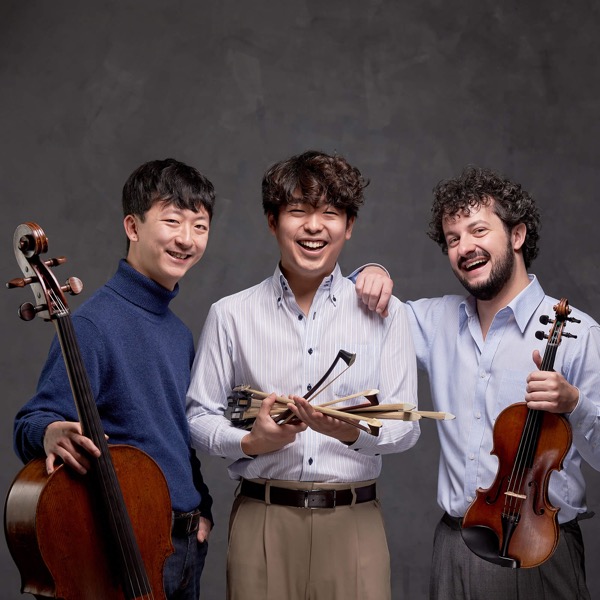
Trio Pantoum
The Trio met at the Paris Conservatoire, and in 2023 alone they took part in six major international chamber music competitions, in Vienna, Lyon, Osaka and Munich, winning prestigious awards. They began in the Viennese piano trio tradition of Haydn, Mozart, and Beethoven, then extended it to Brahms. At the ARD Music Competition, they discovered Srnka’s work and so ‘enabled us to begin a fruitful collaboration with one of the most brilliant composers of the moment’.
In his music, Arensky wasn’t afraid to make us recall even older piano trios, while Ravel required the trio to make an almost orchestral-like sound as he reached into new harmonic areas. Srnka, the ultimate modernist, wanted the players to be both mechanical and free. By playing music spanning over a century, the Trio Pantoum encourages us to consider the piano trio’s radical nature.
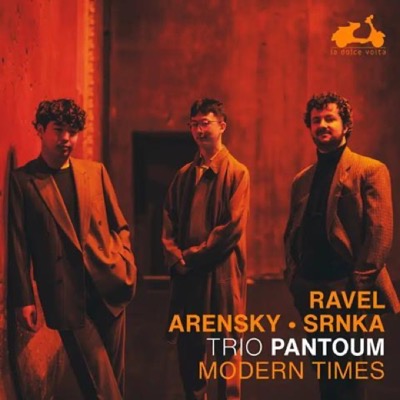
Modern Times: Ravel, Arensky, and Srnka
Trio Pantoum
La Dolce Volta LDV145
Official Website
For more of the best in classical music, sign up for our E-Newsletter