“As soon as I could negotiate a keyboard, I gained an affinity for Sergei Rachmaninoff’s piano music,” pianist Ian Hobson recalls. “It gave me a richness, authority and suavity that I couldn’t quite yet extract from Mozart and Chopin.”
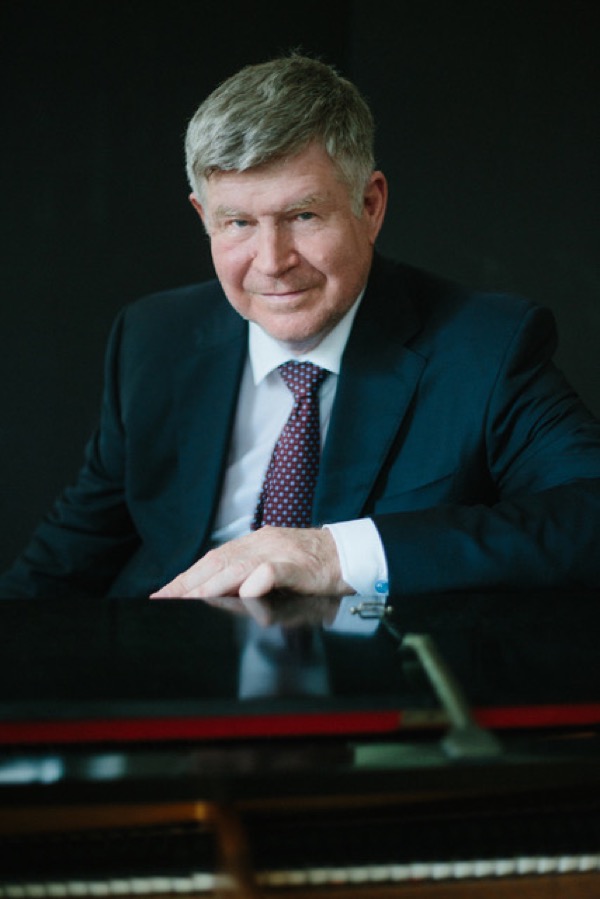
Ian Hobson
That early attraction to Rachmaninoff is at the heart of Hobson’s upcoming recital, Sonatas, Small and Great, which brings together two composers from different musical eras: Franz Schubert and Sergei Rachmaninoff. The program pairs Schubert’s Piano Sonata in A major, D. 664, and Piano Sonata in A minor, D. 784, with Rachmaninoff’s Piano Sonata No. 1 in D minor, Op. 28, and Piano Sonata No. 2 in B-flat minor, Op. 36, in its 1913 version.
Hobson’s relationship with Schubert developed differently. As a young pianist, he first encountered Schubert through the composer’s piano duets, which he played with teachers and friends. Later, as a teenager, he discovered Schubert’s songs, mostly as a listener. That eventually led to his first performance of a Schubert sonata, the A minor Sonata, D. 784, during his student years at Yale.
For Hobson, the pairing of Schubert and Rachmaninoff is not simply a meeting of two composers separated by more than a century. He hears a strong connection in their approach to melody and large-scale musical construction. “The similarities are easier to define,” he says. “Sure, creators of memorable melodies, ability to conceive and construct large musical structures, taste and finesse in applying harmonic invention.”
The contrast between the four sonatas also gives the recital its distinctive shape. Hobson was particularly intrigued by pairing Schubert’s concise A major Sonata with Rachmaninoff’s much larger First Sonata. “Schubert is at his most concise yet bursting with lyricism,” he says. He is especially interested in the emotional interplay between major and minor in the second movement. “Perhaps the major key evokes tears more than the minor?”
Rachmaninoff’s First Sonata takes the listener into a very different musical world. “In Rachmaninoff’s massive first movement we go through granitic minor-key struggles to eventually achieve comfort in the soft D major close.” For Hobson, the contrast between the two works is not simply one of scale. Both composers use melody and harmonic language to create powerful emotional journeys, but they do so on very different dimensions. The juxtaposition allows the “small” and “great” of the program to speak to each other, from Schubert’s concise lyricism to Rachmaninoff’s expansive musical architecture.
The two Schubert sonatas themselves also reveal very different sides of the composer. Hobson describes the A major Sonata as “comforting, beatific, and with a modicum of drama.” At the same time, the A minor is “tense, forceful (Beethoven-like), and full of fire as well as lyric simplicity.” For him, performing these qualities is less about imposing an interpretation on the music than responding to what is already there. “Playing them effectively is more a matter of responding to these emotions rather than ‘interpreting’ their meaning,” he says.
The Rachmaninoff’s Second Sonata presents a different kind of interpretive question, particularly because Hobson has chosen the original 1913 version rather than the more frequently encountered 1931 revision. His preference began with a practical problem. After hearing the 1931 version several times, he says, “I did not understand its structure.” When he began playing the work himself, however, the 1913 version immediately made sense.
“It has the connective tissue, the building blocks of form, and development that make it even more impressive architecturally than the First Sonata,” Hobson explains. In his view, the 1931 revision makes relatively few harmonic changes but loses some of the original’s coherence to streamline the work. He also points to Rachmaninoff’s well-known uncertainty about some of his larger compositions, noting that the composer permitted cuts in works such as the Third Piano Concerto and Second Symphony that, in Hobson’s opinion, do not always serve the music.
Hobson came to the two sonatas relatively late, after performing much of Rachmaninoff’s other piano music. The more he studies them, the more significant they become. “I appreciate the organic qualities of both First and Second Sonatas,” he says. “They now strike me as supremely logical and inevitable. Their difficulties are immense, but their narratives shine through.”
That combination of technical difficulty and musical inevitability is central to Hobson’s view of Rachmaninoff. He regrets that no recordings exist of the composer performing his larger solo works, though he points to Vladimir Horowitz’s recording of the Second Sonata as an important reference. Horowitz’s performance, Hobson notes, combines elements of both the 1913 and 1931 versions.
Hobson also sees an interesting historical parallel between Schubert and Rachmaninoff. Schubert grew up in the shadow of Haydn and Beethoven, and much of his music was rarely performed during his lifetime. Rachmaninoff, meanwhile, received early encouragement from Tchaikovsky but was deeply affected by the reception of his First Symphony. Later, some viewed his music as “increasingly viewed by some as outmoded or reactionary.”
Hobson sees both composers today as “multifaceted masters with distinctive voices and lasting value.” His exploration of their music will continue later in the season with Fantasies Great and Small, a program that shifts from the sonata to the fantasy and expands beyond solo piano. It will open with Rachmaninoff’s Morceaux de Fantaisie, followed by Schubert’s Fantasy in F minor for piano four hands, performed with his wife, pianist Muen Wei, and Schubert’s Fantasy in C major for violin and piano, with violinist Andrés Cárdenes. The program will conclude with Schubert’s Wanderer Fantasy.
But first comes Sonatas, Small and Great: four sonatas that bring together the lyricism, emotional depth, and architectural imagination Hobson hears in both Schubert and Rachmaninoff. For Hobson, the recital is an opportunity not simply to contrast the two composers, but to let their distinctive voices illuminate one another.
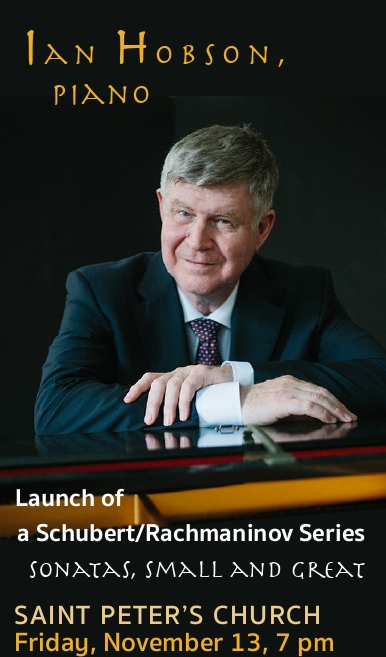
Performed by Pianist Ian Hobson
Saint Peter’s Church, 619 Lexington Ave, New York, NY 10022
Friday, November 13, Starts at 7 PM
For more of the best in classical music, sign up for our E-Newsletter