For today’s brain teaser, let’s turn to Antonín Dvořák. What opera of his features a happy ending but is entirely missing the traditional love interest? The answer is The Devil and Kate, a comic opera to a libretto by Adolf Wenig based on a Czech folktale, which was premiered in Prague on 23 November 1899.
The opera continues Dvořák’s interest in Czech folklore, but in this case, the composer treated a comic theme without serious issues. He came up with a merry folk tale in which hell is not filled with demons, and its devils never strike fear into people.
The main character, Kate, is in plenty of comic situations, and at the end, the Princess has to hand over the best house in the village so that Kate finally has the prospect of marriage. To celebrate Dvořák’s birthday on 8 September, let’s have a peek at an opera that was an immediate success and remained popular in Czechoslovakia.
Antonín Dvořák: The Devil and Kate, “Overture”
A Folk Tale Comes Alive
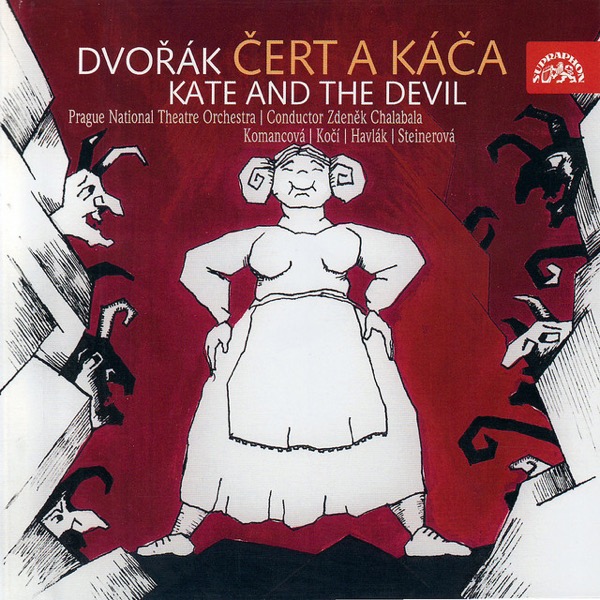
Kate and the Devil
Antonín Dvořák composed the opera after his return from the United States in 1896. The libretto is based on a story by the important 19th-century Czech writer Božena Němcová, published in her 1845 collection Folk Tales and Legends.
Adolf Wenig wrote the libretto, and the text won first prize in the competition for new librettos organised by the National Theatre Association in 1898. Apparently, Dvořák was advised that the lack of lyricism would pose a problem. Regardless, with some small alterations, Dvořák accepted the libretto.
In musical terms, The Devil and Kate is full of dance melodies. “The very nature of the libretto indicates that dance assumes an important role in the plot, particularly in relation to Kate, whose insatiable desire to dance is one of the main traits of this character.” (https://www.antonin-dvorak.cz/en/work/the-devil-and-kate/)
Antonín Dvořák: The Devil and Kate, “Devil’s Dance”
A Dance with the Devil
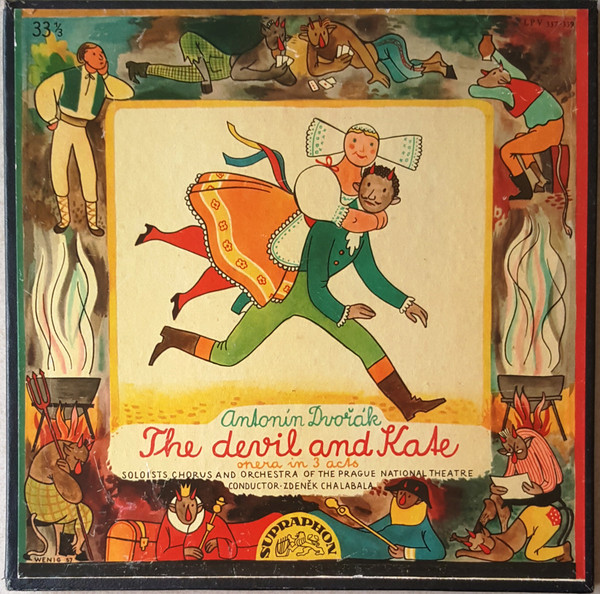
The Devil and Kate
The opera opens in a country inn during a holiday weekend, where peasants have gathered to celebrate. With everybody exuberantly dancing to music, young men are teasing the shepherd Jirka, since he is a serf and the only one who has to get back to work.
He does leave the inn with a small band of musicians, which infuriates the Steward, who tells him to “go to hell.” Meanwhile, Kate arrives and wants to dance, but nobody takes her up on the offer because she talks too much. Annoyed, she exclaims that she would even dance with the devil.
And thus the devil appears, disguised as a strange hunter by the name of Marbuel, and invites her to dance. Actually, he’s come to find out if the Princess and the Steward have been wicked enough to deserve being sent to Hell.
The devil ends up dancing and drinking with Kate, and Jirka returns and announces that the Steward has fired him. Kate is willing to be swept off to his “castle,” and the ground opens up, and the devil takes Kate with him down to hell. While Kate’s mother is beside herself, Jirka jumps down through the hole leading to hell to search for Kate.
Antonín Dvořák: Čert a Káča (Kate and the Devil), Op. 112, B. 201 – Act I: To je přece k zlosti (Ludmila Komancová, mezzo-soprano; Vera Krilová, mezzo-soprano; Prague National Theatre Chorus; Prague National Theatre Orchestra; Zdeněk Chalabala, cond.)
Antonín Dvořák: Čert a Káča (Kate and the Devil), Op. 112, B. 201 – Act I: Dobrý večer! (Přemysl Kočí, bass; Prague National Theatre Chorus; Prague National Theatre Orchestra; Zdeněk Chalabala, cond.)
Antonín Dvořák: Čert a Káča (Kate and the Devil), Op. 112, B. 201 – Act I: Prosím, prosím, zavdejte si (Přemysl Kočí, bass; Ludmila Komancová, mezzo-soprano; Prague National Theatre Chorus; Prague National Theatre Orchestra; Zdeněk Chalabala, cond.)
Dancing Her Way to Hell
The second act takes place in hell, and Marbuel is carrying Kate on his back. Jirka arrives as well, banging on the gate. Lucifer appears and scolds everybody for making such a racket. Kate is furious since she was promised a castle, and everybody is tired of her tirades.
Kate refuses to leave until Marbuel has been taught a lesson, and Lucifer decides that it is time for Marbuel to go back and fetch the Princess, with the Steward to receive a caution. Marbuel enlists Jirka’s help in removing Kate from Hell. Marbuel will pretend to have come for the Steward, but Jirka will bravely drive him away.
This deed will apparently bring Jirka a large reward, and once he agrees, a gigantic banquet is organised. To the delight of all the devils, Kate and Jirka dance their way out of hell.
Antonín Dvořák: Čert a Káča (Kate and the Devil), Op. 112, B. 201 – Act II: Co tu ches? (Arutjun Kotchinian, bass; Peter Straka, tenor; Michelle Breedt, mezzo-soprano; Cologne Radio Symphony Orchestra; Gerd Albrecht, cond.)
Antonín Dvořák: Čert a Káča (Kate and the Devil), Op. 112, B. 201 – Act II: Mas ji s krku (Arutjun Kotchinian, bass; Peter Mikuláš, bass; Cologne Radio Symphony Orchestra; Gerd Albrecht, cond.)
Antonín Dvořák: Čert a Káča (Kate and the Devil), Op. 112, B. 201 – Act II: Chtel bys Kacu odtud odnest (Peter Mikuláš, bass; Peter Straka, tenor; Cologne Radio Symphony Orchestra; Gerd Albrecht, cond.)
Antonín Dvořák: Čert a Káča (Kate and the Devil), Op. 112, B. 201 – Act II: Kaco, ted’ se priprav (Peter Mikuláš, bass; Michelle Breedt, mezzo-soprano; Cologne Radio Symphony Orchestra; Gerd Albrecht, cond.)
The Devil’s Worst Nightmare
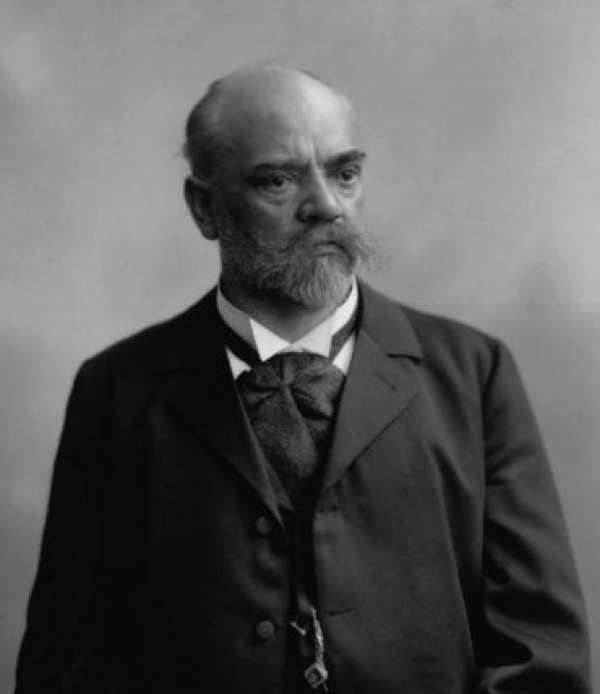
Antonín Dvořák, 1904 (photo: Jan Langhans)
Act three finds the Princess horrified when the devil appears for the Steward, and she suspects that hell is preparing for her as well. She calls upon Jirka, who apparently managed to drive away the Steward’s devil, as perhaps he can help her as well.
Jirka agrees, but only on the condition that the Princess agrees to free the serfs. The Princess agrees, and Jirka hides Kate in the next room to wait for the devil. As soon as Marbuel arrives, Jirka tells him that Kate is waiting for him.
Marbuel is appalled and declares that all the terrors in hell and on earth are nothing compared to being around Kate, and he disappears through the window. The grateful Princess places Jirka in charge of all her affairs of state. The peasants rejoice in having a fair leader and in their freedom, and Kate gets a large house so she can finally find herself a husband.
Antonín Dvořák: Čert a Káča (Kate and the Devil), Op. 112, B. 201 – Act III: Jak smutno v zamku (Olga Romanko, soprano; Brigitte Schweizer, soprano; Cologne Radio Symphony Orchestra; Gerd Albrecht, cond.)
A Modern Opera with a Czech Soul
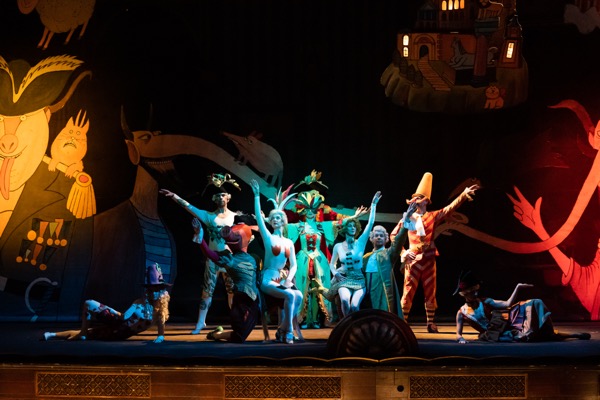
Čert a Káča, National Theatre (photo: Zdeněk Sokol)
As Dvořák wrote to a friend a couple of days after the premiere, “The opera was… well attended and enjoyed the kind of success I would never have expected in our day. There is little point in describing it to you, since you will surely have read about the outcome of the premiere in the newspapers.
The opera was extremely well liked, first by the soloists, the orchestra, and the chorus, then by the audience and, this time, also by all the critics, with just the odd reservation. The performance was excellent; the soloists, chorus and orchestra did what they had to do with great enthusiasm, so I am highly pleased…” (https://www.antonin-dvorak.cz/en/work/the-devil-and-kate/)
The odd reservation concerns Dvořák’s inclination towards the principles of Wagnerian drama, although he had been an admirer of Wagner since his early days. As Jan Smaczny writes, “The recrudescence of Wagnerian harmony and the use of leitmotif are incidental features in a work which is completely characteristic of Dvořák’s maturity.” (Smaczny, Groves Online, 2002)
The Devil and Kate is the result of a modern approach to the requirements of dramatic music, with Dvořák’s effective set pieces and sharp characterisation, particularly in the title roles. The opera is essentially through-composed, and symmetrical phrases balance the simplicity of the melodic writing. In the words of the contemporary critic Emanuel Chvála, “it has all the prerequisites of a modern opera.”
For more of the best in classical music, sign up for our E-Newsletter