Praised for “extraordinary sensibility and passionate intensity”, London-based pianist Zeju Fan recently presented a sold-out debut recital at St John’s Smith Square in London during an intense summer heatwave, featuring an ambitious and demanding repertoire, including Beethoven‘s Waldstein Sonata, Berg’s Piano Sonata, Op. 1, Ligeti‘s Études, and Liszt‘s Sonata in B minor.
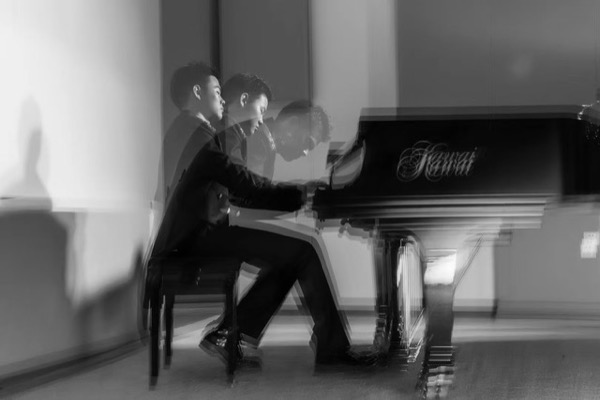
Zeju Fan
Rather than presenting a collection of showpieces, Fan conceived the program as a musical argument, with each work illuminating the next while leaving listeners free to draw their own conclusions.
“I wanted it to work more like an argument, with each piece acting as a paragraph and helping to explain the others.”
Berg’s Piano Sonata, Op. 1 serves as an important bridge within the program. While Fan mentioned he was initially hesitant to learn the work, he soon became fascinated by its relationship to Liszt.
“Berg’s Sonata became an important link because its single-movement form and process of transformation connect naturally with Liszt.”
The Ligeti Études introduce “fragmentation, rhythmic instability and a different kind of physical energy” before the program culminates in Liszt’s Sonata in B minor. Although Beethoven and Ligeti inhabit very different musical worlds, Fan hears a shared sense of propulsion between them.
“I would not pretend that Beethoven and Ligeti are closely related composers, because their sound worlds are very different. But both have a very strong sense of propulsion.”
For Fan, Beethoven’s long-range architecture contrasts with Ligeti’s intricate rhythmic layers and shifting textures.
“I do not need to make them sound similar for them to belong in the same program.”
Instead, he believes their juxtaposition allows listeners to hear both composers more clearly, with the contrast itself bringing their energy and structural imagination into sharper focus.
Beethoven Sonata No 21 in C major Op 53 Waldstein I Allegro con brio
Fan, who was born in China, started his career in music when he was four years old.
“I began learning the piano at the age of four since my mother is a singer and therefore music was always present in my life; it was she who first inspired me to take up the piano. I joined the affiliated school of the Central Conservatory of Music in Beijing when I was ten and started my specialist training there. After spending six or seven years at the school, I decided that I needed a change of environment and more diverse ideas. So in 2020 I came to the UK to study at the Purcell School before going on to the Royal Academy of Music.”
Since receiving his musical training in both China and the United Kingdom, Fan has become familiar with two different traditions of piano teaching. In September, he will begin his studies at the Royal Academy of Music with William Fong providing continuous guidance. He believes that both of these systems have contributed to the formation of various aspects of his musicianship.

Zeju Fan
“My studies and training in China gave me a very solid technical foundation and discipline. In the UK, there has perhaps been more emphasis on individuality and on finding character even in repertoire that is not outwardly virtuosic.”
Instead of citing a single teacher or a particular influential lesson, Fan regards his artistic development as the product of several influences gathered over the years. The most important lesson, he states, has been learning to trust his own musical judgment; his teachers, such as William Fong, have encouraged him to think independently rather than seek a single “correct” interpretation.
“Two equally accomplished pianists can play the same piece in completely different ways. What matters is whether the musician can justify the choices through the playing itself.”
That philosophy doesn’t stop at the lesson studio; Fan thinks that musical personality takes shape through the many hours spent working alone.
“Most of the real development happens in those private hours: how you listen, question the score, solve problems and decide what you actually believe.”
Fan is now carrying out his plan for linking musical arguments at the Leeds International Piano Competition.
“The repertoire ranges from Berg and Liszt to Mozart, Albéniz, Schumann, Brahms, Fauré, Chopin and Dutilleux. I am also preparing Jasmine Flower as an encore, in an arrangement that includes my own contribution. My concerto choices are Britten, Schoenberg and Tippett, which reflects my growing interest in twentieth-century repertoire and in works that are not always the most obvious competition choices.”
Away from the piano, Fan enjoys cooking, especially the Cantonese classic white-cut chicken (白切雞). Although the dish appears simple, he says mastery lies in the preparation, which requires careful deboning, precise knife work, and close coordination between both hands. “In that sense, it feels a little like playing the piano: the right hand controls the knife, while the left hand holds and guides the chicken.” He often listens to the repertoire he is studying while cooking and finds the focused, repetitive process both calming and rewarding, adding, “People sometimes say pianists should not do too much manual work, but I genuinely enjoy it—it feels almost therapeutic, as though it is just me and the dish.” Like his approach to music, the pleasure comes from steady refinement, with each attempt offering another opportunity to improve.
To learn more about Zeju Fan, please visit: https://zejufan.com
For more of the best in classical music, sign up for our E-Newsletter