The year 2026 marks both the 120th anniversary of Dmitri Shostakovich‘s birth and the fiftieth anniversary of the death of the British composer Benjamin Britten. Today, the two composers, who lived on opposite sides of the Iron Curtain, are not so often associated together. Yet they were not only friends bound by profound mutual admiration; they also had a remarkable amount in common.
Born only seven years apart, they died within little more than a year of one another, in 1975 and 1976 respectively, both from possibly heart-related conditions. Both achieved fame while still young, and both possessed considerable talents beyond composition: Shostakovich was once an accomplished pianist, while Britten distinguished himself as both a pianist and a conductor. Both were celebrated as cultural treasures in their respective countries and showered with public honours, yet both remained, in different ways, alienated outsiders – Shostakovich repeatedly suffered political persecution and was later afflicted by serious illness; Britten was homosexual at a time when sexual relations between men remained illegal in Britain. Their musical styles may have differed greatly, but both were driven by an intense sense of conviction. Using economical and somewhat conservative musical languages, they transformed wit, bite, natural poetry, profound catharsis, and a wide range of expressions into music.
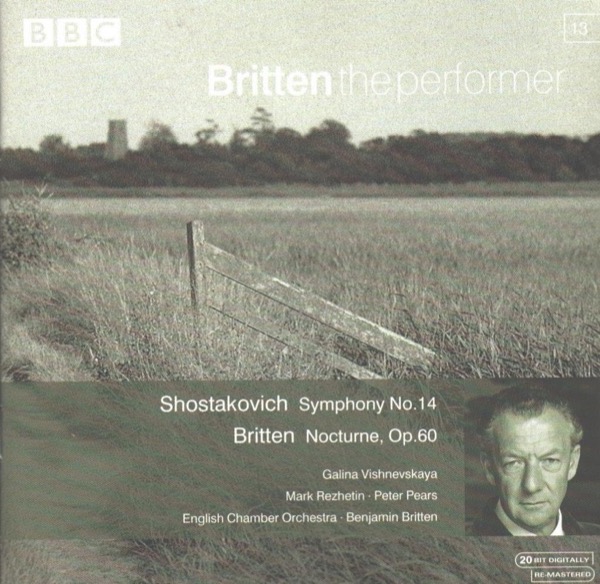
BBC “Britten the Performer”: Shostakovich Symphony No. 14 and Britten Nocturne, Op. 60 (English Chamber Orchestra, Benjamin Britten)
Britten probably became aware of Shostakovich before Shostakovich encountered his music. In a 1935 letter to a friend, Britten wrote:
“The real musicians are so few & far between, aren’t they? Apart from the Bergs, Stravinskys, Schönbergs & Bridges, one is a bit stumped for names, isn’t one? … Shostakovitch—perhaps—possibly.”
A few months later, he attended a concert performance in London of Shostakovich’s opera Lady Macbeth of Mtsensk. He recorded his reaction in his diary:
“There is a consistency of style & method throughout. The satire is biting & brilliant. It is never boring for a second—even in this form.”
Britten also added, with characteristic sharpness:
“The ’eminent English Renaissance’ composers sniggering in the stalls was typical. There is more music in a page of Macbeth than in the whole of their ‘elegant’ output!”
Living in a comparatively closed cultural environment, Shostakovich may not have properly encountered Britten’s music until the 1950s, and the first Britten work he heard may have been one of the English composer’s most accessible pieces, The Young Person’s Guide to the Orchestra. After admiring one another from afar for many years, the two composers finally met in London in 1960. The Leningrad Philharmonic, conducted by Yevgeny Mravinsky, was touring Britain and presented the British première of Shostakovich’s First Cello Concerto with Mstislav Rostropovich as soloist. On that occasion, Shostakovich invited Britten to sit beside him during the concert.
Few written details survive about that first encounter, but subsequent events make it clear that they immediately took to one another and that their respect deepened as they became better acquainted. In a 1963 interview, Britten named Shostakovich as one of the living composers he most admired, alongside Stravinsky, Copland and Tippett. From the 1960s until their deaths, they maintained a regular correspondence across the European continent. Britten travelled to the Soviet Union on six occasions, while Shostakovich made several visits to Britain. Their friendship penetrated the Iron Curtain, bringing a note of sincere human warmth to an otherwise cold political era.
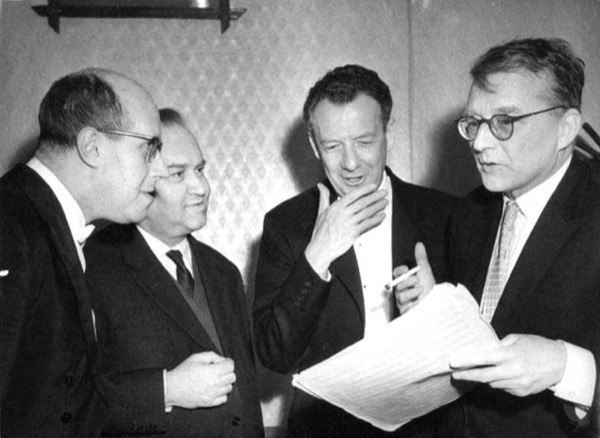
Dmitri Shostakovich (right) and Benjamin Britten examining a score, 1963
In 1966, to mark Shostakovich’s sixtieth birthday, Britten wrote a special essay entitled “Tribute to Dmitri Shostakovich”, expressing the “deep attachment” he felt for Shostakovich’s music. Comparing his own works with those of Shostakovich, Britten described them as:
“so very different from his own, but conceived, many of them, in the same period, children of similar fathers, and with many of the same aims.”
Britten acknowledged that their music sounded very different, yet perceptively identified a deeper affinity between them: directness of expression, moral seriousness, sympathy for outsiders and victims, and resistance to fashionable aesthetic orthodoxies. That same year, Britten travelled to Moscow for Shostakovich’s sixtieth-birthday celebrations, where the two composers attended the première of Shostakovich’s Second Cello Concerto.
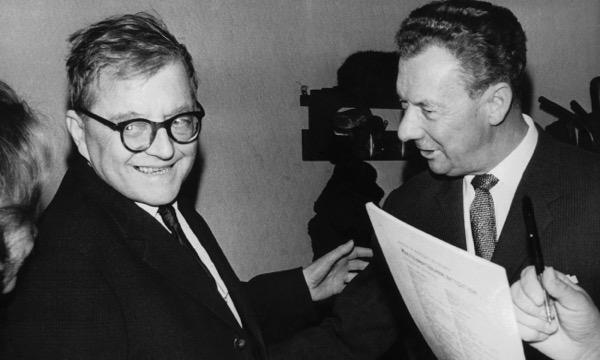
Dmitri Shostakovich and Benjamin Britten, 1966
Britten reciprocated the friendship by dedicating his church parable The Prodigal Son of 1968 to Shostakovich. Shostakovich, in turn, dedicated his Fourteenth Symphony of 1969 to Britten. In their correspondence, the two men referred to it as “our symphony”.
Benjamin Britten: The Prodigal Son (Peter Pears, tenor; John Shirley-Quirk, bass-baritone; Bryan Drake, baritone; Robert Tear, tenor; English Opera Group Choir; The English Opera Group Orchestra; Benjamin Britten, cond.)
Dmitry Shostakovich: Symphony No. 14, Op. 135 (Kristīne Opolais, soprano; Alexander Tsymbalyuk, bass; Boston Symphony Orchestra; Andris Nelsons, cond.)
A precious recording preserves a unique document of their friendship. On 14 June 1970, at the Aldeburgh Festival founded by Britten, he conducted the English Chamber Orchestra in the first British performance of Shostakovich’s Fourteenth Symphony. To my mind, it remains one of the most authoritative and affecting recordings of the work. It is music-making in the fullest sense, transcending the limitations of the recording and questions of technical execution. Britten perfectly grasps the caustic irony of Shostakovich’s language and balances it against the music’s piercing bitterness and sorrow. The two soloists associated with the work’s earliest performances, Mark Reshetin and Galina Vishnevskaya, are also close to ideal. Had Shostakovich heard the recording, might even his habitually impassive face have broken into a knowing smile?
Mstislav Rostropovich – Benjamin Britten- Tchaikovsky Pezzo capriccioso op.62
The legendary cellist Mstislav Rostropovich entered Britten’s world alongside Shostakovich. It was Rostropovich who performed the First Cello Concerto at the concert where the two composers first met. He subsequently became both a witness to and a participant in their friendship – he appears frequently in photographs of Britten and Shostakovich together.
Shostakovich later joked that he had suffered because Rostropovich played the First Cello Concerto so well: whenever Britten was particularly moved by the performance, he prodded Shostakovich in the ribs. After the concert, however, it was Rostropovich who made the first approach to Britten, asking him to compose something new for the cello. The result was a succession of works written specifically for Rostropovich: the Cello Sonata, the Cello Symphony and the three Suites for Solo Cello.
This almost became a form of artistic exchange between the two great composers. Shostakovich subsequently wrote his Second Cello Concerto for Rostropovich, while in the final movement of Britten’s Cello Sonata the composer directly invoked Shostakovich’s celebrated musical monogram, D–E-flat–C–B: DSCH in German notation. It is an affectionate tribute that also carries a faint suggestion of friendly artistic rivalry.
Dmitry Shostakovich: Cello Concerto No. 1 in E-Flat Major, Op. 107 – I. Allegretto (Mstislav Rostropovich, cello; Moscow Philharmonic Orchestra; Gennady Rozhdestvensky, cond.)
Benjamin Britten: Cello Sonata in C Major, Op. 65 – V. Moto Perpetuo (Mstislav Rostropovich, cello; Benjamin Britten, piano)
The two composers also seemed to possess an unspoken understanding. It may not have been coincidental that in 1962, both completed works that rank among the crowning achievements of their careers, each centred on war and humanitarian concern. Shostakovich composed his Thirteenth Symphony Babi Yar, using poems by Yevgeny Yevtushenko. Scored for bass soloist, male chorus and large orchestra, it creates an atmosphere of immense, oppressive drama. Its opening movement confronts ethnic hatred through the memory of the 1941 massacre at Babi Yar, from which the symphony takes its title.
Britten, meanwhile, composed the large-scale choral work War Requiem. It interweaves the monumental sonorities of the Latin Requiem with the intimate song-writing in which Britten excelled. While mourning human suffering on a universal scale, the work also focuses on individual tragedy through poems written during the First World War by Wilfred Owen.
Britten: War Requiem
By the end of the 1960s, the composers’ deteriorating health, particularly Shostakovich’s, and occasional political difficulties made meetings increasingly hard to arrange. In 1971, after an interval of several years, Britten returned to Moscow for what would be his final Soviet visit. Perhaps moved by Britten’s persistence, Shostakovich, after cancelling several proposed journeys due to illness, finally travelled to Britten’s home in Aldeburgh during the summer of 1972 despite his frail health.
There, Shostakovich was shown sketches for Britten’s final opera, Death in Venice, then still in progress. For the intensely private and sensitive Britten, allowing a friend to see an unfinished composition represented an extraordinary mark of trust. It was perhaps the most intimate encounter of their friendship. Shostakovich would return to Britain later that year, when the two men met for the final time.
In August 1975, news arrived of Shostakovich’s death. Archival records show that Britten and Peter Pears wrote a letter of condolence to his widow, Irina, and later invited her to the 1976 Aldeburgh Festival. That year, the festival presented the British première of Shostakovich’s final completed work, the Viola Sonata. Irina attended the performance.
Less than eighteen months after Shostakovich’s death, Britten also died, on 4 December 1976.
For more of the best in classical music, sign up for our E-Newsletter