As a dedicated champion of contemporary music, Gérard Caussé served as principal violist of the Ensemble Intercontemporain under Pierre Boulez. Caussé has greatly expanded the viola repertoire through close collaborations with living composers, and to celebrate his birthday on 26 June, let’s explore a selection of works written for, or closely associated with him.
Gérard Caussé performs Grisey: Les espaces acoustiques, “Prologue”
The Spiral of Sound
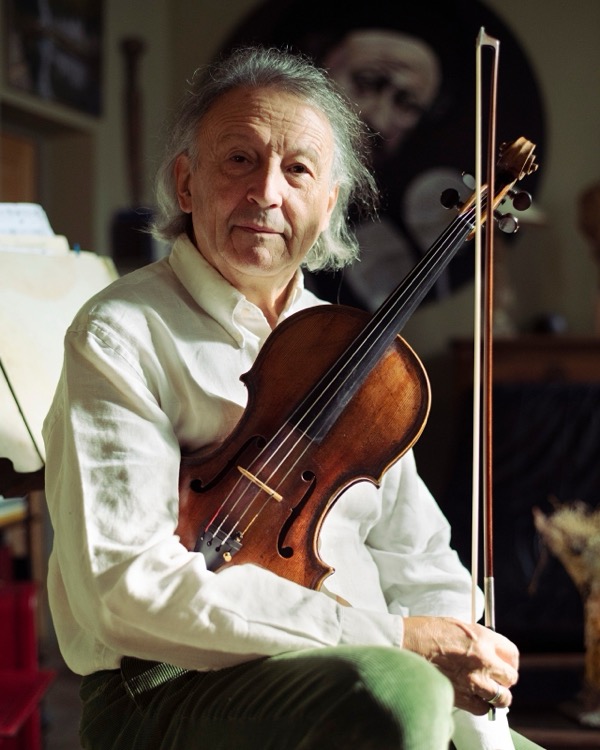
Gérard Caussé
Gérard Grisey was born in Belfort, France, and between 1968 and 1972, he studied with Olivier Messiaen. At the same time, he also took composition lessons from Henri Dutilleux. He attended the International Summer Courses in Darmstadt, studying with Karlheinz Stockhausen, György Ligeti, and Iannis Xenakis.
Grisey began his monumental cycle Les Espaces acoustiques in 1974 and completed the work in 1985. Built on the overtone spectrum and periodicity, it consists of six instrumental works that explore musical spectralism. It unfolds as an immense sonic journey from a single instrument to a full orchestra.
The opening movement, “Prologue”, for solo viola is dedicated to Gérard Caussé, as the violist’s virtuosity and openness to new sonorities made him an ideal collaborator. “Prologue” features a melodic silhouette and transformations that recur in a spiral. This single voice expresses the essence of music for Grisey, namely, the dialectics between noise and form.
Philippe Hersant: Musical Humors
A Viola Between Centuries

Gérard Caussé
From 2002 to 2004, Gérard Caussé served as artistic director of the Orchestre National de Chambre de Toulouse. He appeared both as soloist and conductor, and he commissioned a number of works for the viola, among them Philippe Hersant’s Musical Humors of 2003.
Explicitly dedicated to Caussé, who also premiered the work in Toulouse on 11 June 2003, the title refers to a 17th-century collection of viol music by the English composer and soldier Tobias Hume.
The composer explained that he had long admired Hume’s music, particularly in the recordings by Jordi Savall, and that he borrowed literal musical quotations and the idea of emotional unpredictability. This concerto freely juxtaposes contrasting episodes and shifting emotional colours, and Caussé was the perfect interpreter for a music modern in language yet emotionally direct and often elegiac.
Henri Dutilleux: String Quartet, “Ainsi la nuit”
The Architecture of Night

Gérard Caussé (© Dorotha Marciak)
Henri Dutilleux did not specifically write his string quartet “Ainsi la nuit” for Gérard Caussé. Rather, it was commissioned by the Koussevitzky Foundation for the Juilliard Quartet, but it was premiered by the Parrenin Quartet in Paris on 6 January 1977. Gérard Caussé was the violist, and therefore he was at the centre of a twentieth-century musical landmark.
According to the composer, the title indicated a certain poetic atmosphere, not a specific message. The work is strictly structured and divided into seven sections using fragments and extended string techniques for thematic development.
Dutilleux is one of the few French composers who did not break entirely with tradition, and Caussé belonged to a generation of French musicians comfortable in both classical repertoire and contemporary experimentation. It was Caussé’s participation in the premiere that established “Ainsi la nuit” as a modern classic of the string quartet repertoire.
Michaël Levinas: Les Lettres enlacées No. 2 (Gérard Caussé, viola; Michaël Levinas, piano)
At the Centre of New Music Networks

Gérard Caussé (© Dorotha Marciak)
Gérard Caussé was deeply embedded, through IRCAM-linked composers and the network of the Ensemble Intercontemporain, in a thriving contemporary French chamber-music ecosystem.
The pianist and composer Michaël Lévinas was also a student of Olivier Messiaen at the Conservatoire de Paris, and his work continually explores the realms of timbre and acoustics.
He was a co-founder of the ensemble “L’Itinéraire” and the spectral music movement, alongside Gérard Grisey, a composer we have already met.
The work for solo viola Les Lettres enlacées II dates from around 2000-2001, and belongs to a small cycle where the composer is exploring the idea of interlaced writing. Basically, he treats musical lines in a manner of braided calligraphy as strands of music continuously overlap.
Les Lettres enlacées II was written and performed within a dedicated network, and Gérard Caussé belongs to a generation in which the viola ceased to be a secondary orchestral voice and became a distinguished solo instrument. Beyond his own collaborations, the late 20th-century finally gave the viola a life of its own.

Gérard Caussé
For more of the best in classical music, sign up for our E-Newsletter