Johannes Brahms is one of the most widely performed and beloved composers of all time. In the history of music, he stands alongside Johann Sebastian Bach and Ludwig van Beethoven as one of the shining testaments to human inspiration and creativity.
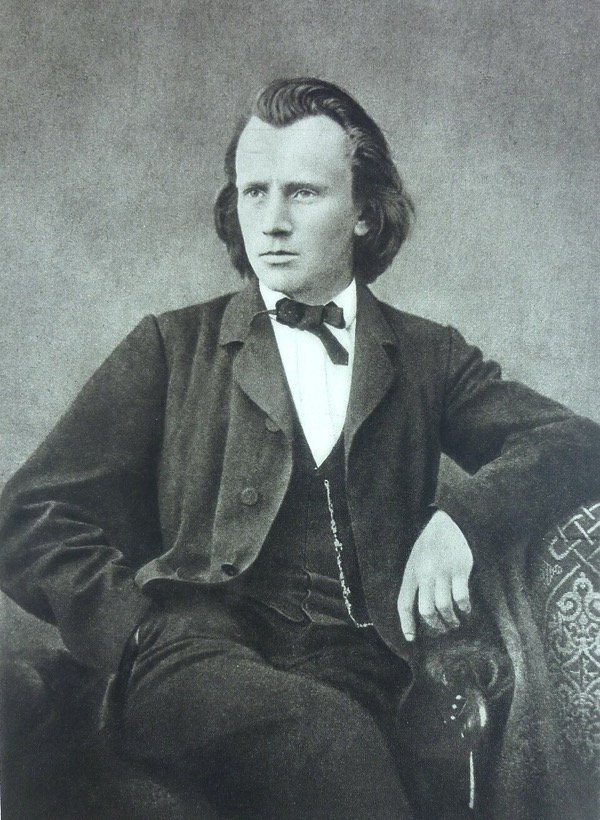
Johannes Brahms, 1866
In spite of the powerfully Romantic characteristics of his music, he imposed a Classical sense of order, and everything he created musically took shape according to a thoroughly considered structural plan.
Firmly rooted in the structures and compositional techniques of the Baroque and Classical masters, Brahms uniquely transferred the Classical ideals and Baroque counterpoint into a Romantic idiom.
Brahms the Progressive
To his contemporaries and critics, Brahms appeared to be a bastion of musical conservatism.
Surprisingly, it was Arnold Schoenberg in his celebrated radio address entitled “Brahms the Progressive”, who suggested that Brahms was a great innovator in the realm of musical language, and that his chamber music prepared the way for the radical changes in musical conception at the turn of the 20th century.
To celebrate his birthday on 7 May, let us probe the more intimate and experimental nature of his chamber music and how he reimagined Classical forms through a Romantic lens of continuous development and rhythmic ambiguity.
Johannes Brahms: Piano Quartet No. 1 in G minor, Op. 25
Between Genius and Self-Doubt
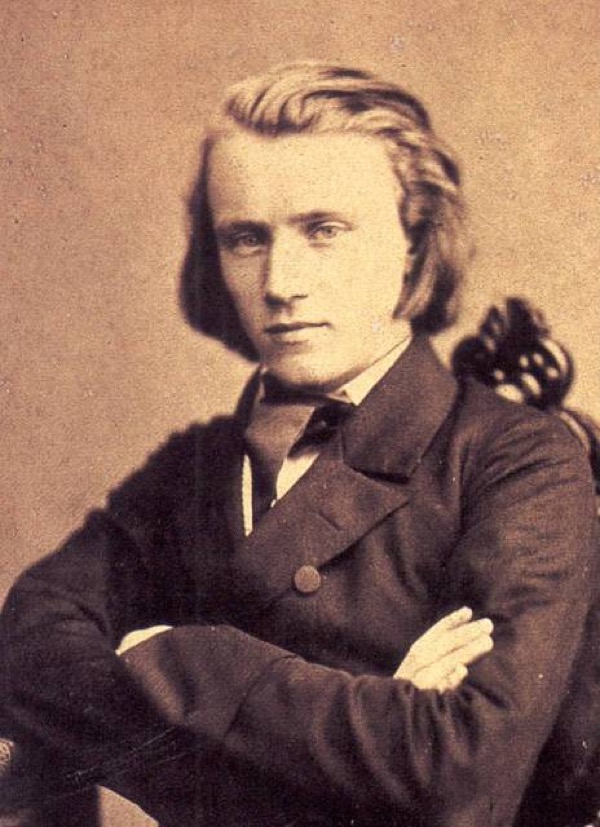
Johannes Brahms, 1853
Johannes Brahms was born on 7 May 1833 in Hamburg, and while some of his melodies and compositions have gained international popularity, the psychological depths of his character have remained a mystery.
He was a shy and awkward boy, and this awkwardness never entirely left him. On one hand, he was fantastically loyal and generous, but he could also be highly unpleasant, secretive, mean-spirited and full of irony and reserve. Yet, his conflicted and often contradictory personality found an anchor in his compositions.
Brahms was trained as a pianist but quickly dabbled in composition. He finally found enough courage to visit his musical hero, Robert Schumann, in 1853. Schumann publicly announced the arrival of a new musical Messiah, and Brahms carefully reconsidered what to publish.
He intensely studied and worked through every available textbook on theory, harmony, and counterpoint, and exhibited a heightened sense of musical insecurity in public.
He responded self-consciously to criticism, even when levelled by his closest friends, by ruthlessly destroying or severely reshaping his compositions.
Emotion Within Classical Structure
In the 1850s, he began work on his ambitious first piano quartet in G minor, but he did not release it until 1861, at the age of 28. Brahms is often thought to have had Clara Schumann in mind, and his infatuation is often cited as an emotional undercurrent in his chamber music.
The work uses traditional forms, but every measure is filled with the emotional urgency of youth in all its distress, raving bliss, expectations of love, and courageous vitality.
Brahms selected this particular work to make his debut as a pianist and composer in Vienna in November 1862, and violinist Joseph Hellmesberger apparently exclaimed, “This is the heir of Beethoven.”
The fiery and relentless “Rondo alla Zingarese,” with its rousing and throbbing rhythms and striking accents, was particularly popular, and Arnold Schoenberg actually arranged the work for orchestra in 1937.
Johannes Brahms: Piano Quintet in F minor, Op. 34
Transformation and Experimentation
For Brahms, chamber music became the medium of experimentation with musical language and syntax. His Piano Quintet in F minor, Op. 34, is monumental in scope and feels like a symphonic drama compressed into chamber form.
The work originated as a String Quintet, borrowing its scoring of two violins, viola and two cellos from Franz Schubert‘s famous C-major Quintet, D. 956. Joseph Joachim, who rehearsed the piece with friends, responded enthusiastically, yet found fault with its instrumentation.
As a result, Brahms recast the work as a Sonata for Two Pianos and destroyed the String Quintet manuscript altogether. Clara Schumann called this new version a masterpiece, yet suggested that it needed a full orchestra. Hermann Levi then proposed that it be cast as a String Quintet, but in October 1864, the piece was complete as a Piano Quintet.
Motivic Logic and Structural Drama
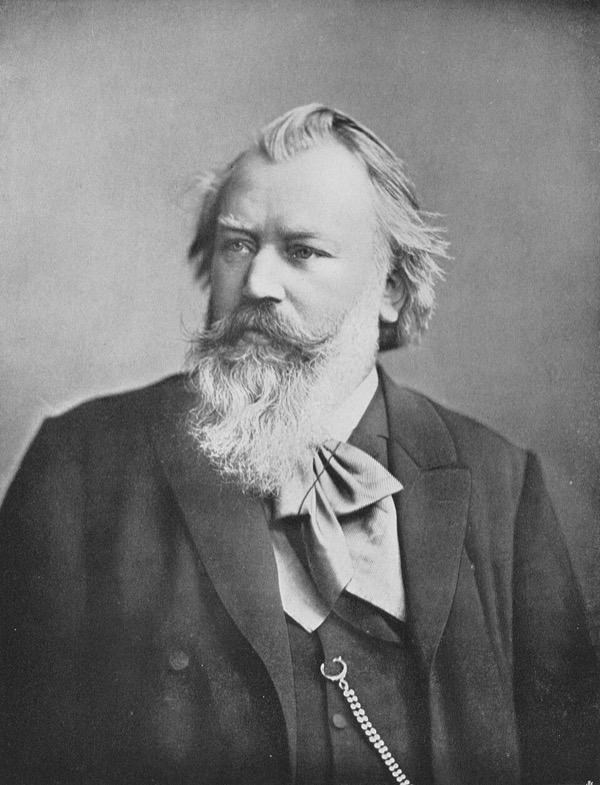
Johannes Brahms, 1898
Combining youthful exuberance, sophisticated musical textures, and an entirely logical approach to constructing motives and controlling their subsequent development and continuation, Brahms opens the first movement with a subdued unison passage. However, without warning, the movement erupts with limitless musical energy and expression.
The piano quickly assumes a dominant role, aggressively developing the opening theme, but also gently supporting the lyrical contrast. Limitless variations in musical texture help unify this movement. Harmonically unstable and featuring generous rhythmic displacements, the Adagio nevertheless conveys a sense of peaceful, serene lyricism.
Short pizzicato pulses give rise to the syncopated main theme of the Scherzo. Almost immediately, this theme turns into an ominous march in the minor key, which is also treated as a four-voice fugal exposition. The Trio, in turn, provides a much-needed lyrical interlude.
A densely contrapuntal and ominous introduction builds into a fiery theme, which is contrasted by a more lyrical, yet nervous-sounding theme. Brahms summarises the entire work by sounding the main motives of the entire composition in an excitable Presto coda.
Johannes Brahms: String Quartet No. 1 in C minor, Op. 51, No. 1
Counterpoint Meets Form
Johannes Brahms famously remarked that he had sketched, composed, and eventually destroyed no fewer than twenty string quartets before actually publishing two compositions in this genre as Op. 51. Although prone to exaggerating his indebtedness to musical history and his illustrious predecessors, Brahms nevertheless took an inordinately long time to discover his unique personal musical style.
He began composition on the C-minor quartet in the 1850s, and after a couple of trial performances in 1866 and 1868, it was finally published in 1873. The Brahms friend and scholar Karl Geiringer suggested that Brahms had “not only conquered a new form of ensemble, but at the same time his musical style developed to its full maturity.”
In his string quartets, we truly observe the logical union of Bach’s contrapuntal art and Beethoven’s formal perfection. Essentially, Brahms’s fundamental language relied on a soprano-bass framework constructed in strict accordance with his extensive knowledge of contrapuntal theory.
This rudimentary structure established an overall harmonic plan and organised the material into a contrapuntally inspired phrase structure. Since the outer voices were insufficient to answer all questions of harmony and voice leading, the composer added figured bass to indicate the desired harmonic progression at a localised level.
Music That Grows Itself
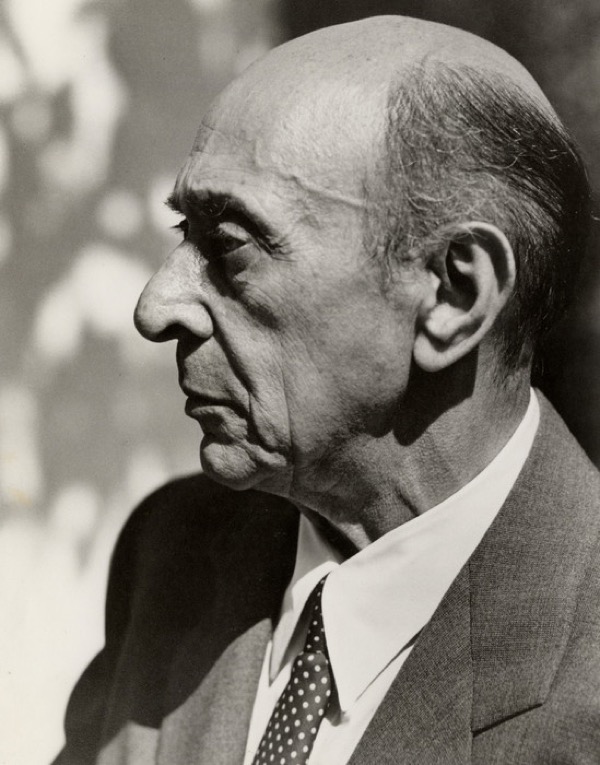
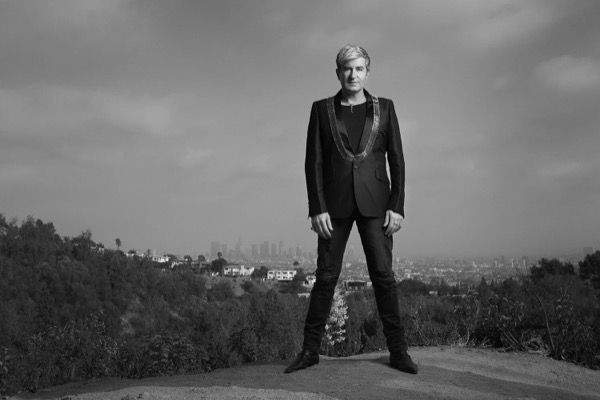
Arnold Schoenberg, Los Angeles, 1948
In terms of formal architecture, the sonata-form structure appears to function as a pre-existent and static element. However, for Brahms, form is a highly dynamic process that involves ongoing contradictions and contrasts until the shape of the whole emerges at the end.
Brahms constantly alludes to the sonata-form principles without ever actually adhering to them. He does, on occasion, overdetermine his structures, as though neither architecture nor logic were by themselves sufficient to meet his need for musical solidity.
For Schoenberg, Brahms blurred the boundaries and distinctions between theme and development. Brahms’s musical prose is not confined to regular, predefined, or predictable patterns, but the principle according to which ideas are continuously varied provides the grammar for the creation of his musical syntax.
As such, a small musical idea organically germinates, generating the larger overall formal structures. Schoenberg termed this process “developing variation,” and he saw in Brahms’s music the construction of a theme through the continuous modification of the intervallic and/or rhythmic components of the initial idea.
The intervals are developed by recognised procedures such as inversion and combination, and the rhythms by augmentation and displacement. According to Schoenberg, developing variation is a compositional principle that prevents monotonous repetition, and Brahms’s music stands as the most advanced manifestation of this principle in the common-practice era.
Johannes Brahms: Violin Sonata in A Major, Op. 100
Discipline Becomes Expression
Brahms had finally achieved an economy of musical composition that refused to tolerate even a single superfluous note. In his combination of strict counterpoint and the abandonment of small-scale rhythmic and metrical symmetry, Brahms created a genuine musical prose.
He develops and varies his motives almost immediately, and once he has found his compositional recipe, everything becomes more relaxed. Finally, intellectual rigour and emotional expansiveness could co-exist naturally.
Brahms now writes deeply personal works for his friends, like the three violin sonatas for Joseph Joachim. They all balance virtuosity with emotional depth in a typical Brahms style. There is nothing flashy for the sake of it, but there is plenty of emotion.
The A-major sonata is probably the most lyrical of the three, and it tenderly reveals the introspective and contemplative side of the composer’s personality. And while it all feels rather laid-back, like a heartfelt chat between the violin and the piano, the underlying structure and construction of the melodies is impeccable.
Passion and Serenity
As the piano gently strums chords, the violin rhapsodically introduces a seemingly endless melody. In this conversational interchange, the themes flow seamlessly between the instruments, and a development of agitated intensity quickly makes way for the restatements of the opening strains.
Brahms combined the roles of the adagio and scherzo in the middle movement, as a tranquil yet probing Andante contrasts with a folk-like Vivace. It’s typical Brahms, with the hymn-like melody written in the major key while the scherzo-like dance is cast in the minor. Brahms ties it all together by hinting at the slow theme in the fast section.
Using a musical quotation from an earlier song, the concluding “Allegretto grazioso” unfolds as a graceful, elegant rondo, with moments of sudden, passionate outbursts and emotional upheaval. Clara Schumann famously wrote to Brahms, “I wish the last movement could accompany me in my journey from here to the next world.”
It is a radiant and serene work with the glow of late summer, as Brahms blends sunny melodies with tight-knit craftsmanship across all three movements. Perfectly balanced, emotionally rich, and utterly convincing.
Johannes Brahms: Clarinet Quintet, Op. 115
Power and Influence
With nothing more to prove in the early 1890s, Brahms went on to influence the Viennese musical scene in terms of administration and governance. He was a highly active member of the most important committees, legislative boards and funding commissions.
Every appointment at the Conservatory, the University or private music institutions was subject to his approval or venomous contempt. He happily told Hans Rott and Gustav Mahler that they had no talent whatsoever, and that they should give up music altogether.
Brahms continued to polarise, with many composers and critics wanting his music to be swept away by a new wave of music, referred to as the “music of passion.” Proponents of Brahms’s music stubbornly and innocently maintained that his music came from intuition, and that he composed exclusively for the sake of expressing music.
This conception clearly clashed with those who promoted compositions that sought overt connections to extra-musical elements, be it poetry, literature or architecture, seeking a programmatic content that involved a process of conscious reflection.
Expressive Retrospection
Brahms emerged from his self-imposed retirement because of the clarinettist Richard Mühlfeld. Brahms heard Mühlfeld in concert on numerous occasions, but it took him until 1891 before he truly appreciated the exceptional quality of Mühlfeld’s playing and composed four of his last works for him. Brahms writes, “Mühlfeld is the greatest master of the instrument, and I cannot imagine a performance of these compositions by anybody else.”
Brahms’s supreme chamber music achievement emerged in the Clarinet Quintet, Op. 115, a work that pairs profound sadness with intimate beauty. Brahms was highly pessimistic as to the future of German cultural and political supremacy, and he militantly opposed foreign influences and everything having to do with technology.
Brahms’s mastery of motivic development remains central, with the clarinet becoming a fully-fledged member of the musical discourse. Youthful exuberance is replaced by subtle melancholy and reference to Mozart and Schubert.
Brahms creates a sense of cyclical remembrance, with earlier ideas returning transformed, as if experienced through memory. It’s not the music of conflict, but rather a statement of reflection. Coloured by modal inflections and shifts between major and minor keys, cadences don’t become conclusive but simply dissolve. It is Brahms at his most economical, and his most personal.
Between Youth and Maturity
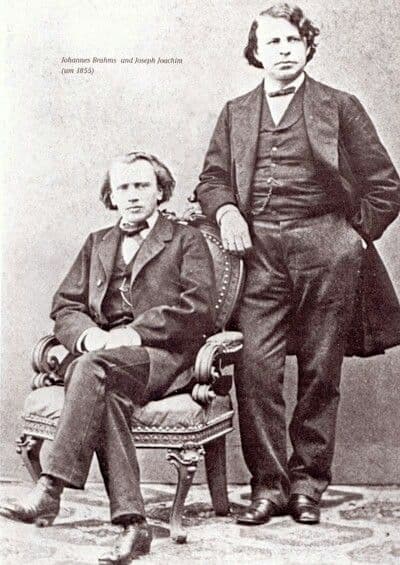
Brahms and Joachim, ca 1855
The chamber music of Brahms exerted a powerful influence on his contemporaries and on subsequent generations of composers. Yet, the meticulously formal construction and organically grown surfaces still present challenges to musicians and listeners alike.
The main stumbling block for contemporary listeners is the fact that neither his achievements as a composer nor his emotions of his life as an artist are explicitly identified in his music. While extraneous events and spiritual encounters did influence his compositions and his creative genius, Brahms had no intention of giving us written instructions to his compositions.
Brahms’s music can certainly be enjoyed on a surface level, but only with forensic attention to detail will his music reveal its full riches. I want to close with the Piano Trio No. 1 in B major, Op. 8. This work was originally published in 1854, but Brahms decided to revise it in 1889.
In this work we find a hybrid of the two sides of Brahms’s chamber music personality. The opening of the first movement presents a luscious melody of youth, expansive and highly lyrical. Brahms kept this section in its original shape, but he reworked the second thematic group and development completely.
Here we find the motivic concentration and organic flowering associated with the principle of developing variation. Youthful inspiration and mature craftsmanship fuse into a self-renewing musical logic.
For more of the best in classical music, sign up for our E-Newsletter