
Vadim Chaimovich, born on 29 April 1978 in Vilnius, Lithuania, has jumped to YouTube stardom with millions of clicks. His digital stardom, amplified by his remarkable social media fame, is positioning him as an ambassador of classical music for modern audiences.
Whether he represents a genuinely new pathway or simply a highly visible extension of an older tradition is open to debate. Yet, he has brought millions of listeners to classical music through his online presence.
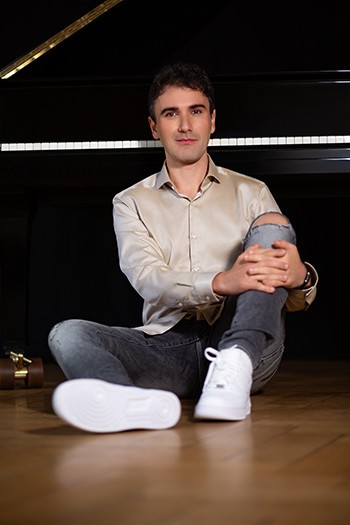
Vadim Chaimovich
His career thus reflects a broader transformation in classical music culture, and to celebrate his birthday, let us explore what makes him seemingly irresistible in this new digital landscape.
Nocturne in C-sharp minor, Op. 19, No. 4 by Pyotr Tchaikovsky
A Reputation Written Online
During the early days of his career, a number of German and European newspapers offered consistently enthusiastic reviews of his performances. He was called a “simmering volcano” of expression, and papers stressed a mix of tonal refinement and his emotional range.
Confined to regional press and artist-curated press quotes, his initial reputation was not built through traditional critical means. His massive online popularity clearly comes from a different criterion, one that values instant accessibility and emotional immediacy.
Vadim Chaimovich plays Mendelssohn: Song without Words in C minor, Op. 38, No. 2
Emotion in Compact Narratives
One key aspect of his online success is a focus on highly emotional miniatures. Short compositions by Chopin, Mendelssohn, Einaudi, and Yiruma naturally fit the attention of the modern digital world.
With this kind of repertoire, there are no long architectural or extended dramatic narratives. Rather, it creates an immediate emotional payoff. Listeners are drawn into the music within seconds, and repeat listening is exactly what social platforms reward.
Vadim Chaimovich plays Chopin: Nocturne in C minor, Op. 48, No. 1
Private Experience
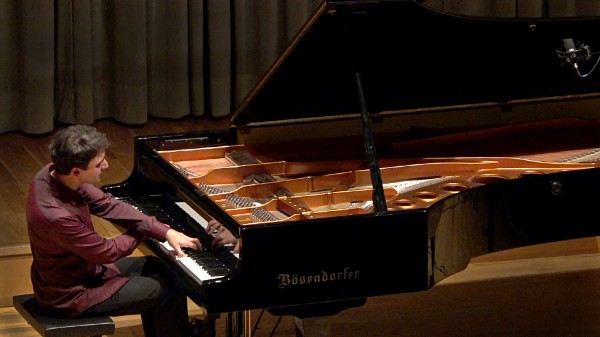
Pianist Vadim Chaimovich performing on a Bösendorfer grand piano at the Onoldia Hall Ansbach, Germany, on October 22, 2015
Chaimovich’s repertoire and interpretive style are based on introspection and emotional immediacy. For listeners, there is no doubt as to what kind of emotional space they are entering.
One aspect of this emotional pull is a sense of nostalgia. However, it’s not a nostalgia necessarily tied to a specific period. Instead, his performances create a private memory space, a sense of hesitation that invites looking back.
Vadim Chaimovich plays Bach: “Largo in F minor,” BWV 1056 (trans. Wilhelm Kempff)
Sonic Softness
Chaimovich’s interpretations are carefully curated for sound. He avoids clearly defined articulations, instead presenting singing lines with blurred edges. Pedalling, with harmonies slightly overlapping, becomes an important aspect.
Avoiding extremes of drama and irony, his performances are not theatrical at all. Instead, they feel very personal in a confessional way. And that particular emotional space recurs across his postings, with listeners able to anticipate a sound world of reflection and the suspension of time.
Vadim Chaimovich plays Satie: Je te veux
New Musical Reach

Vadim Chaimovich
Digital platforms don’t really understand music in a human way. What they do understand is patterns. When a digital creator consistently delivers similar content, the system can easily classify it and push it onto the “right” audience.
Vadim Chaimovich has built a clearly defined audience profile. His video performances engage listeners looking for atmosphere and emotional clarity.
Personally, I think this process is entirely positive. It is reaching audiences that might never set foot in a concert hall. Algorithms and digital strategies aside, what matters most is that this timeless music is being heard and played by future generations.
For more of the best in classical music, sign up for our E-Newsletter





Un tout grand merci pour votre article et pour les petites vidéos musicales interprétées par Vadim Chaimovich, qui sont jointes.
J’aime vraiment beaucoup ce pianiste, qui partage toute l’émotion qu’il ressent en jouant la musique avec cœur, intensité et bienveillance.
Merci beaucoup encore et la musique de Vadim Chaimovich m’aide beaucoup car elle m’apporte le rêve qui manque si souvent à la vie. 💜🎹🎵🌹🌿
I agree totally with this article! Living in a small city, one gets few opportunities to hear masterful pianists. Online we have access every day. That’s how I’ve watched blooming careers, including Hayato Sumino who has mastered the online world. As an older pianist, I cannot take on giant pieces, so these shorter lyric interludes fit the bill. The first time I heard his playing I was captivated and his interpretations have informed my own playing. I appreciate his self contained playing. Today online we can access so much more music than we could have ever imagined.
Vadim is such a wonderful pianist. I have been listening to his performances for years, mostly on YouTube and Spotify. His playing has a very special, unique quality — it feels as though every sound and every phrase is truly alive. It is never just a reproduction of the score, but something filled with new life each time. I always get that feeling when I listen, and honestly, it’s almost like a narcotic.