When I first met Barbara Diana, it was in the last century, and she was a student in Cremona, finishing her bachelor’s degree and looking forward to graduate study in England. She went to King’s College in London and completed her PhD on the subject of Benjamin Britten. From there, she didn’t go into the expected and usual direction of more work in academia, but used her breadth of knowledge in music to explore many different aspects.
I’ve met Barbara Diana, the classical singer, and have a recording of Barbara Diana, the pop singer. I’ve seen Barbara Diana, the conductor, and heard about Barbara Diana, the vocal coach, and Barbara Diana, the librarian, and all of this training brought something unique and interesting together to create Barbara Diana, the opera director.
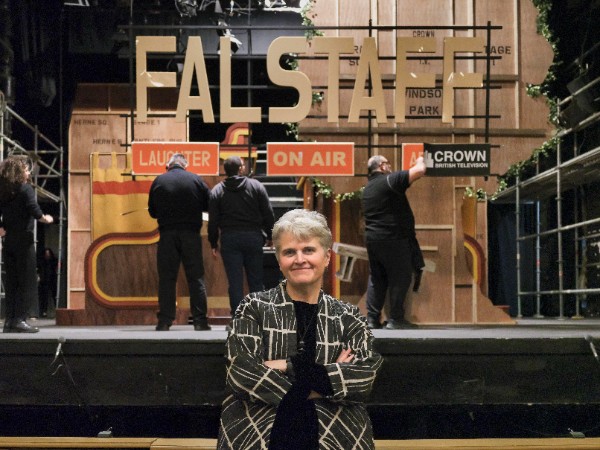
Barbara Diana in Malta, 2026 (photo by Silvano Pupella)
We spoke with Barbara recently about her latest opera production, coming from a recent engagement with the Malta National Opera at the Teatru Manoel in Valletta, where she directed a production of Verdi’s Falstaff (22 February–1 March 2026).
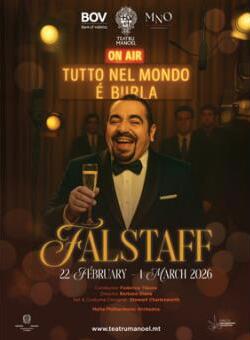
Falstaff poster, 2026 (Malta National Opera)
The conductor was Federico Tibone, and costumes and sets were by Stewart J. Charlesworth. Artistic Director was Maltese tenor Nico Darmanin. The opera was set in the 1960s world of live television, with its combination of on-camera smoothness and behind-the-scenes chaos.
Malta National Opera (MNO) is a newly formed company with the intention of returning Malta to the international opera scene. The Teatru Manoel is a Baroque theatre built in 1731 and is very small, seating only 600. Its proscenium is only 7.5 meters wide, and there is virtually no space in the wings. It is one of the oldest European theatres still in operation and is a special, intimate theatre. Its size, however, poses a challenge for directors!
Barbara was invited to create a Falstaff for the new stage. This was MNO’s first appearance on the Teatru Manoel stage and a prime opportunity to create a work that would fit with MNO’s vision.
As you may remember, Verdi’s opera Falstaff takes its story from Shakespeare. Italian playwright Arrigo Boito used the story from The Merry Wives of Windsor with the addition of scenes from Henry IV, Part 1 and Part 2 to create a comedy focused on the efforts of the fat knight, Sir John Falstaff, and his unsuccessful attempts to seduce two married women to gain access to their husbands’ wealth. The women are prepared to thwart him at every turn and are successful in defeating his desires.
Giuseppe Verdi: Falstaff – Act II: Gaie comari di Windsor! é l’ora! (Alice, Meg, Quickly, Nannetta) (Virginia Tola, soprano; Liliana Mattei, mezzo-soprano; Cinzia de Mola, mezzo-soprano; Sabina Puertolas, vocals; Wallonie Royal Opera Orchestra; Paolo Arrivabeni, cond.)
As a figure of comedy, the character of Falstaff has long stood for the excesses of man: food, drink, and his desires run his life, and it’s up to others to deflect or steer him in other directions. Barbara moved the setting from Shakespeare’s medieval setting around the royal court to a 1960s television studio, complete with studio lights and rolling cameras. She created a double world: backstage and then, turning the set around, onstage. When the set is turned, the audience becomes part of the action, as they’re not just the opera audience but are now the television audience. The action is on stage and in the middle of the audience in the aisles.
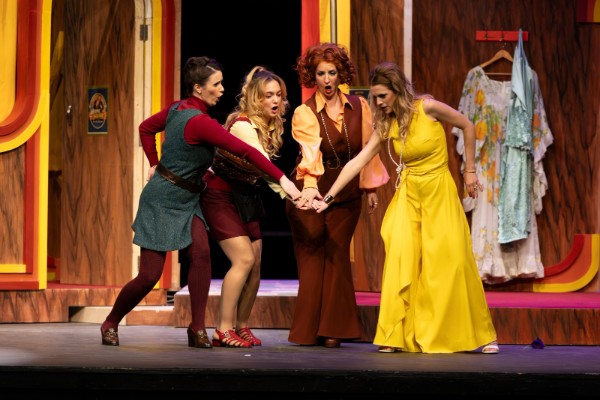
The Women decide to act, 2026 (Malta National Opera)
Falstaff is a washed-up celebrity who has descended to the level of being in a soap opera (Herne Square), while still trying to claim his due as one of England’s most irresistible heartthrobs (which only he believes). In his attempt to woo Alice, who is married to the jealous Ford, his attentions are noticed, and he has to hide in a laundry basket…that is then wheeled through the television studio and dumped in the Thames.
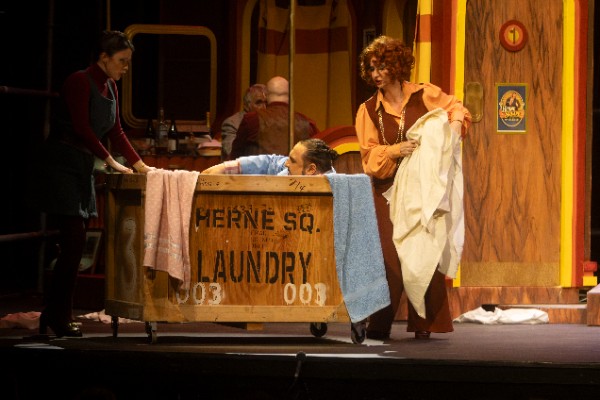
Falstaff in the laundry, 2026 (Malta National Opera)
When he tries to meet Alice again, this time in the studio set of Windsor Forest, the women work with the studio crew to convince Falstaff that the set has fairies who terrify the fat knight into confessing his misdeeds and asking forgiveness. A second plot for two young lovers to marry works and, in the end, everyone recognises that as much as all the world’s a stage, everyone in the studio has gotten played. As the production’s tag line says: All the world’s a joke…and we’re all in on it.
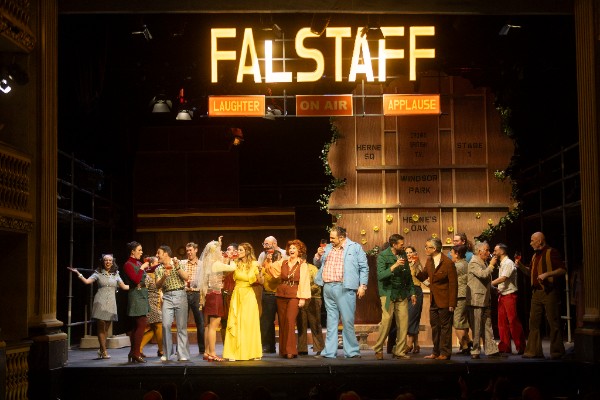
Falstaff on Air, 2026 (Malta National Opera)
Barbara and her co-conspirators, Stewart J. Charlesworth, who designed the set and costumes, and Nico Darmanin, Artistic Director of the MNO, created a production that caught the attention of Malta. It was the hot ticket in February and March and was discussed not only in Valletta but also in the international press. This first outing of the MNO at the historic Teatru Manoel was significant and important in achieving Darmanin’s vision of making Malta a Mediterranean hub for international operatic collaboration.
Giuseppe Verdi: Falstaff – Act II Part II: Quand’ero paggio (Falstaff, Alice, Quickly, Meg) (Tito Gobbi, baritone; Elisabeth Schwarzkopf, soprano; Giulietta Simionato, mezzo-soprano; Anna Maria Canali, mezzo-soprano; Vienna Philharmonic Orchestra; Herbert von Karajan, cond.)
In discussing her philosophy behind the production, Barbara made reference to her work on Benjamin Britten. In her work on Britten’s music and dramaturgy in his operas, she found that he used opera as a means to an end. Peter Grimes may be a story of a lonely and maladjusted fisherman, but it’s just as much a story about bullying and societal pressure to conform, about empathy, and about the value of a human life. All of these topics are certainly current today. In the MeToo generation, someone like Falstaff, with his assumptions of male prerogative, plays badly. He mistreats his assistants and never knows anyone’s name. In the context of getting his comeuppance from the women in his world, however, the power shifts, and he goes from heartthrob to contrition, finding a better place in an equal society.
The British musicologist Donald Mitchell once remarked that doing a staging of an opera was much like writing a book on it – you needed to know all the subtleties, the intentions, the societal references, the hidden references – and Barbara took this to heart. For her, watching an opera is immersing yourself in a complete world and in her staging of Falstaff, she had to create that world for the audience. In her eyes, watching an opera isn’t just entertainment, it’s good for you! You’re engaged with the characters, caught up in the action, and your blood pressure responds to the action, with the added advantage of all of Verdi’s music.
The singers, Kiril Manolov as Falstaff, Elisa Balbo as Alice Ford and Angharad Rowlands as Meg Page, with Vittorio Prato as Ford, brought together an international ensemble. Bulgarian baritone Manolov has made his career across Europe, in Chicago, and Tokyo. Italian soprano Elisa Balbo has appeared in the leading theatres of Italy with a repertoire from Mozart to Rossini. Welsh mezzo-soprano Angharad Rowlands is a Rising Star of the Orchestra of the Age of Enlightenment for the 2025 to 2027 period. Her opera appearances extend from Handel to Britten, and her concert repertoire includes Bach and Handel. Italian baritone Vittorio Prato brings an international performing career centered around the operatic greats. They were joined by Maltese tenor Nico Darmanin singing Fenton. As well as serving as the Artistic Director of the MNO, he has an extensive performing career in Europe and a growing international presence.
By setting the opera in a 1960s television studio, Barbara freed the opera from its old associations and uses the context to help us observe our own world. As you get caught up in the pressure and frenzy of getting something on the air NOW, we see the compromises they have to make, the assumptions that they have to let slide, and, fortunately for all, the lessons that are learned.
The production opened on 22 February, and it was only on 28 January, three weeks before opening night, that the focused work really started. The opera opens in the backstage area of the television studio, where there are many doors and rooms for people to move through, all of which require careful coordination. For the second part, the stage was reversed and became the television studio itself.
Barbara approached the rehearsals with the complete opera laid out in her head, as though what she was really doing was leading a revival production of an opera that had been performed at another time and place. She wanted her singers to fully achieve a natural freedom, so she gave them signposts of progress, and they would form their actions to achieve those goals. Singers came to the production with experience of singing opera under other conductors, so some came in with precise and pre-formed ideas that needed to be loosened and adapted to the scenario at hand.
Barbara is a firm believer in what the composer and librettist created and said that she never underestimated the power of the text and the action of the music. She, however, felt free to disregard convention in moving the setting to the 20th century because both the text and the music would be served.
In the final scene, which might be termed ‘the haunting of Falstaff’, the forest of Shakespeare’s original is transformed into a created forest on a studio set. The ‘fairies’ use flashlights to confuse the eye, black capes to assist their vanishing, and carnival masks to disguise their features. ‘Let’s do it weird’ might be the whole motto of the scene and the costuming.
Giuseppe Verdi: Falstaff – Act III: Tutto nel mondo è burla (All) (Geraint Evans, baritone; Robert Merrill, baritone; Alfredo Kraus, tenor; John Lanigan, tenor; Piero De Palma, tenor; Giovanni Foiani, bass; Ilva Ligabue, soprano; Mirella Freni, soprano; Giulietta Simionato, mezzo-soprano; Rosalind Elias, mezzo-soprano; Rome Opera House Chorus; Rome Opera House Orchestra; Georg Solti, cond.)
Falstaff gets his comeuppance, the women keep their reputations, and everyone realises that the world, including the world of television, is not to be trusted. Being that the MNO was such a small and new company, Barbara found that in addition to the Director hat, she also sometimes wore the Executive Producer hat, the Press Department hat, the Fund-Raising hat, and the PR hat. The net result was exactly what the MNO needed: an innovative production that was cutting-edge and had an international reach. It will be broadcast locally in Malta, in Italy by SKY, and will be available on demand on Med.TV.
Speaking with Barbara, we quickly realised how much an opera director has to have under their belt. It’s not enough to love Verdi. You also have to know about how to sing, how to act, how to move on a stage, and how to read what the composer and librettist put on the page (and what they had in their minds). Barbara’s vast experience across music as a singer, as a researcher, and as a language expert made her ideal for her opera director role. She first directed an opera in 1997, in a production at Oxford’s Holywell Music Room of Handel’s Giulio Cesare. She stage-managed a production of Britten’s A Midsummer Night’s Dream for the Aldeburgh Festival, and has spent the last 13 years at Glyndebourne, ostensibly doing Italian language coaching but always involved in the opera world around her. This has led to jobs at Covent Garden, Copenhagen, and Amsterdam.
While she hates watching directors who cannot deal with the work as given to them by the composer and librettist, she found she learned the most from directors, such as David McVicar, who were also good musicians. It’s the music understanding that lets you know that the titular head of an opera may not, in fact, be the main character. She gave the example of Mozart’s La Clemenza di Tito, where Tito, despite being in the title, is only given three arias and is a tenor, whereas Sesto, who is in love with Vitellia, has far more to sing, both arias and duets, and is a soprano castrato, making him the real star of the work.
Wolfgang Amadeus Mozart: La clemenza di Tito, K. 621, Act II: Deh per questo istante solo (Valer Sabadus, counter-tenor; Recreation – Graz Grosses Orchester; Michael Hofstetter, cond.)
It’s been a delight to see Barbara achieve a stage for her operatic vision. She has visions and plans for other operas, and we can’t wait to see what’s next.
For more of the best in classical music, sign up for our E-Newsletter