Violist Rebecca Clarke was one of the most talented British composers of the early twentieth century.
Although she is best known for her viola sonata, she also wrote a number of other wonderful works.
These often blend a late Romantic language with tinges of British folk music. All are written in her own uniquely personal, deeply emotional voice.
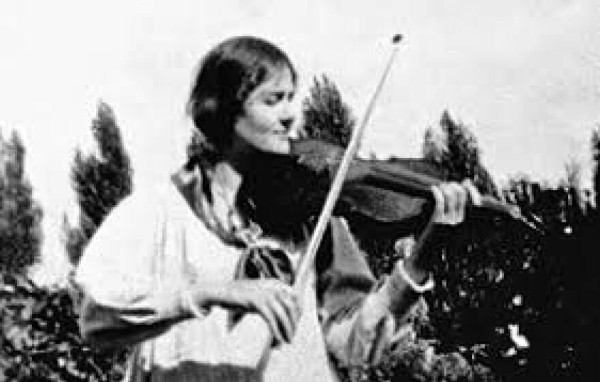
Rebecca Clarke
Here are some of the best works from Rebecca Clarke’s compositional output.
1. Viola Sonata (1919)
Her masterpiece and most famous work
Clarke’s viola sonata was composed for a competition sponsored by wealthy patron Elizabeth Sprague Coolidge in 1919.
It ended up tying for first place with a piece by Ernest Bloch. In the end, Coolidge awarded the prize to Bloch.
Allegedly, the judges were suspicious that a woman could compose such a powerful and well-constructed work. In fact, some wondered if Rebecca Clarke was actually Bloch’s pseudonym!
The top of the score is inscribed with a snippet of poetry by Alfred de Musset, the translation of which reads:
Poet, take up your lute; the wine of youth
this night is fermenting in the veins of God.
It’s a perfect summation of the sonata’s three thrilling, sweeping movements.
There are many highlights here, but listen to how Clarke effortlessly works in the dramatic themes from the first movement into the finale: a thrilling full-circle moment that creates cohesion and demonstrates Clarke’s compositional mastery.
2. Piano Trio (1921)
A close runner-up to the Viola Sonata
Clarke’s Piano Trio is another ambitious chamber work that demonstrates her command of form, contrast, and colour.
The writing is deeply emotionally charged and technically demanding. The moods shift on a dime – going from mysterious to demanding to ecstatic to joyful – and yet the trio never comes across as being contrived. Indeed, it often sounds like a magical improvisation.
Like in the viola sonata, she plays with the idea of returning and cycling themes, to great effect.
3. Morpheus (1917)
A shimmering, Impressionist-styled gem for viola and piano
As a young woman, Rebecca Clarke became estranged from her abusive father after criticising his infidelities.
He kicked her out of the family house and stopped paying her Royal College of Music tuition. She was forced to go to work as a professional performing violist to support herself.
By the time she relocated to the United States in 1916, she was used to making her own way.
In 1918, she gave a recital in New York City. She wanted to include a few of her original compositions, but worried about what it would look like to have a bunch of works by Rebecca Clarke on the program. So she wrote in the program that Morpheus had been written by a (fictional) composer named “Anthony Trent.”
Predictably, the critics preferred the work of the fictional male composer over the work of the female composer.
Morpheus is the Greek god of dreams, and this work conjures a sleepy, dreamy, magical atmosphere. It clearly draws inspiration from composers like Debussy, Vaughan Williams, and Ravel, but Clarke’s voice is immediately recognisable.
4. Prelude, Allegro and Pastorale (1941)
A late-career jewel for clarinet and viola
Tragically, sexism, depression, self-doubt, and other factors led Clarke to drift away from composition in the 1920s and early 1930s.
However, by the late 1930s and early 1940s, her output began ticking upward again. Her music had a new austerity and edge to it: different from her earlier works, perhaps, but just as gripping.
This twelve-minute piece is written for the unusual combination of clarinet and viola. The timbres of the two instruments blend beautifully, and Clarke’s treatment of them makes a listener wonder why more composers haven’t tried their hand at this particular instrumentation.
The Prelude is introspective and conversational; the Allegro has a wary wit; and the Pastorale provides a wistful conclusion.
5. Passacaglia on an Old English Tune (1944)
A mature, old-fashioned work of poetry
Clarke’s love life was often messy. She had suffered the indignity of being proposed to when she was still a college student by one of her professors; her father responded by yanking her out of class.
Later, between 1927 and 1933, she was in a relationship with a married baritone named John Goss. She dedicated several songs to him, but in the end, the relationship was doomed.
When World War II broke out, she was visiting her brothers in the United States. She wasn’t able to get a visa to return to Britain, so she spent the war years in America, eventually becoming a tutor in Connecticut.
In 1944, totally by chance, she ran into her old university friend James Friskin on the streets of Manhattan. He had become a pianist and teacher and was one of the founding faculty members of the Juilliard School. The two married that September and were very happy together.
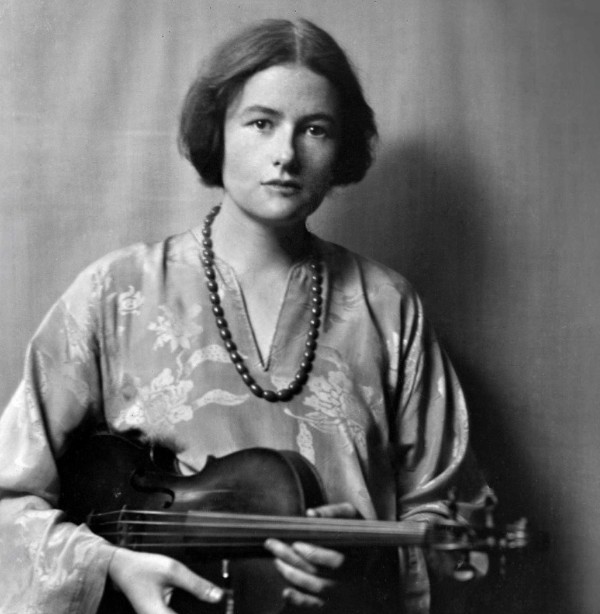
Rebecca Clarke
This Passacaglia dates from that time of transition. It draws on themes that were important to Clarke at that time: her English heritage, the role of fate, the melancholy of war, and a world-weary and deeply felt emotion. The conclusion to this work is a heavy, hard-won triumph.
6. Two Pieces for Viola and Cello: Lullaby and Grotesque (c. 1918)
Two spritely contrasting pieces
Clarke appears to have written these two pieces for a practical reason: she wanted chamber music to perform with her accomplished colleague and frequent collaborator, cellist May Mukle. They performed them together in recital for the first time in New York in 1918.
The Lullaby has all of the quiet dynamics and lilting lines that you’d expect from the genre…but there are also intermittent hints of dissonance here, with a few unpredictable harmonies that worm their way in. This sounds like the loving good-night song of an exhausted parent.
The accompanying Grotesque is quick, biting, colourful, and deeply satisfying. Perhaps the naughty children from the lullaby are running loose in the middle of the night!
As always, Clarke avoids all traces of sentimentality or shlock.
7. Chinese Puzzle (1921)
A short sweet encore piece for viola and piano
One of Clarke’s most famous encore pieces, her brief “Chinese Puzzle” was based on a folksong that one of her brother’s Chinese friends would hum while visiting the Clarke household.
Over the course of her career, Clarke traveled all around the world. When she came to Beijing, she asked around to see if she had transcribed the folksong correctly. The answer was she had, but apparently the lyrics to the song “could not be repeated in polite company”!
Conclusion
It is a musical crime that Rebecca Clarke’s music was overshadowed by her male peers for so many years.
Fortunately, nowadays it’s clear that her viola sonata and piano trio stand alongside the best examples of their genres.
Taken as a whole, her output is gorgeous and gripping, and her biography is uniquely inspirational.
As more performers bring more of her works to the stage, it seems safe to say that her legacy will only become more secure.
For more of the best in classical music, sign up for our E-Newsletter