One of the ways a composer would show off his familiarity with great works and his own skills as an improviser was to do a variation set. Starting with a well-known piece from a work that was in the air, the virtuoso would run wild with his ideas on where this piece might go.
One work like that was Don Giovanni’s duet with Zerlina: ‘Là ci darem la mano’ from Don Giovanni. Starting with a simple and straightforward melody with all kinds of possibilities for making it more complex, a variation set was just waiting to be born.
Frédéric Chopin (1810–1849) was one who took up the challenge of the duet. Shortly after his graduation from the Warsaw Conservatory in 1829, Chopin made his Vienna debut with a small concert series, and in one of those concerts, he performed the Variations on “Là ci darem la mano”, Op. 2, written for piano and orchestra. He wrote the set in 1827, when he was just 17, and it was an attention-getter from the beginning. It was Chopin’s first work for piano and orchestra. A later version reduced the piano and orchestra to piano solo, and this was the piece that caused Robert Schumann in 1831 (in the guise of his alter-ego Eusebius) to write in the Allgemeine Musikalische Zeitung about Chopin: ‘Hut ab, ihr Herren, ein Genie’ (Hats off, gentlemen, a genius).
In a new recording by pianist Natalia Rehling, she opens with this bravura variation set, but with a difference. Although the work was conceived for piano and orchestra, it also appeared in a version for piano solo.
The Austrian National Library holds the autograph score for the piano and orchestra edition, and in examining it, researchers found that Variation IV exists in a very different earlier version. Rehling has included both the earlier bravura variation and the later published variation in her recording, and this is where we can appreciate how much genius was in Chopin’s composition.
Both variations are marked ‘con bravura’ and are full of motion. It’s clear, though, that the earlier version required a very high level of virtuosic playing and that the second version is a bit gentler on the performer.
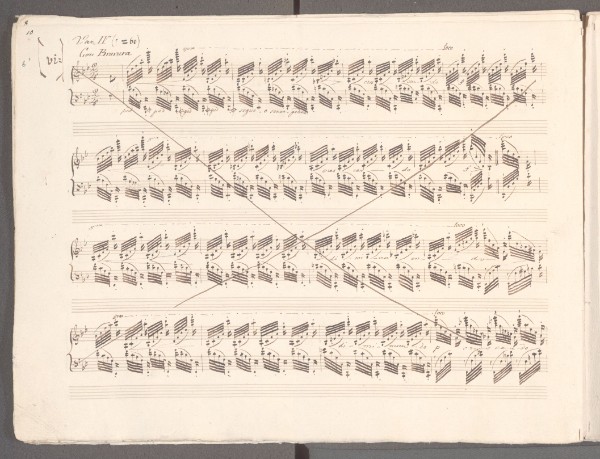
Chopin: Variations on “Là Ci Darem La Mano” in B flat Major, Op. 2: IV: Con bravura (crossed-out version)
(Austrian National Library, ÖNB Mus.Hs.16789)
In the score at the Austrian National Library, the original crossed out section, with its 64th notes (hemidemisemiquavers) replaced with chordal 16th notes (semiquavers).
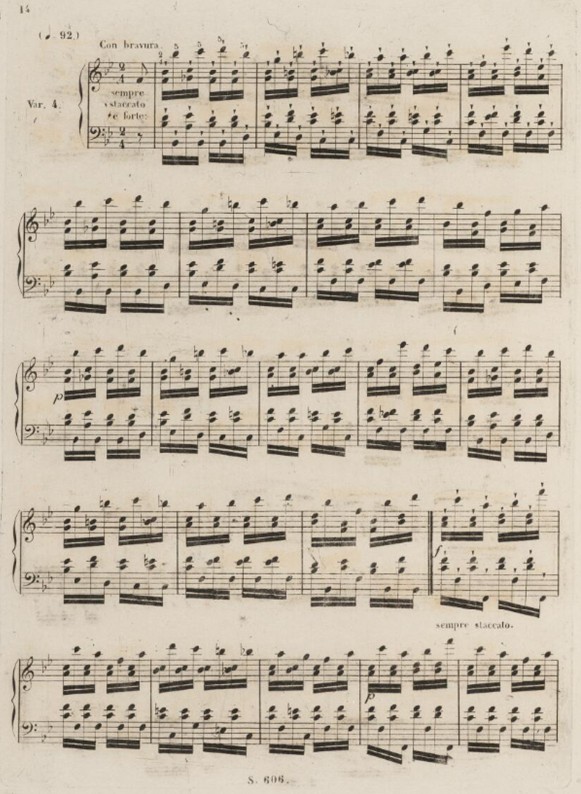
Chopin: Variations On “Là Ci Darem La Mano” In B flat Major, Op. 2: IV: Con bravura (published version), Paris: Schoeneberger, early 1840
(Houghton Library, Harvard University)
It’s rare that we see the working process of a young composer with such skill. Although we do not know if Chopin ever played the crossed-out version, its very existence gives us room to consider what a composer could do and then what he felt he could publish so that others could actually play it.
The recording includes Chopin’s Scherzo No. 1, Op. 20; Ballade No. 1, Op. 23; and earlier works, starting with his Mazurkas, Op. 7, one of the Op. 10 Études, and the Nocturne in F sharp major, Op. 15/2. All of these works were performed during his two trips to Vienna between 1829 and 1831. As noted above, it was his appearances in 1831 that caught the attention of Robert Schumann.
Throughout this review of Chopin’s work in Vienna, Natalia Rehling plays with quiet authority, bringing out the singing lines in works such as the Op. 10 Étude No. 6. Where the original has no pedal markings, Rehling is guided by modern performance practice to create a work with life and colour using the pedals to not only shape the left-hand chromaticism but also enable the right-hand melody to float above as a melancholy song.

Chopin in Vienna
Natalia Rehling, piano
Azure Sky AZ1009
Release date: 13 February 2026
For more of the best in classical music, sign up for our E-Newsletter