Mozart’s music is often described as light, frothy, effortless, elegant, or even decorative. That lightweight reputation does him a disservice.
Beneath the beauty lies one of the sharpest dramatic minds in music history: a composer inspired by human psychology, social issues, desire, grief, joy, and so much more. His music isn’t just pretty; it says something about the human condition.
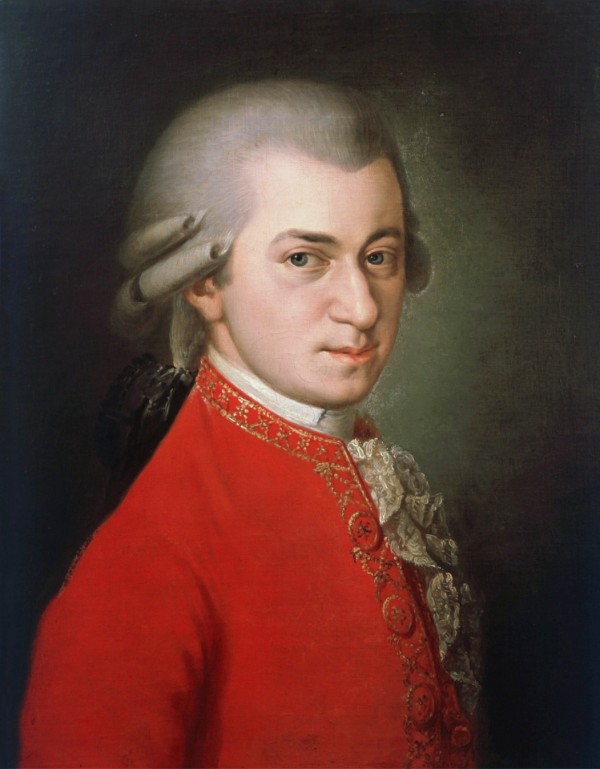
Barbara Krafft: W. A. Mozart, 1819 (Gesellschaft der Musikfreunde)
If you had exactly one hour to understand why Mozart matters – not just why he’s admired, but why he remains foundational to Western music – this is the hour.
These nine movements trace his range from comic brilliance to existential darkness, from operatic wit to symphonic mastery. Together, they show how Mozart succeeded in balancing craft and emotion, and why his music still feels alive, nearly three centuries after his birth.
Overture to Le nozze di Figaro, K. 492 (4 minutes, 30 seconds)
Composed: 1786
The Figaro overture is one of the most perfect openings in all of opera, not because it previews melodies (it doesn’t), but because it establishes character and mood so quickly and thoroughly.
From the very first bar, the music buzzes with nervous energy, wit, and a sense of barely contained chaos.
There’s no grand introduction, no pomp. Instead, Mozart plunges us straight into motion, mirroring the opera’s themes of class conflict and sexual politics.
This overture shows Mozart at the height of his theatrical powers, showcasing his sense of economy, momentum, and intelligence in under five minutes.
Symphony No. 40, K. 550 – I. Molto allegro (8 minutes)
Composed: 1788
Few works have done more to dispel the myth of Mozart as a perpetually happy man than his fortieth symphony, which is one of only two mature symphonies that he wrote in a minor key.
This restless, urgent first movement is one of the most emotionally charged openings that Mozart ever wrote.
The rapidly sighing opening motif never finds peace, and the tension simmers through the whole eight minutes.
Mozart’s fortieth is part of a trilogy of symphonies that he wrote in quick and brilliant succession in the summer of 1788, during a period of financial stress and personal uncertainty.
In it, he brings emotional volatility to a genre long associated with nobility and restraint – and it works, opening the door to the overtly emotional symphonies of the nineteenth century and beyond.
Piano Sonata in A minor, K. 310 – I. Allegro maestoso (9 minutes)
Composed: 1778
This sonata stands out sharply from Mozart’s piano works, for good reason.
Mozart wrote it in Paris shortly after the sudden death of his mother, who had joined him on a work trip to the city.
This stormy music is defiant and dark, with a relentless drive. Here, Mozart is writing from genuine grief rather than a theatrical affect.
It’s one of the clearest examples of how personal grief influenced his instrumental music, even within the tightly constrained structural confines of the Classical era.
Piano Concerto No. 23 in A major, K. 488 – II. Adagio (8 minutes)
Composed: 1786
Set in the unusual key of F-sharp minor, the Adagio unfolds with suspended time and hushed intensity.
The orchestra breathes softly around the piano, which plays a series of long, vulnerable lines.
This movement exists in its own emotional universe.
Taken as a whole, Mozart’s piano concertos transformed the genre into something conversational, with deeply moving psychological nuance. Here, instead of being a virtuoso showman, the soloist is a reflective voice thinking aloud.
String Quintet in C major, K. 515 – II. Andante (10 minutes)
Wolfgang Amadeus Mozart: String Quintet No. 3 in C Major, K. 515: III. Andante (William Primrose, viola; Griller String Quartet)
Composed: 1787
Mozart considered his string quintets among his finest achievements, and this movement shows why.
By adding a second viola to the standard string quartet instrumentation, he deepened the ensemble’s sonority, allowing for warmth, richness, and an unusual amount of interplay between inner voices.
The Andante unfolds with serene inevitability, pairing elegance and quiet, thoughtful depth, and again demonstrating Mozart’s love of writing music that calls to mind the spirit of intimate conversation.
“Là ci darem la mano” from Don Giovanni, K. 527 (2 minutes, 30 seconds)
Composed: 1787
Few composers understood how to portray operatic seduction like Mozart.
This duet between womaniser Don Giovanni and the hesitant Zerlina is a masterclass in psychological portraiture.
The music begins hesitantly, with separate lines, before gradually intertwining as Zerlina gives in to Don Giovanni’s pressure.
Don Giovanni, with its fatally flawed but unforgettably well-rounded protagonist, pushed the art form of opera closer to embracing moral ambiguity. Mozart doesn’t necessarily judge his characters; he observes them and portrays them.
In any case, the villain’s charm here is powerful, which makes his manipulation all the more sinister, unsettling, and engaging.
Requiem, K. 626 – “Lacrimosa” (4 minutes)
Composed: 1791 (unfinished at death)
The Lacrimosa is among the last pieces of music that Mozart ever wrote.
Mozart died before completing the movement, and the Requiem has since taken on a near-mythic status.
It captures Mozart at his most vulnerable: stripped of showy operatic wit, confronting death with open eyes, clarity, and tasteful restraint.
Its weeping phrases and aching suspensions capture mortality in a way that few composers ever have.
Clarinet Concerto in A major, K. 622 – II. Adagio (7 minutes)
Composed: 1791
This was Mozart’s final completed instrumental work, and although he certainly didn’t mean for it to be, it comes across as a farewell.
Written for his clarinettist friend Anton Stadler, the Adagio movement floats with extraordinary calm. The clarinet’s voice is warm and human.
Over the course of his career, Mozart helped establish the clarinet as a serious solo instrument. This movement shows why, as it sings with a depth few instruments can match.
Symphony No. 41, K. 551 – IV. Molto allegro (8 minutes)
The finale of the Jupiter Symphony is one of the most astonishing achievements in Western music.
Five – count them, five – independent themes are woven together in a single jubilant contrapuntal tour de force, combining Baroque counterpoint technique with Classical ease and clarity.
Historically, this movement represents the composer at his most confident and visionary: the perfect way to end what is, in our opinion, the best sixty minutes of music that Mozart ever wrote.
Conclusion

Statue of Mozart in Salzburg
This hour shows why Wolfgang Amadeus Mozart remains one of the most essential figures in the history of Western music.
Across opera, symphony, concerto, chamber music, and sacred works, these pieces reveal a composer who deeply understood human behaviour, and who translated that understanding into sound with unmatched ease and panache.
Even to modern listeners, born 250 years after his birth or later, Mozart’s music still feels startlingly perceptive and emotionally honest.
This hour makes clear why his work wasn’t just important to the Classical era; it remains important – indeed, indispensable – to us even today.
For more of the best in classical music, sign up for our E-Newsletter