If you had exactly one hour to understand why composer Frédéric Chopin matters – not just why he’s beloved, but why he’s historically transformative, and considered one of the greatest composers of all time – this is the hour.
These nine pieces trace his evolution from elegant Parisian composer to one of the most psychologically complex voices of the 19th century.
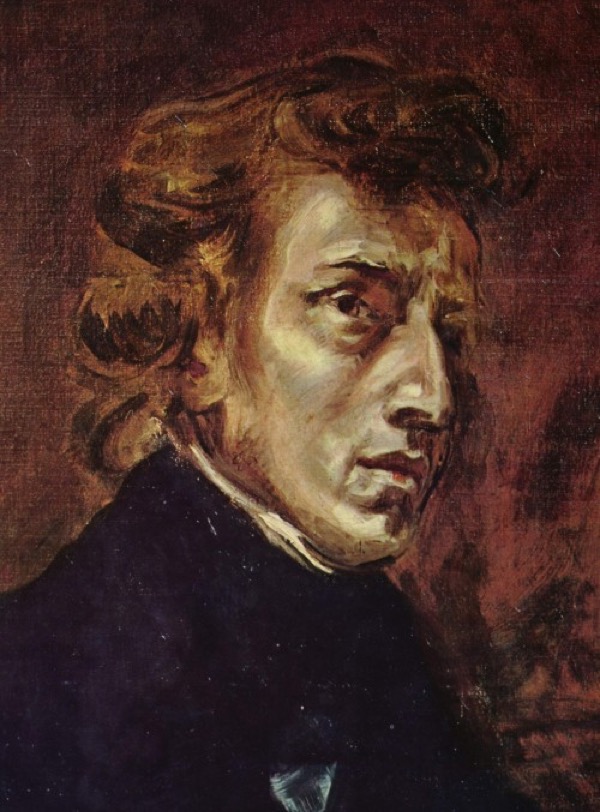
Frédéric Chopin
This playlist moves through the refinement of the salon, his fury at the oppression of his beloved homeland, and his private grief, ending with an unapologetic flourish of extroverted self-assertion.
Together, these nine pieces come in just under sixty minutes. That hour tells a coherent emotional story: one unique to Chopin.
1. Nocturne in D-flat major, Op. 27 No. 2 — 5:30
Composed: 1835–36
By the mid-1830s, Chopin had established himself as the pianistic poet of the Parisian salon.
The Op. 27 nocturnes mark a turning point in his output. For one, they’re more harmonically adventurous than his earlier nocturnes, and they stretch the form well beyond what other composers were doing at the time. In fact, by this time, Chopin was well on his way to making the nocturne genre his own.
This nocturne features a swanlike glide in the right hand. Beneath the melody, the harmony slips constantly between keys, never quite letting the listener rest. It’s simultaneously seductive and destabilising.
Here Chopin refines his voice, embracing intimacy and elegance while also coming across as surprisingly modern.
2. Grande Valse Brillante, Op. 18 — 5:00
Composed: 1833
Written in his early twenties, shortly after he settled permanently in Paris, the Grande Valse Brillante helped cement Chopin’s reputation as a fashionable composer.
Waltzes like this weren’t meant for dancing; rather, they were portraits of dances, and concert pieces designed to dazzle aristocratic audiences.
The takeaway here is how Chopin elevates the genre. This isn’t background music for airheaded aristocrats looking for a fun night out. It’s stylised, theatrical, and knowingly glamorous.
The charm here is deliberate, almost ironic – and it shows how Chopin mastered the language and customs of the aristocratic society he taught piano to and depended on for money. (In fact, this waltz was dedicated to one of his wealthy patrons, Laura Horsford.)
3. Étude in C minor, Op. 10, No. 12 (“Revolutionary”) — 3:30
Composed: 1831
This piece is a bit of political and musical history.
Chopin wrote it at the age of 21, shortly after learning that the November Uprising in Poland had been crushed by Russian forces. At the time, he was stranded abroad, trying to make a go of a piano career and was unable to return home.
The fury he writes into the left-hand part isn’t just a technical display; it’s his grief and rage over the political situation and his exile channelled into a musical form.
Chopin’s études themselves were revolutionary: instead of dry exercises, they fused technical innovation with emotional content. This particular étude made that fusion impossible to ignore.
4. Nocturne in C minor, Op. 48 No. 1 — 6:00
Composed: 1841
By the 1840s, Chopin’s tuberculosis was worsening, and his music was growing darker, heavier, and more architectural. This nocturne is worlds away from the floating elegance of earlier ones.
The central chorale – massive, almost religious – feels unsettlingly like a funeral oration, and the music works itself into a grief-stricken frenzy before the end.
This piece shows Chopin pushing the nocturne toward something that verged on operatic. This isn’t background music; it grabs listeners by their lapels and demands your attention and emotional engagement.
5. Fantaisie-Impromptu, Op. 66 — 5:30
Composed: 1834 (published posthumously)
Chopin never intended this piece for publication, possibly because it bears striking similarities to the third movement of Beethoven‘s Moonlight Sonata. However, despite Chopin’s reservations, it has since become one of his most famous works.
Its restless outer sections and aching middle melody encapsulate Chopin’s contradictions between brilliance and vulnerability, motion and suspension, and extroversion and tender introversion.
Historically, it offers a glimpse into the ideas Chopin was exploring as he and his generation were grappling with the recently deceased Beethoven’s works.
The theme from this fantaisie has also found its way into several pop recordings over the years, especially in the song “I’m Always Chasing Rainbows.”
6. Mazurka in C-sharp minor, Op. 50 No. 3 — 5:00
Composed: 1841–42
The mazurkas were, arguably, the genre closest to Chopin’s heart.
Rooted in the tradition of Polish folk dance, but radically transformed for salons and the concert hall, they became his deeply personal way of exploring his intense, bittersweet emotions surrounding nostalgia and displacement.
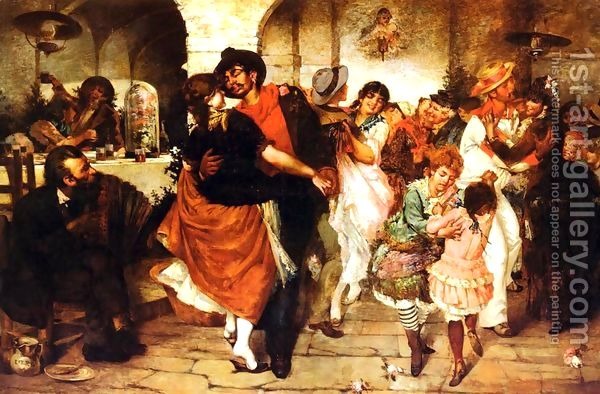
Mazurka Dance
This particular mazurka is harmonically ambiguous, rhythmically unsettled, and emotionally elusive.
It reflects Chopin’s lifelong preoccupation with his Polish identity and his drive to propagate and promote it even during his exile.
7. Ballade No. 4 in F minor, Op. 52 — 12:00
Composed: 1842
By the early 1840s, Chopin was writing piano music on an almost orchestral scale.
The fourth Ballade is not Chopin’s most immediately accessible (that would likely be his first in G-minor), but this one, his last, is widely regarded as his structural masterpiece.
Unlike earlier ballades, its drama unfolds gradually, almost imperceptibly, through subtle transformations rather than sudden or startling overt contrasts.
The craft behind this twelve-minute work places Chopin alongside the great large-scale composers of his time – even as he avoids adopting their forms.
It’s not a sonata and not a symphony, but something uniquely Chopin’s: masterfully paced and affecting narrative music for piano solo, packing just as intense an emotional punch and architectural clarity as any Wagnerian overture.
8. Scherzo No. 2 in B-flat minor, Op. 31 — 11:00
Composed: 1837
Chopin’s scherzos subverted expectations. The word means “joke” and, during the Classical era, had a reputation of being a light contrasting movement within the context of a larger work. In Chopin’s hands, the scherzo became a dark, volatile, epic, independent thing.
Chopin’s second Scherzo balances explosive drama with moments of fragile calm. Alongside his ballades, it is yet another one of his works that demonstrates how he could sustain symphonic tension without employing orchestral or operatic forces.
9. Polonaise in A-flat major, Op. 53 (“Heroic”) — 6:30
Composed: 1842
Often misunderstood as mere bravura, the “Heroic” Polonaise is deeply political.
Like the mazurka, the polonaise originated with Polish folk dances. In 1842, after the November Uprising, it became an especially potent symbol of Polish national identity, and Chopin transformed it into a statement of defiance and dignity.
Written at the height of his powers, this piece closes the hour with a steely strength. Its thrilling, revolutionary power shows why Chopin’s name continues to top many music lovers’ favourite composer lists, even over two centuries after his birth.
Conclusion
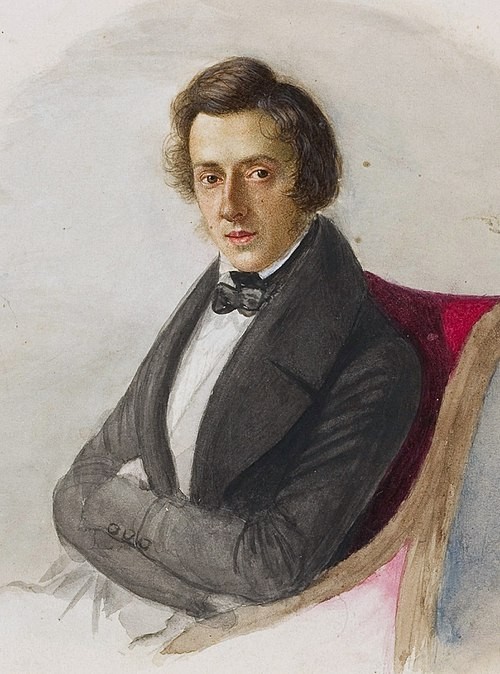
Maria Wodzińska: Chopin, 1836 (National Museum in Warsaw)
This hour of music shows why Chopin’s music continues to feel so inexhaustible.
Working almost exclusively at the piano, he managed to encompass lyric beauty, political fury, private introspection, and large-scale architectural ambition – often within the span of a single piece.
Nearly two centuries after it was written, Chopin’s music still feels intimate, daring, and deeply human. This hour explains why, and why his place among the greatest composers of all time remains unquestioned.
For more of the best in classical music, sign up for our E-Newsletter