The dedication page of a musical score is always fascinating. It’s always fun to ask why a particular composer chose to honour a particular man…or, in rarer cases, woman.
Today, we’re looking at the best violin music dedicated to women, written by composers like Mozart, Vaughan Williams, and Ravel… and the fascinating stories behind the accomplished women they were honouring.
Mozart: Violin Sonata in B-flat-major, K. 378 (1781)
Dedicated to Josepha Auernhammer
Josepha Aurnhammer was a Mozart student who matured into one of the most brilliant pianists in Vienna.
In November 1781, when she was 23, teacher and student performed his Sonata for Two Pianos, K. 448 and the Double Concerto, K. 365. They reunited a couple more times after that, too.
He clearly respected her as a musical and interpretive partner.
In 1781, when he published a set of six violin sonatas, he dedicated them to Josephine. This one, the sonata in B-flat-major, is among the most popular today.
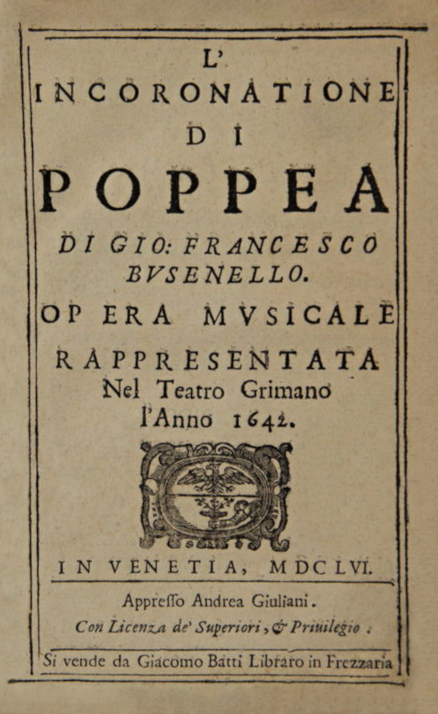
It may seem strange that he dedicated a violin sonata to Aurnhammer, given that she was a pianist, but at the time, the violin was considered to be an accompaniment to the piano part, instead of the other way around. You can see that in the order of the instruments on the printed score: it’s a sonata for clavichord or piano with violin accompaniment, not a violin sonata.
Sarasate: Romanza Andaluza; Jota Navarra (1878)
Dedicated to Wilhelmina Norman-Neruda
Wilhelmina Norman-Neruda, born in 1840, was one of the first women violin soloists who achieved international prominence.
Pablo de Sarasate was one of her colleagues. As a sign of his respect for her, he dedicated these two Spanish-style showpieces to her.
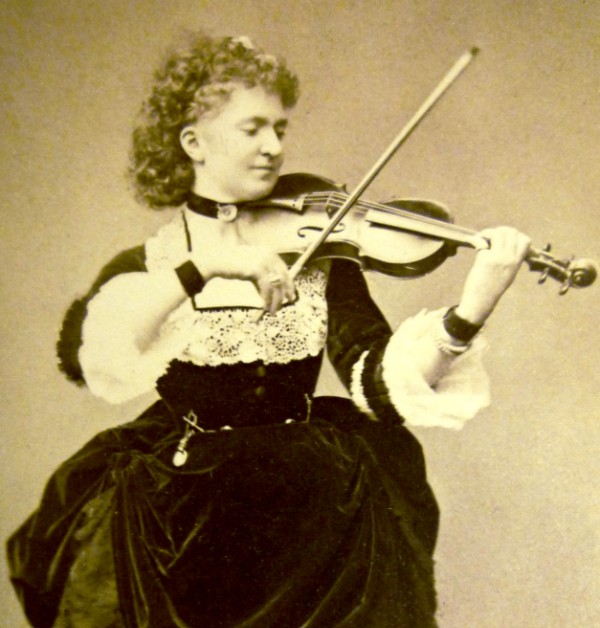
Wilhelmina Norman-Neruda
A fun piece of trivia is that both violinists appear in Sir Arthur Conan Doyle’s Sherlock Holmes stories. In the novel A Study in Scarlet, Holmes raves over her bow arm, while in the short story “The Red-Headed League”, Holmes remarks to Watson before the Sarasate concert: “Off to violin-land, where all is sweetness, and delicacy, and harmony.”
Fauré: Romance, Op. 28
Dedicated to Arma Senkrah
Arma Senkrah – born Anna Harkness – was a gifted American violinist who moved to Europe to study music when she was just a child.
In 1876, at the age of twelve, she enrolled at the Paris Conservatoire and made a big impression. Musicians in Paris immediately took note of her.
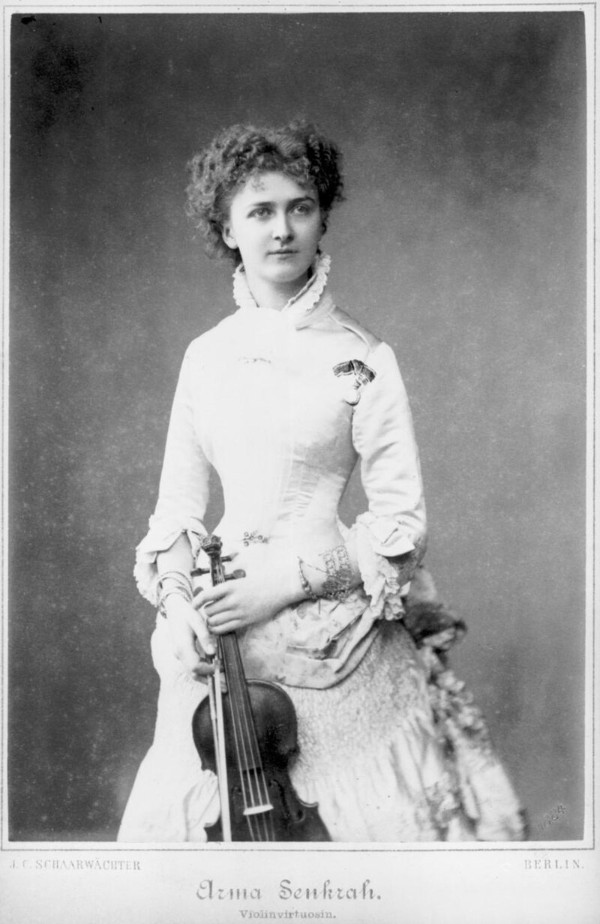
Arma Senkrah
The following year, Fauré wrote this Romance, and she premiered it. When he published the piece in 1883, he officially dedicated it to her.
Senkrah died tragically young by suicide, twelve years after marrying and giving up her career. Historians still aren’t sure why she took such drastic action. However, this piece remains a tribute to her artistry.
Beach: Romance (1893)
Dedicated to Maud Powell
Violinist Maud Powell and composer Amy Beach were true kindred spirits.
They were born two weeks apart in the late summer of 1867. Powell grew up to become the most famous American woman violinist, and Beach became the first American woman to have her own symphony played by a major orchestra.
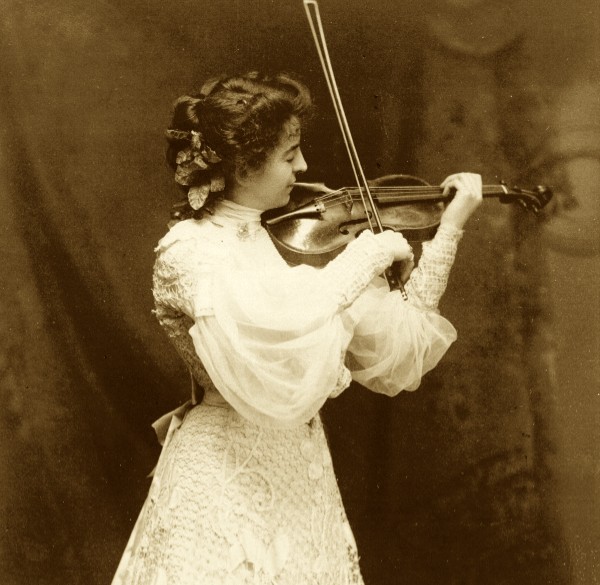
Maud Powell
Powell enjoyed using her fame to popularise the music of contemporary composers, especially women.
Beach performed this work with Powell at the Women’s Musical Congress held at the World’s Columbian Exposition in Chicago in 1893. Given that time and place, the performance became a kind of political statement, celebrating the accomplishments of two of America’s greatest women musicians.
Bartók: Violin Concerto No. 1 (1907–1908)
Dedicated to Stefi Geyer
We don’t know exactly when, but sometime in the early 1900s, composer Béla Bartók fell passionately in love with violin prodigy Stefi Geyer.
In 1907, he was twenty-six and she was nineteen. They spent time together reading through violin and piano music, with Bartók on piano and Geyer on violin.
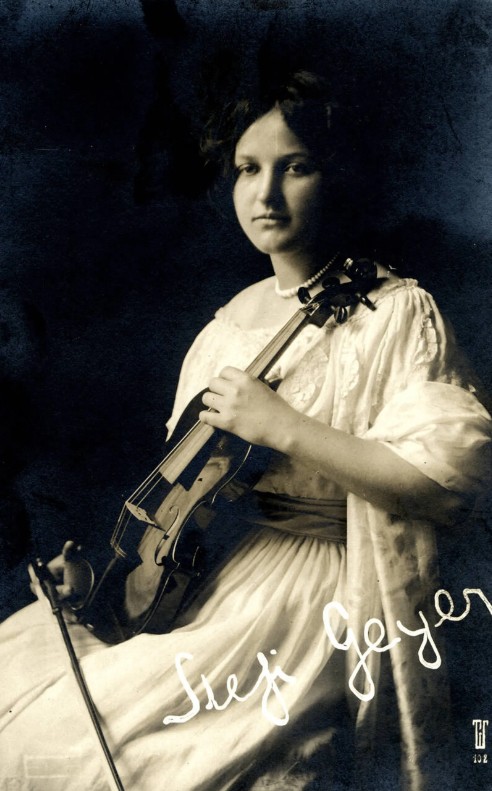
Stefi Geyer
Unfortunately, his love for Stefi was unrequited. He responded to rejection by writing this two-movement violin concerto.
The first movement was meant to be a portrait of Geyer as a person: “the idealised Stefi, celestial and inward,” he wrote. However, the second was, in Geyer’s words, “the violinist he admired”: virtuosic and extroverted.
He mailed the only copy of the score to her, and the work remained unperformed during his lifetime.
Vaughan Williams: The Lark Ascending (1914)
Dedicated to Marie Hall
We don’t know exactly when or where Vaughan Williams wrote The Lark Ascending, his ethereal violin work inspired by a George Meredith poem.
It is believed that during its composition, he worked together with British violinist Marie Hall, who would go on to premiere it.
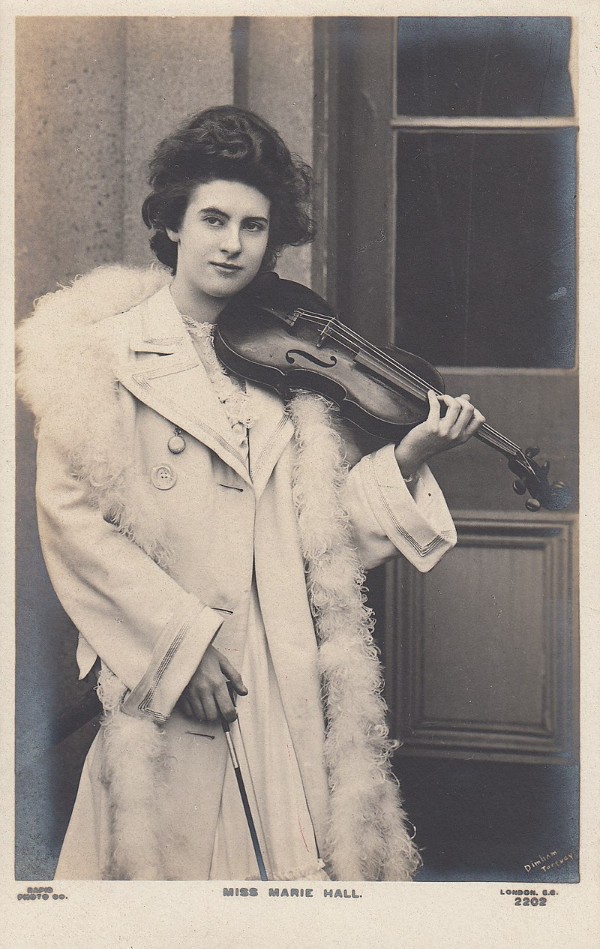
Marie Hall
Marie Hall was one of the most accomplished British violinists of her generation. When she was a girl, she spent a year studying with Edward Elgar. Later, she worked with Otakar Ševčík in Prague, gaining a formidable technique.
As an adult, she enjoyed an international career. But despite the countless audiences she dazzled, her partnership with Vaughan Williams and The Lark Ascending is what she’s best known for today.
Ravel: Tzigane (1924)
Dedicated to Jelly d’Aranyi
Jelly d’Aranyi was the grand-niece of Joseph Joachim, arguably the greatest violinist of his generation.
Jelly, born in 1893, inherited her uncle’s talent and became famous for her fiery interpretations of the violin repertoire.
In the early 1920s, she met Maurice Ravel at a private party in London, where she played his Sonata for Violin and Cello. He was fascinated by her, her heritage, and her knowledge, and the two stayed up until dawn as she played him Hungarian folk music.
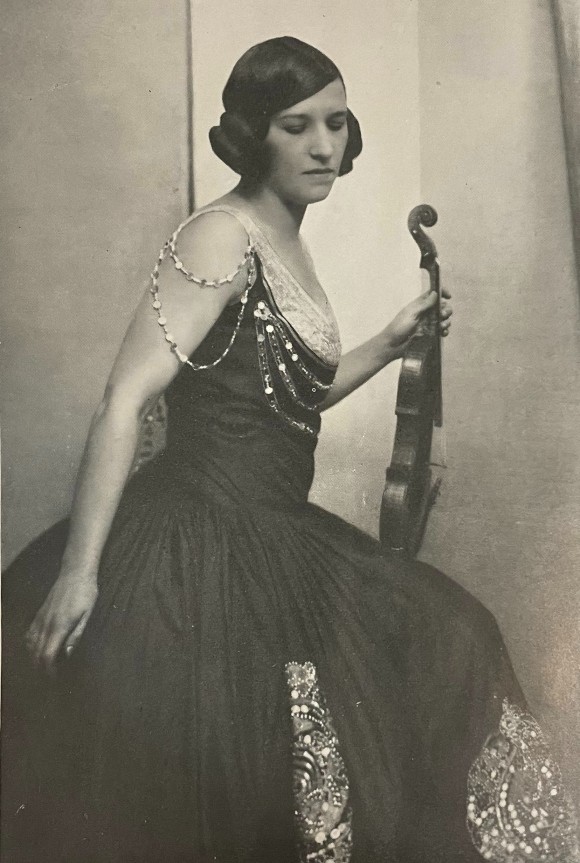
Jelly d’Aranyi
Ravel incorporated some of the magic from that freewheeling night into his famous showpiece Tzigane (often translated as “Hungarian Gypsy”). Jelly d’Aranyi premiered it in April 1924.
Clarke: Midsummer Moon (1924)
Dedicated to Adila Fachiri
Jelly d’Aranyi had a violinist sister named Adila d’Aranyi Fachiri. Adila grew up in Hungary and Berlin, but in 1909, at the age of 23, she relocated to London.
While there, she crossed paths with composer and violinist/violist Rebecca Clarke, who in 1912 became one of the first professional orchestral violinists in Britain.
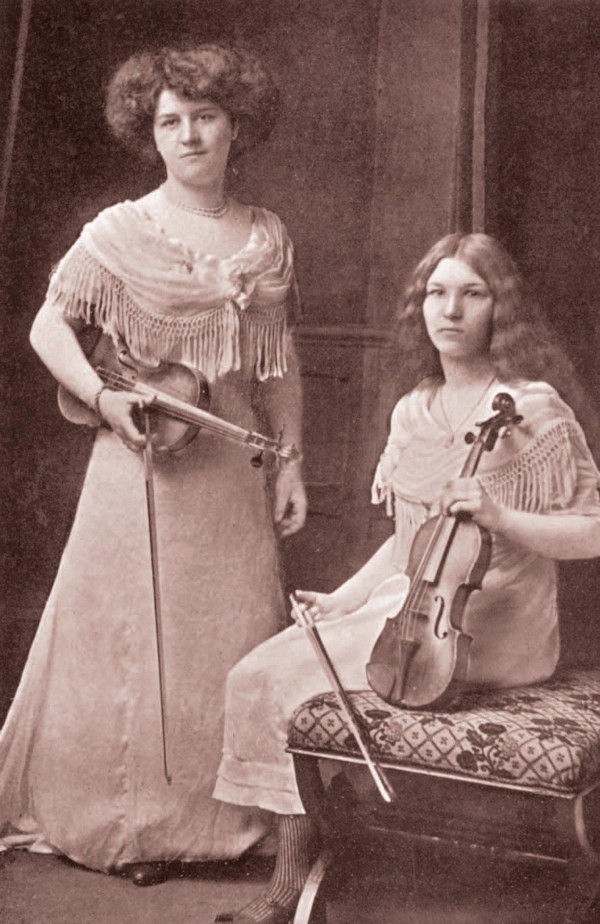
Adila Fachiri and Jelly d’Aranyi
It was written for Fachiri, premiered at Wigmore Hall in October 1924, and published in 1926.
Higdon: Violin Concerto (2008)
Dedicated to Hilary Hahn
Written for superstar violinist Hilary Hahn, Jennifer Higdon’s Pulitzer Prize-winning concerto is a modern masterwork.
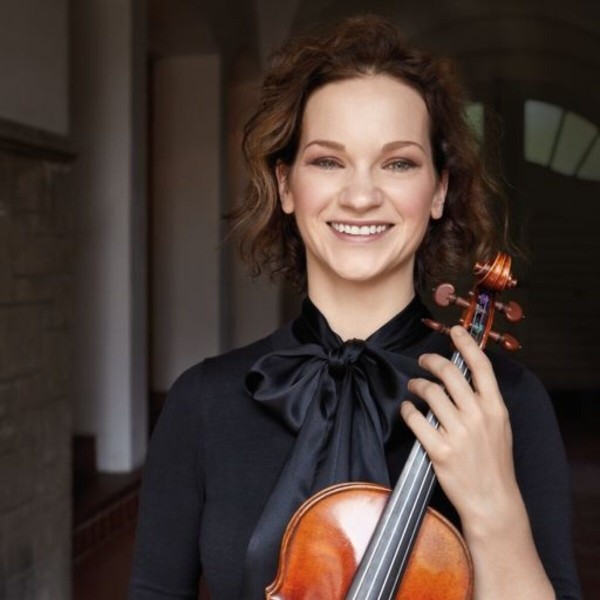
Hilary Hahn
Part of the inspiration came from the mutual connection the two women have to the renowned Curtis Institute in Philadelphia. Both attended Curtis, and Higdon served as a professor of composition during the time Hahn studied there.
The opening movement is titled 1726, after Curtis’s address of 1726 Locust Street. It features a variety of sevenths, seconds, and sixths, meaning that the composer and violinist’s shared history is literally written into the notes of the piece.
Aside from the Curtis connection, Hahn’s technical precision and expressive clarity clearly inspired Higdon’s propulsive writing.
For more of the best in classical music, sign up for our E-Newsletter