Paintings in Carl Schimmel’s String Quartet No. 2, “Six Faces”
The paintings in Carl Schimmel’s Second String Quartet, Six Faces, are all Cubist works painted between 1911 and 1920. The 4 women and 2 men are shown with their belongings: a cross, a pipe, some animals, a mandolin, a fan, and a cane. For the composer, each painting shows a different character and the possessions they hold are keys to the person.
The piece opens with a Prelude that introduces the four voices of the string quartet and the six characters they will present.
Carl Schimmel: String Quartet No. 2, “Six Faces”: Prelude (The Left Coast Ensemble)
The first painting is Georges Braque’s Girl with a Cross, painted in 1911. Beginning in late 1907, Braque and Pablo Picasso began experimenting with a new style of representation, reducing images to highly simplified geometric forms. They were developing this from work previously done by Cezanne and came up with a style that began with ‘putting together unaligned observations of adjacent parts’. Matisse came up with the name ‘Cubism’ and a style was born.
At the time, because of the fragmentation of the Cubist style, people first perceived the works as abstract, with only vestiges of anything familiar—an eye, a newspaper, a nose, glasses, or a cross—implying that boundaries did not define the object or the space around it.
In Girl with a Cross, we can see her curly hair, her nose, the flowers in her hair, her eye, and the cross she wears around her neck. The colours are muted greys and ochres, and shadows are everywhere.
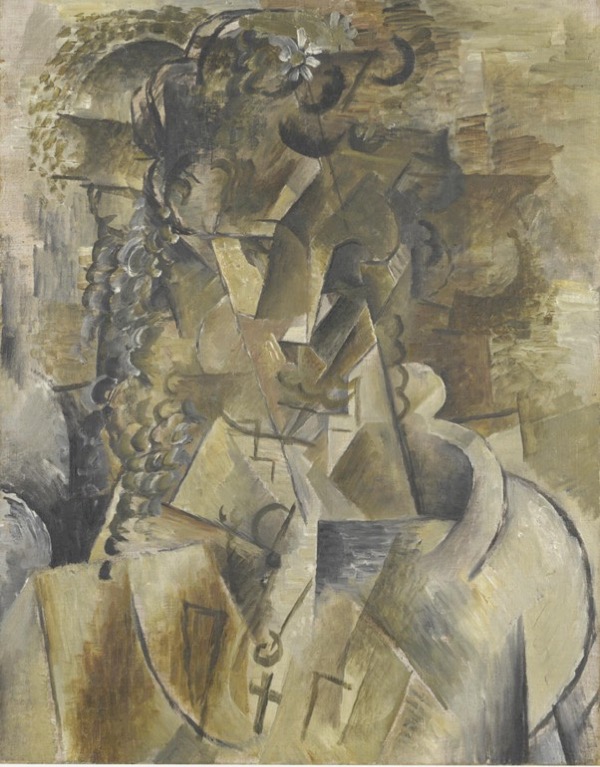
Georges Braque: Girl With a Cross, 1911 (Fort Worth, TX: Kimbell Art Museum)
In his music, Schimmel makes us reassess how we read the girl. Is she as pure and innocent as Braque suggests, or could she be impetuous, frustrated, desirous, or desperate? What part does the cross play in defining the girl? The composer focuses on the cross and uses music borrowed from Liszt’s ‘cross motive’ from his 1862 orchestral work Die Legende von der Heiligen Elisabeth, S.2.
Carl Schimmel: String Quartet No. 2, “Six Faces”: I. Girl with Cross (The Left Coast Ensemble)
The following interlude moves us over to a painting by Picasso.
Carl Schimmel: String Quartet No. 2, “Six Faces”: Interlude (The Left Coast Ensemble)
In 1915, when Picasso created Man With a Pipe, WWI was taking its toll on France’s artistic community: Braque had already been given a severe head injury in 1914 and had become temporarily blind. A head operation relieved the pressure, and as he recovered, he collaborated closely with Picasso. Braque resumed painting in 1916 and started to ease up on the more stringent elements in Cubism.
Picasso’s portrait is of his Paris art dealer, the German Daniel-Henry Kahnweiler. It also signals Picasso’s return to colour and his use of recognisable architectural elements, including scrolls, frieze designs, and furniture. He wears his hat as proudly as his moustache and holds his still-smoking pipe in his left hand. In the puzzle-like assembly of his face, a little bird appears. The coloured dots take us back to Impressionist pointillism. The representation of the body ranges from a grey-and-black face with a dotted nose and chin, to a pink-and-white right hand, to a brick-red left hand holding the pipe. As your eye moves across the image, the brighter colours at the bottom pull your vision downward. We seem to read the picture from the top left to the bottom right.
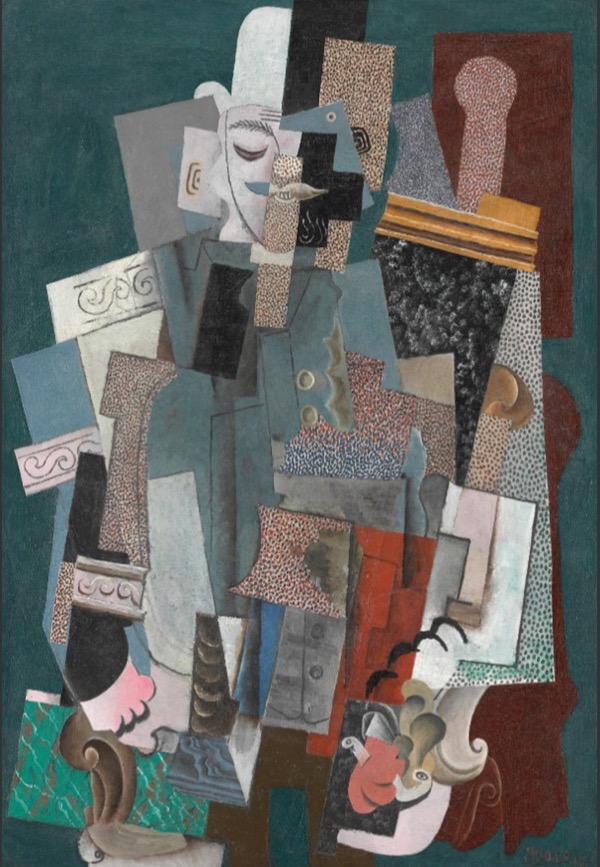
Pablo Picasso: Man With a Pipe, 1915 (Chicago: Art Institute)
The man with the pipe is a businessman. His interests go everywhere.
Carl Schimmel: String Quartet No. 2, “Six Faces”: II. Man with Pipe (The Left Coast Ensemble)
The next interlude takes us to a room where a woman is surrounded by her animals.
Carl Schimmel: String Quartet No. 2, “Six Faces”: Interlude (The Left Coast Ensemble)
The woman is Madame Raymond Duchamp-Villon, the wife of sculptor Raymond Duchamp-Villon. As a sculptor, Duchamp-Villon was part of the wide-ranging discussion of Cubism that was rife in Paris in the early 20th century. Four of his siblings were also artists, the best-known of whom is Marcel Duchamp.
Madame Duchamp-Villon is shown carefully situated in a secure bourgeois environment with her dog and two cats, her sensible shoe on the floor, her wedding band on her hand and a string of beads around her neck. As with Cubism, she becomes part of the background; her face appears from several simultaneous angles, and strong sections of light and shade define the scene. The strong colour contrasts almost suggest collage, and Cubism’s power shows in the dog’s wagging tail.
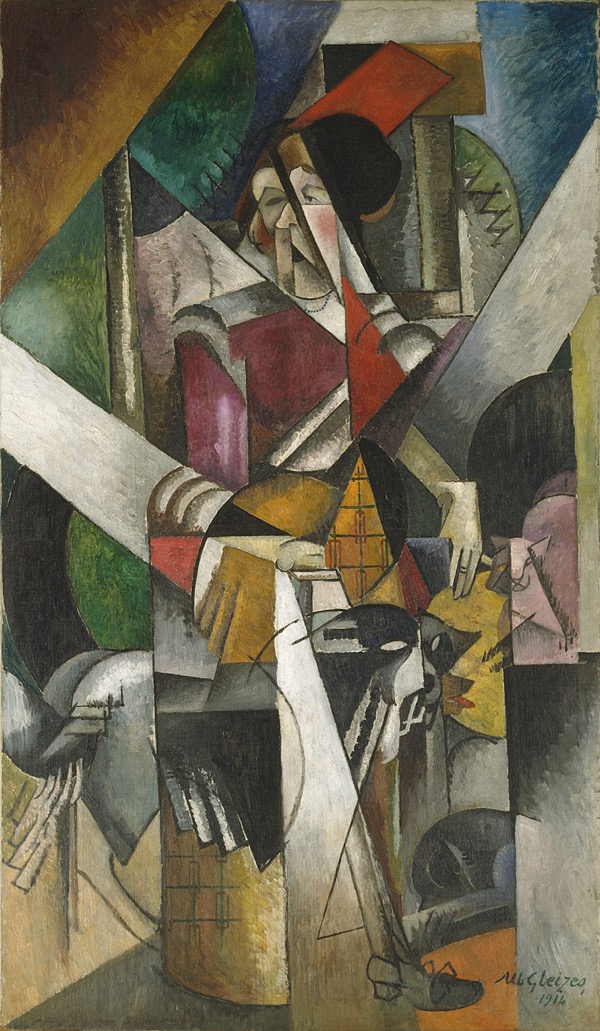
Albert Gleizes: Woman with Animals (Madame Raymond Duchamp-Villon), 1915 (Guggenheim Museum)
Schimmel’s music looks beyond the placid presentation of a seated woman and instead focuses on the animals. They’re never still, yet they provide solid comfort to their owner. The piece ends at a quiet, still point.
Carl Schimmel: String Quartet No. 2, “Six Faces”: III. Woman with Animals (The Left Coast Ensemble)
The Intermezzo gives us a pause in our picture viewing.
Carl Schimmel: String Quartet No. 2, “Six Faces”: Intermezzo (The Left Coast Ensemble)
Juan Gris based his painting of Woman with Mandolin on an earlier painting by Corot. She wears an Italian peasant costume and idly plays with the instrument’s strings.
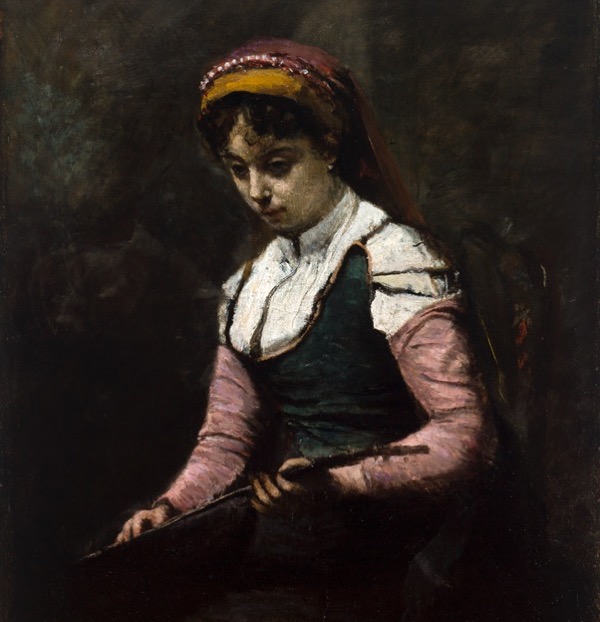
Camille Corot: Girl with a Mandolin, 1860–1865 (St. Louis Art Museum)
In his Cubist take on the picture, the viewing angle has shifted and things that were invisible before, such as the face of the instrument and its strings, are now visible. She still wears the same clothes, but they are now rendered in a Cubist style, with the pink sleeves lightened in colour. Her left hand, holding the instrument’s neck, has changed from small and delicate to square and blocky. The shadows in her face are emphasised. The model is thought to be Josette Herpin, Gris’ partner. Reimagining a painting from 50 years earlier in the most contemporary style is striking for both its novelty and its tradition.
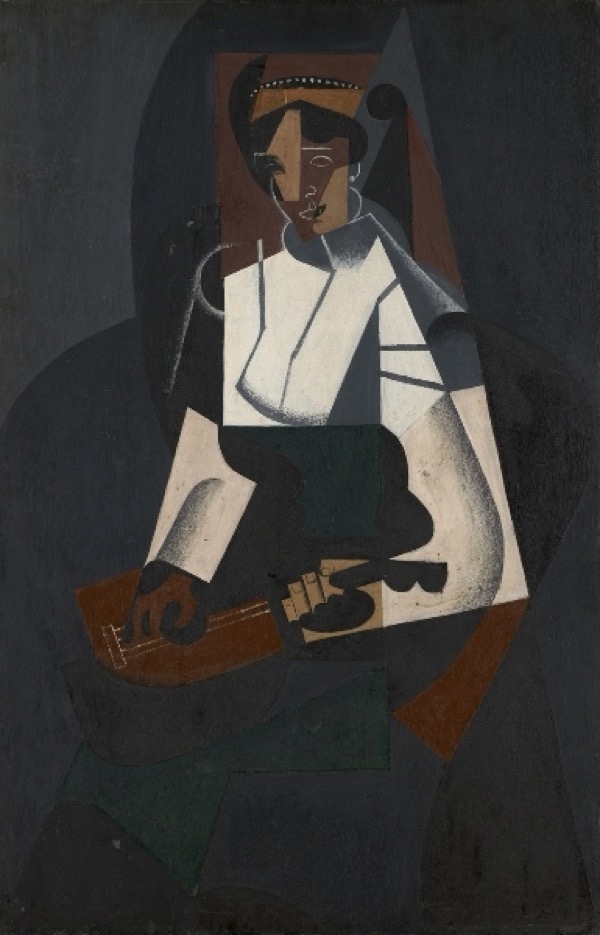
Juan Gris: Woman with Mandolin, after Corot, 1915 (Basel: Kunstmuseum)
The mandolin’s vibrato seems echoed in the music, with jumping pizzicatos picking up on the model’s plucking of the instrument in her lap. There’s no melody to speak of, since the model can’t really play the mandolin.
Carl Schimmel: String Quartet No. 2, “Six Faces”: IV. Woman with Mandolin (The Left Coast Ensemble)
The Interlude brings us to our last women in the series.
Carl Schimmel: String Quartet No. 2, “Six Faces”: Interlude (The Left Coast Ensemble)
Jean Metzinger’s Woman with a Fan is clearly set outdoors, shown in a blue spotted dress with a red belt. Her hat has an extravagant feather. Green elements appear in the window shutters, the chair, and the background. In her left hand, she clutches a paper – a menu? A newspaper? In her right hand is her fan, held closed but ready to use at a moment’s notice.
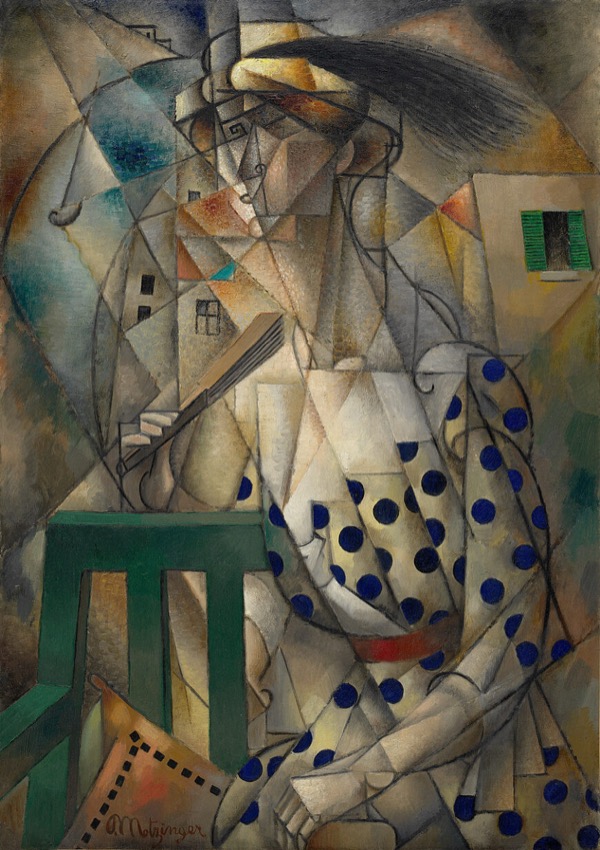
Jean Metzinger: Woman with a Fan (Femme à l’éventail), 1912 (New York: Solomon R. Guggenheim Museum)
In Schimmel’s music, we sense the woman’s impatience. Her fingers slide over the fan, indecisive about whether to open it or to hold it closed.
Carl Schimmel: String Quartet No. 2, “Six Faces”: V. Woman with Fan (The Left Coast Ensemble)
We close with Fernand Léger’s Man With A Cane, from 1920. After returning from WWI, Léger wanted to step away from pure abstraction. He wanted to return to the world of objects. At the same time, this painting reflects the post-war fascination with mechanical objects. Part man (you can see his green face) and part machine, the Man With a Cane is our first work with a bright colour scheme. Colours chase through the picture, with a bright blue in the centre, framed by red elements, with yellow and orange cutting through at an angle. Green serves as a highlight, and the top and bottom edges are largely black and white. It’s been described as a ‘syncopated environment, the embodiment of Jazz Age urbanity’.
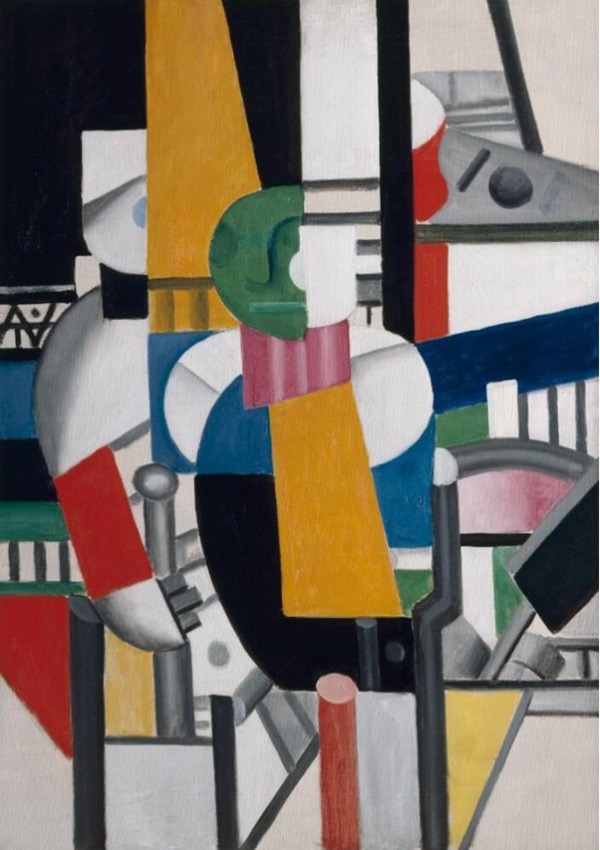
Fernand Léger: Man with a Cane, 1920 (Houston: Museum of Fine Arts)
Picking up on the mechanistic elements, Schimmel gives us a portrait that’s active and moving. We move from a wagging dog tail to playing with a fan to an entire world in motion. Syncopation plays a role in the rhythm, and the music builds to a climax that resolves in the brief Epilogue.
Carl Schimmel: String Quartet No. 2, “Six Faces”: VI. Man with Cane (The Left Coast Ensemble)
Carl Schimmel: String Quartet No. 2, “Six Faces”: Epilogue (The Left Coast Ensemble)
Together, the six paintings take us through the history of Cubism. From Braque’s 1911 portrait, all in subdued greys and ochres, through Picasso’s addition of textures and architectural details to Léger’s colourful new world, we see the many faces of an artistic style that still makes us think. The flattening of the image plane and our ability to see many dimensions at once changes our relationship with the world. Even in Gris’ new take on Corot’s image from a half-century earlier, we can see how much we gain with our new perspective. We’re no longer held to the outside of the image but can see for ourselves what the girl/woman is playing.
We can hear the implied actions in the paintings in the music and use that to enter the painters’ world as well. Each painting has elements the composer could illustrate in the music, sometimes subtly, as in the use of Liszt’s ‘cross motive’, or more directly, as in the final image, where the man with the cane is clearly placed in a mechano-technical new world.
The composer noted that the title, Six Faces, could also refer to the six sides of a die – each character has their own colour scheme in art and in music, and the method of choosing something by tossing a die could be a reference to John Cage’s experiments in random choice through Aleatoric Music.
From muted colours to bright spots on a dress to the syncopated bright colours of Léger’s world, we enter a new style and exit into an even newer one.
For more of the best in classical music, sign up for our E-Newsletter