In this interview, I swap seats with another artist and ask the questions I wish I’d been asked. Today, I meet Australian musician and pianist Zubin Kanga following his October performance at Southbank Centre in London.
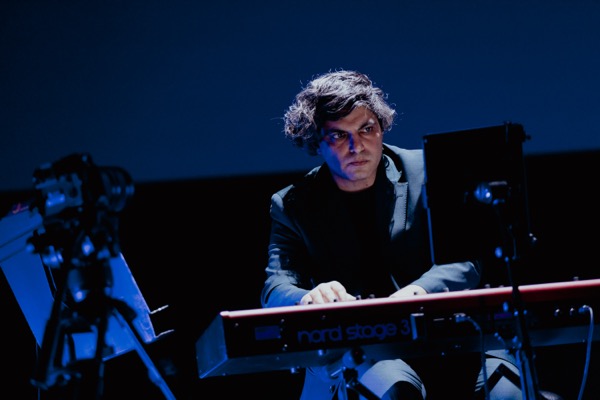
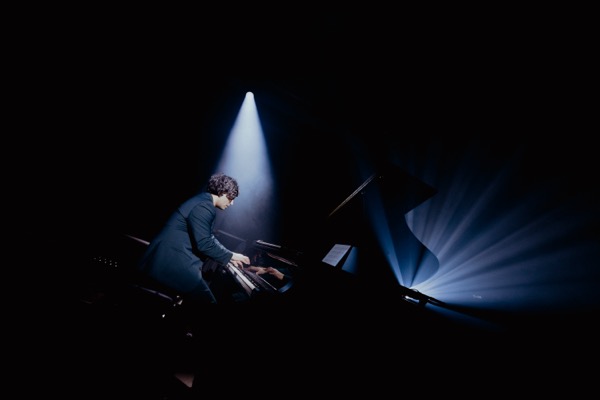
Zubin Kanga at the Southbank Centre, October 2026 © Robin Clewley
Zubin, before we dig in, tell us a little bit about yourself and your most recent career updates.
I am a pianist, composer and technologist, and director of Cyborg Soloists, a music technology research project exploring digital instruments, audio-visual interactions, body sensors (including brain sensors) and AI. I have premiered over a hundred and seventy works, most of them newly commissioned, and performed in sixteen countries. Recent collaborations include Answer Machine Tape, 1987 by Philip Venables, which uses an experimental KeyScanner device to turn the piano into a hybrid audio-visual instrument capable of typing text onto a screen; Steady State by Alexander Schubert, which uses EEG brain sensors to control music and holographic visuals; and TECHNO-UTOPIA, a concerto by Robert Laidlow for AI-integrated digital instruments, piano, keyboards and orchestra.
You had a back-to-back evening performance at Southbank on October 17, 2026. Run us through both parts: Ghost in the Machine and After Dark: Club Cyborg. Also tell us about the programme for the evening, which is almost exclusively composed of premieres.
I wanted to feature some of the most exciting younger British composers alongside a range of new technologies. All the works were commissioned through Cyborg Soloists and explore subjects ranging from video games and avatars to sapient robots and turning everyday household sounds into keyboard samples.
The centrepiece of Ghost in the Machine is the premiere of Blombos Playground, a major new work by legendary American composer George Lewis, a pioneer of human-computer interaction and AI in music. Lewis has spent 45 years exploring autonomous AI improvisation. In this work, I perform alongside two AI improvisers that listen to me and each other, each with a distinct personality. The first, Voyager, is Lewis’s iconic rule-based system, developed in 1987. It listens and responds to a live performer, behaving like an accomplished improviser that can accompany or take the lead. The second, Somax2, was developed at the French music institute IRCAM. It uses machine learning and cognitive modelling to create an improvisational model from recordings. I sent IRCAM my own improvisations, which the team used to create an improvising doppelgänger. The work is extraordinary to perform, like playing with a virtual chamber group or jazz ensemble. It also raises fascinating questions about musical creativity, personality and empathy.
For After Dark: Club Cyborg, the late concert, I will transform the Queen Elizabeth Hall foyer into a nightclub. The programme features two works by Alex Groves, with whom I have collaborated for several years. His earlier work for me, DANCE SUITE, combined Baroque forms with nightclub sounds and was performed at the 2025 New Music Biennial. He has now expanded it into the concert-length PARTITA, exploring the characteristic dances of a Baroque suite, including the Allemande, Courante, Sarabande and Chaconne. The result is a darker, more formally complex tapestry of interlocking rhythms that works as both dance music and a richly detailed listening experience.
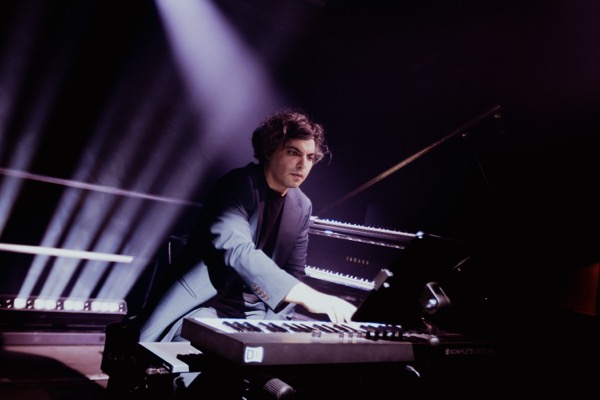
Zubin Kanga at the Southbank Centre, October 2026 © Robin Clewley
AI seems to scare creativity — and artists. You, by contrast, seem to have embraced it. Tell us a little more about your relationship with technology, and where did it all start?
I share many artists’ concerns about AI. The music industry has undergone several paradigm-shifting technological changes over the past century, creating opportunities for some musicians while causing serious problems for others. AI is particularly disruptive and could have significant consequences for the industry. I am especially concerned about systems trained unethically by scraping the internet and generating music without requiring human creativity. Anyone working with AI must consider the ethics of its use. However, there are many different types of AI, and every musician will draw their own ethical boundaries. I am interested in AI as a creative tool: autonomous AI performers, systems for exploring archives, virtual instruments, and technology integrated into instruments and sensors to make performance more ergonomic and accessible. These are very different applications, despite being grouped under the same umbrella, and I choose not to use many types of AI. My relationship with technology began with experimenting on the piano, exploring the limits of virtuosity through preparations and extended techniques. About 14 years ago, I started exploring technology on stage and realised the possibilities for expanding what a solo performer can do were virtually limitless. Whether working with synthesisers and video or more experimental technologies such as hybrid instruments and biosensors, I love creating expanded sonic, visual and theatrical experiences. Collaborating with composers continually surprises and inspires me with new approaches to music technology.
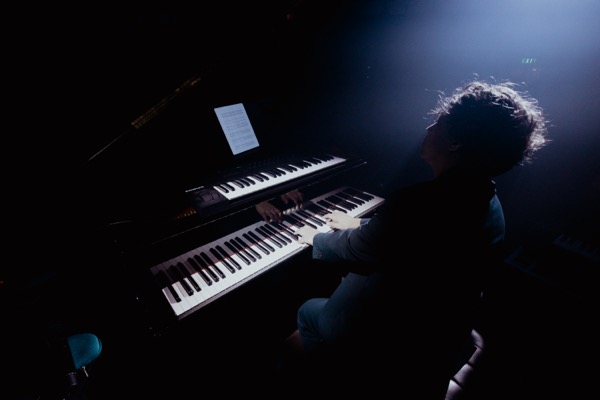
Zubin Kanga at the Southbank Centre, October 2026 © Robin Clewley
How do you feel our relationship with innovation has changed, and what seem to be the limits of technological progress for artists, and particularly musicians?
Over the past twenty years, digital music-making has become far more accessible. This is not simply because laptops are more powerful, but because technologies once restricted to research institutions and people with advanced programming skills are now commercially available, often with intuitive interfaces. Many cutting-edge software tools are free to download, and the wealth of knowledge online enables musicians to develop sophisticated technical skills independently. I do not see a fundamental limit beyond musicians’ imaginations. The real barriers are often limited opportunities for musicians and researchers to collaborate, along with funding constraints. Researchers and start-ups developing technologies that have yet to become mainstream face financial pressures, while musicians often cannot afford the digital instruments and software they want to explore.
Tell us more about your research project, Cyborg Soloists, started in 2021, and what you hope to achieve with it.
Cyborg Soloists is a UK Research and Innovation-funded fellowship exploring how live musicians can use cutting-edge technologies on stage, including new and hybrid instruments, audio-visual interactions such as holograms, body sensors including brain sensors, and AI. More than 120 musicians and other artists have participated, enabling me to commission over 70 works and give composers access to the project’s technologies and expertise. Working with an international network of researchers and twenty-six industry partners, we have developed new approaches to these tools. The project has also delivered dozens of international performances, thirty publications, software downloads, public symposia and workshops, alongside technological innovations ranging from brain sensors used as instruments to AI-integrated tools for navigating musical archives and hybrid audio-visual piano controllers.
What are some of the most exciting projects ahead for you?
I am premiering new works by composers including Dai Fujikura, Nicole Lizée, Jasmin Kent Rodgman and Mathis Saunier, all four at Kings Place in February. Other major projects in development include an expanded, concert-length version of Alexander Schubert’s Steady State, which uses brain sensors to control music and large holographic images. Robert Laidlow is writing a new concerto for Birmingham Contemporary Music Group and me, using an AI-integrated instrument to explore the ensemble’s archive and celebrate its 40-year history. Walter Sallinen is also creating a new work that uses a Disklavier to transform my voice into piano sounds, refracted through the music I play as I speak. All these projects use technology to explore new musical approaches and interdisciplinary performance.
Thanks very much, Zubin. A last one for the road — one book, one album, one film: tell us about your latest cultural findings?
A book I recommend is Pink Noises by Tara Rodgers, a collection of interviews with women working across electronic music, from composers to DJs and performance artists. It includes excellent conversations with pioneers such as Annea Lockwood, Pauline Oliveros and Éliane Radigue.
For an album, I have been exploring the work of composer, keyboardist and producer Ryuichi Sakamoto (1952–2023). I recently discovered 12 Conversations, a posthumous release featuring Sakamoto and Alva Noto, the pseudonym of German electronic musician Carsten Nicolai. After collaborating for twenty years, Nicolai takes piano and synthesiser tracks from Sakamoto’s final album, 12, and expands them through electronic transformations, continuing an approach they developed together on stage over several decades. It is an intimate, moving tribute from one musician to his longtime collaborator. Film is my main obsession outside music, so I will mention two. Among recent releases, Kane Parsons’s Backrooms is particularly striking, creating an endless maze of office-like spaces that captures the geography of nightmares.
Among older films, I recently watched Derek Jarman’s Wittgenstein, filmed in a black-box studio with minimal sets, somewhere between a play and an illustrated lecture. It recounts the life of philosopher Ludwig Wittgenstein while exploring his ideas in a remarkably engaging and lucid way, using unusual devices, including an alien playing the glockenspiel. It also captures the complexity of his life, from coming to terms with his homosexuality to his relationships with those closest to him, including the flamboyant economist John Maynard Keynes. It is an excellent introduction to both Jarman and Wittgenstein.
Zubin Kanga | Live at Classical:NEXT 2022
Drawing on Zubin’s vision, music emerges as a space where technology becomes an extension of human creativity; a meeting point between performer and machine where improvisation, experimentation and imagination challenge the boundaries of musical expression, opening up new possibilities for what it means to create and perform in an increasingly technological world.
For more of the best in classical music, sign up for our E-Newsletter