Today, marrying a cousin is unusual, but throughout history it was hardly unheard of, especially in close-knit families where relatives often lived near one another. The musical world was especially interconnected, and several composers found love within their own extended families.
For Johann Sebastian Bach, Edvard Grieg, and Sergei Rachmaninoff, family connections ultimately led to marriages with cousins, with very different circumstances and consequences.
Other composers found themselves drawn to the sisters of women they’d already fallen in love with – and marrying them.
Here are some fascinating stories of composers whose wives were already part of their family or social circles.
Composers Who Married Their Cousin
Johann Sebastian Bach and Maria Barbara Bach, 1707
Bach’s Cantata “Aus der Tiefen rufe ich…” BWV 131, 1707–1708
We don’t know when Johann Sebastian Bach met his first wife, Maria Barbara. However, they were second cousins, sharing the same great-grandfather, and the extended Bach family was closely knit, so they likely met through family.
The couple married in 1707, when both Johann and Maria Barbara were 22. They had seven children together, including the composers Wilhelm Friedemann Bach and Carl Philipp Emanuel Bach.
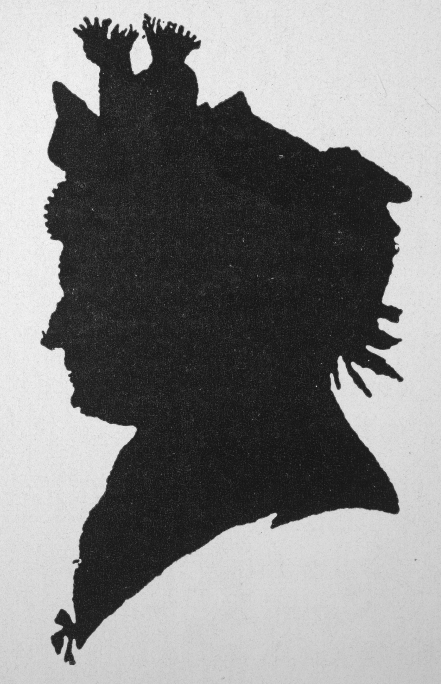
A silhouette of Maria Barbara Bach
Their marriage ended tragically. In the summer of 1720, Johann went on a business trip, accompanying his employer, Prince Leopold of Anhalt-Köthen, to the Karlsbad spa. When he returned, Maria Barbara was dead and had already been buried. We don’t know what she died of.
We looked at what happened to all of Bach’s children with Maria Barbara: https://interlude.hk/what-happened-to-bachs-twenty-children/.
Edvard Grieg and Nina Hagerup, 1867
Grieg’s “Arietta” from Lyric Pieces, Op. 12, 1867
Edvard Grieg and Nina Hagerup’s mothers were sisters, so Edvard and Nina met each other young in their hometown of Bergen, Norway. In 1853, when Nina was eight years old, her family moved to Copenhagen, separating the two children.
A decade later, Edvard also moved to Copenhagen to study music. There, he began meeting Nina, who by then had become a talented soprano.
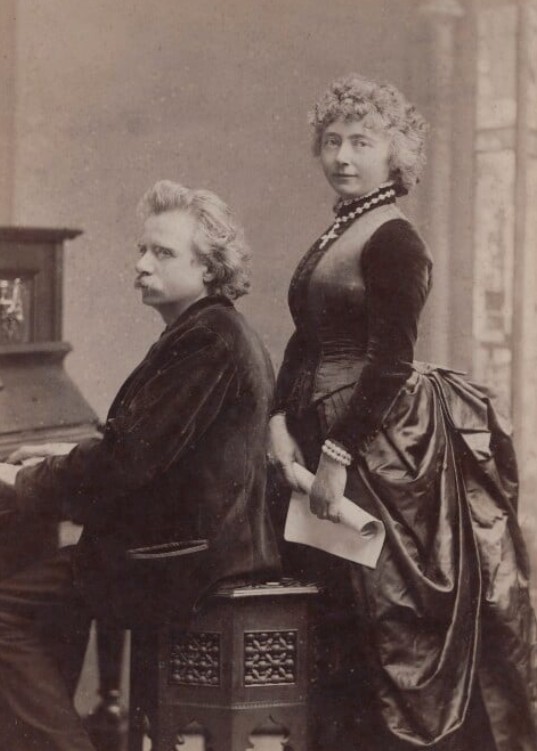
Edvard Grieg and Nina Hagerup Grieg
The two fell in love, and in late 1864, Edvard proposed. Their engagement lasted for nearly three years, and neither side of their family was happy about the match, as Grieg’s economic prospects were considered uncertain.
Still, they married anyway in 1867, and despite their rough patches, they became partners in both life and music until his death.
Sergei Rachmaninoff and Natalya Satina, 1902
Rachmaninoff’s “Night is Mournful” from 15 Romances, Op. 26, No. 12, 1902
Rachmaninoff was a musically precocious child. In 1885, when he was twelve, he moved in with his piano teacher, as was custom for serious students at the time.
However, four years later, after Rachmaninoff asked for more access to a piano to practice and compose and his teacher turned him down, he began looking for new lodgings.
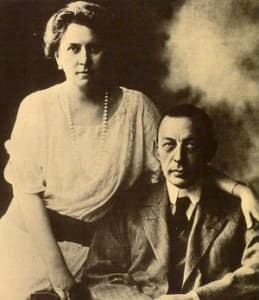
Sergei Rachmaninoff and Natalia Satina
He decided to move in with the Satin family, his paternal aunt’s family. He became part of the household, even travelling with them to their private country estate in the summer of 1890. During that time, he became close to their daughter Natalya, who was also a pianist. He would eventually fall in love with her.
Rachmaninoff’s musical career kicked off in earnest during the 1890s, leading him to consider starting a family; in 1899, he and Natalya became engaged. It was a problematic match, as the Orthodox Church forbade cousins from marrying, and a dispensation from the Tsar was necessary.
Finally, in April 1902, after a three-year engagement, Rachmaninoff and Natalya decided to marry in a military barracks, because the priests there answered to military officials rather than the Church itself.
We wrote about how the Rachmaninoffs met – and pulled off their daring wedding – here: https://interlude.hk/marriage-cousinssergey-rachmaninoff-natalya-satina/.
Composers Who Married Their Love Interest’s Sister
Wolfgang Amadeus Mozart and Constanze Weber, 1782
Mozart’s Great Mass in C minor, K. 427, 1782
In 1777, 21-year-old Mozart left his hometown of Salzburg to look for work. He stopped in Mannheim and met the musical Weber family, whose four daughters were talented musicians.
Mozart eventually fell in love with one of them – the 17-year-old soprano Aloysia Weber – but she was uninterested in him.
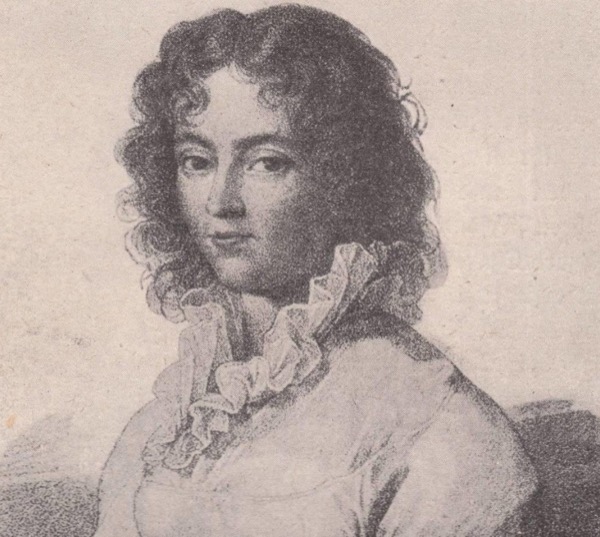
Constanze Mozart
His path crossed with the Webers again in 1781. In the intervening years, the family had moved to Vienna for Aloysia’s singing career. Their patriarch had died, so to support themselves, they took in roomers – including Mozart.
While there, his affections transferred to Aloysia’s sister Constanze. Wolfgang and Constanze fell in love and married in August 1782. Despite the initial disapproval of their families, they enjoyed a happy marriage until his death.
We look at Mozart’s relationship with Webers in more depth here: https://interlude.hk/how-the-weber-sisters-became-mozarts-wife-family-and-muses/.
Joseph Haydn and Maria Anna Keller, 1760
Haydn’s Symphony No. 2, c. 1760
As a young man, Joseph Haydn was hired to teach music to the family of Johann Keller, a wealthy Viennese wigmaker.
Haydn fell in love with one of Johann’s daughters, Theresia Keller. However, their romantic connection was immediately threatened by Joseph and Theresia’s difference in wealth (Haydn had not yet secured his position as a court composer), as well as her parents’ fierce Catholicism; they wanted Theresia to become a nun.
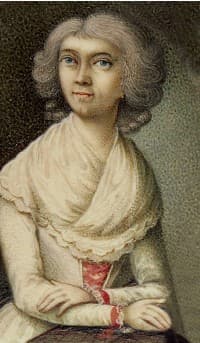
Maria Anna Keller
Obeying their wishes, Theresia entered a convent in 1755 and took her vows the following year. Haydn wrote an Organ Concerto in C major for the ceremony of her profession as Sister Josepha.
Five years later, after Haydn secured his first position and looked for a wife, he returned to the Kellers. Although he didn’t love her, he married Theresia’s older sister Maria Anna.
They discovered quickly that they were a bad match. Joseph famously wrote with scorn, “She doesn’t care a straw whether her husband is an artist or a cobbler.” In addition, Maria Anna was apparently unable to bear children, which Haydn held against her.
The Haydns never reconciled, and they lived apart until Maria Anna died in 1800.
We told the sad and bitter story of Haydn’s marriage here: https://interlude.hk/maria-anna-haydn-the-real-story-of-haydns-hated-wife/.
Antonín Dvořák and Anna Čermáková, 1873
Dvořák’s Symphony No. 3, 1873
In the 1860s, up-and-coming musician Antonín Dvořák was struggling to pay his bills. He began giving piano lessons, and two of his students were two sisters from the Čermáková family: Josefína (born in 1849) and Anna (born in 1854).
Josefína became an actress and joined the Prague Provisional Theatre in 1862. Dvořák was in the orchestra and fell in love with her. However, she was uninterested in him and wanted to focus on her career (she eventually married Count Václav Robert of Kounice in 1877).
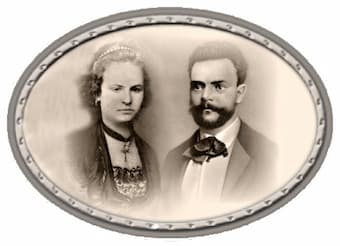
Anna Cermakova and Dvořák
Instead, Dvořák began dating her younger sister Anna, and he married her in November 1873.
Unlike Haydn’s, this marriage was warm. Anna turned into a force behind Dvořák’s career, pushing him to work in America for the money – without which we wouldn’t have masterpieces like the New World Symphony or the “American” string quartet.
Dvořák, Anna, and Josefina remained close (in fact, Dvořák was the best man at her wedding). When Josefina was dying of heart trouble in the 1890s, he wrote a tribute to her in his cello concerto, quoting one of her favourite songs of his. It was a love song not only to her but to the entire close-knit family.
We told the story of the Dvořáks’ marriage here: https://interlude.hk/what-happened-to-antonin-dvoraks-children-their-tragic-stories/.
Conclusion
These stories reveal how interconnected musicians’ personal and professional worlds could be. In several cases, family connections led composers to find their lifelong partners and, often, important musical collaborators and supporters.
The stories of the composers who married their love interests’ sisters are more varied, between Mozart and Dvořák’s happiness and Haydn’s unhappiness.
Their stories show that sometimes in classical music history, love emerged from the closest possible circles – and also that being part of the same family wasn’t necessarily a guarantee of a happy marriage.
For more of the best in classical music, sign up for our E-Newsletter