Franz Joseph Haydn: Symphony No. 45 in F-sharp minor, Hob.I:45, “Farewell”: IV. Finale: Presto – Adagio (Austro-Hungarian Haydn Orchestra; Adam Fischer, cond.)
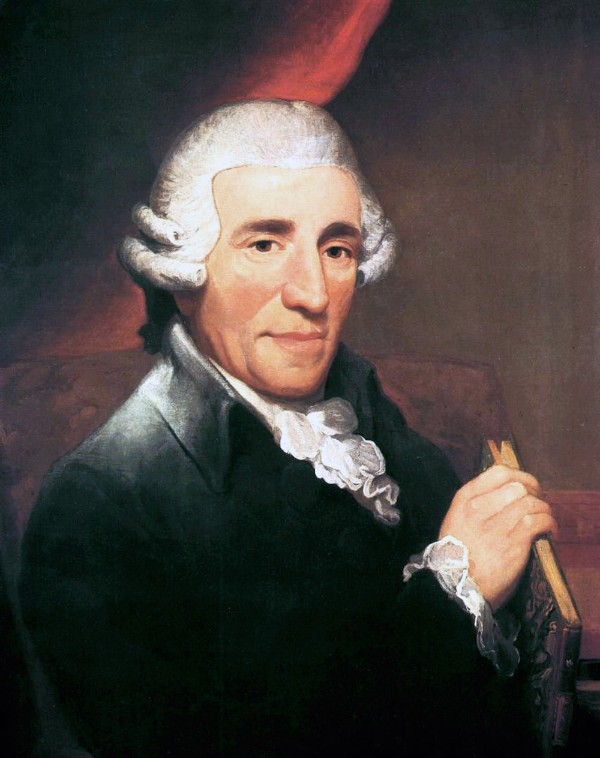
Joseph Haydn
We open our scene in 1766. Haydn‘s fame as a composer is growing; the Wiener Diarium of that year names him “the darling of our nation” and includes him in a list of the most talented musicians in Vienna – a kind of Forbes 30 under 30 for classical musicians in 18th-century Europe. In the spring, Haydn’s patron Nikolaus I, Prince of Esterházy, sees fit to move the court and its entire musical contingent from Eisenstadt to his summer palace, Esterházy, a castle in the French Renaissance style second in grandeur only to Versailles. This summer palace was over a day’s travel from the Prince’s primary residence – remember this, as it will be important later…
This pastoral paradise was equipped for all courtly delight and entertainment that could be desired, with “groves and grottoes, hermitages and temples, summer-houses and hot-houses… deer parks and flower gardens… [and] two theatres in the grounds,” according to Haydn biographer James Cuthbert Hadden. Prince Nikolaus was enamoured of his summer palace and the endless entertainment he found there, and found little reason to journey to Eisenstadt or Vienna. Indeed, on trips to Vienna, the mercurial Prince would often get suddenly homesick and demand the entire troupe return at short notice to his beloved summer home, to the consternation and confusion of Haydn and the court musicians.
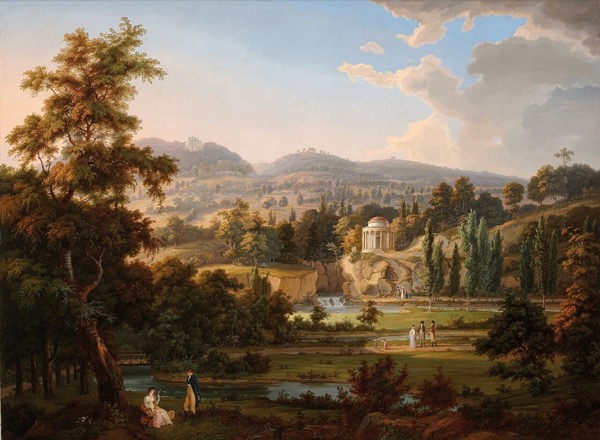
A painting of the rear view from the castle made in 1807 by Albert Christoph Dies, including the outbuilding Leopoldinentempel. Photo credit: Wikipedia Creative Commons
Quite apart from added complications contributed by the Prince, Haydn’s position as head of court music required not just compositional talent but a great sense of organisation, leadership, and tact, as he governed a large assortment of musicians, from Italian singers on annual contracts, to touring virtuosi, and numerous visiting strolling companies and troupes. Haydn indeed possessed the qualities of a good steward and was beloved as a father-figure by his employees, earning him the nickname “Papa Haydn.” In one of those rare situations in life where everyone experiences mutual benefit, Haydn was able to balance the needs of his workers and those of his patron very well. Prince Nikolaus treated Haydn with ample respect and regularly raised his salary and bestowed other benefits upon him.
With the Prince’s preferences and character, the lavish nature of the summer palace, and Haydn’s duties as master of court music outlined, we may proceed to our main story: that of Haydn’s Symphony No. 45, “Farewell” in F-sharp minor. Haydn himself, in his old age, told this story to his biographers, Albert Christoph Dies and Georg August Griesinger.
In 1772, the Capelle, or courtly musical retinue, had been held at Esterházy longer than anticipated, many of them leaving behind wives and families in Eisenstadt or further afield. The musicians were ill-contented and wished for the Prince to finally terminate that particular summer sojourn, as they were contractually obligated to be wherever he was. Haydn, faced with a conflict of interest between patron and employees, decided to handle it in the way he deemed least likely to cause offence, and most likely to secure a return to Eisenstadt: with sensitivity, musicality, and of course, humour.
The “Farewell” Symphony unfolds in quite typical Haydn fashion until the fourth movement. In the Adagio, in sonata form, we reach the end of the recapitulation, and all is poised to end with a bang, when suddenly, a cadence siphons us off into an extended coda-like section (a very unusual happening in this context). In this long coda, each musician leaves one by one – some with little soloistic departures, all with the symbolic gesture of snuffing out their candle – until only Haydn himself and his concertmaster, Luigi Tomasini, remained to sustain the music, pianissimo. The message was clear: “there is no more music to be extracted from us poor musicians – let us go.” The Prince was sharp enough to catch the meaning, and good-natured enough to have supposedly muttered under his breath, “If all goes, we may as well go too.” The musicians were allowed home to their families the very next day.
Haydn Symphony No. 45 | Il Giardino Armonico | Giovanni Antonini
This work occupies a strange position in the canon as a result of this story. It’s an amusing and very tellable anecdote, but not as widely known as other legends and fables about beloved pieces or figures. As such, the work is often performed, listened to, and analysed, with no knowledge of the story whatsoever (though the gradual thinning of the orchestral sound may elicit a remark). However, some ensembles, such as the Charlotte Symphony Orchestra and New Century Chamber Orchestra, have “staged” the protest walk-out element, with varying degrees of theatricality and slapstick. In the NCCO’s performance at the San Francisco Conservatory of Music, a bassoonist threw his soft case on the floor and stamped on it as he left, to great laughter from the audience.
Music is a powerful tool of protest, and when we think of “protest music”, we tend to think of iconic songs from the 1960s onwards, not classical symphonies. And yet, centuries ago, Haydn was artfully standing up for the wellbeing of his musicians by means of a clever coda.
For more of the best in classical music, sign up for our E-Newsletter