If you have ever wondered what O Magnum Mysterium is from, the answer goes back to medieval Christmas worship. It is a responsorial chant from the Matins of Christmas in the Roman Breviary. Interestingly, the text itself is not from the Bible. Scholars trace its church use to the 11th-century reforms of Pope Gregory VII.
Latin text
O magnum mysterium,
et admirabile sacramentum,
ut animalia viderent Dominum natum,
iacentem in praesepio!
O beata virgo, cuius viscera
meruerunt portare
Dominum Christum.
Alleluia!
English translation
O great mystery,
and wonderful sacrament,
that animals should see the newborn Lord,
lying in a manger!
O blessed virgin, whose womb
was worthy to bear
the Lord Jesus Christ.
Alleluia!
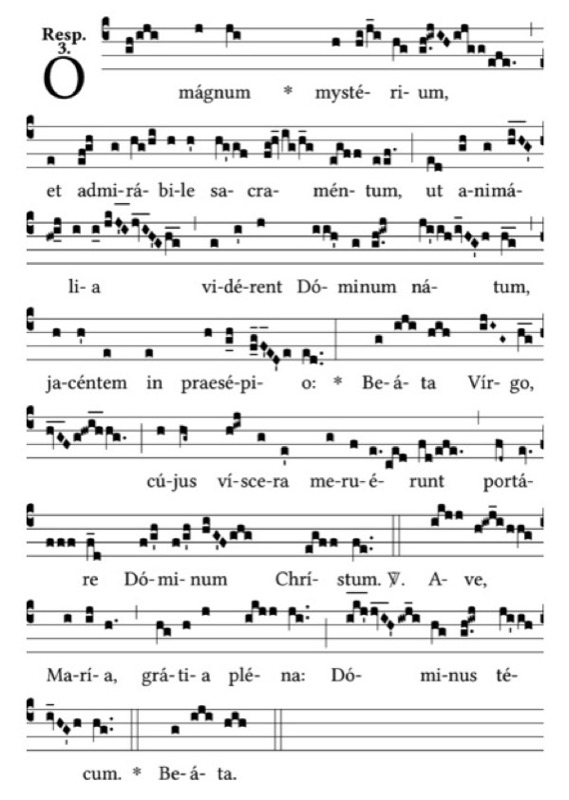
The Gregorian Chant of O magnum mysterium
The Latin poem paints a quiet, humble scene. It marvels that lowly animals saw the newborn Lord lying in a manger. While the Book of Luke mentions the manger, it leaves out the beasts. The ox and donkey come from the Book of Isaiah and later apocryphal stories.
The second half shifts focus to Mary. It praises the blessed virgin whose womb was worthy to bear Christ. These words echo Elizabeth’s greeting to Mary during the Visitation. Most choral versions end right there with a joyful “Alleluia.” They usually drop the extra Ave Maria verse found in the original chant.
Since the Middle Ages, this short text has inspired roughly fifty choral works. Renaissance masters turned it into a staple form for the polyphonic motets. Strangely, major 19th-century composers ignored it completely. The text only roared back to life in the 20th century.
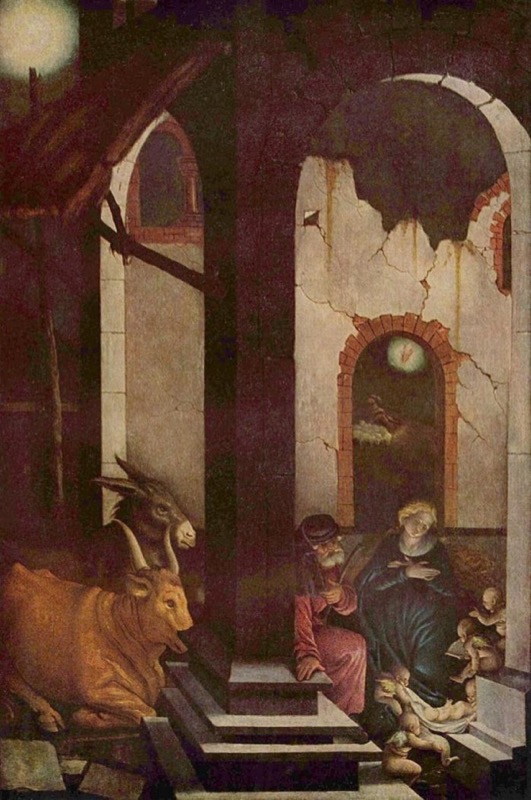
Painting of the Nativity scene, by Hans Baldung (1520)
Here are six essential settings of this Christmas classic, paired with standout recordings.
1. Tomás Luis de Victoria (1572)
No guide to this music is complete without Victoria’s O Magnum Mysterium. Born in Ávila, Tomás Luis de Victoria stands as the top composer of the Spanish Renaissance. He began his training as a boy singer at Ávila Cathedral. In 1565, King Philip II funded his move to Rome for further study. There, Victoria worked as a singer, organist, and teacher, even becoming a priest in 1575. He later returned to Madrid to serve Dowager Empress Maria at a royal convent, staying there until he died in 1611.
His famous 1572 motet opens with calm, weaving vocal lines. That quiet flow stops for a hushed, unified chordal section at the words “O beata Virgo.” Finally, an extended “Alleluia” brings the piece home, shifting smoothly from triple meter into duple time.
Recommended Recording: Gabrieli Consort and Players, conducted by Paul McCreesh
Tomás Luis de Victoria: O magnum mysterium (Gabrieli Consort; Paul McCreesh, cond.)
2. Giovanni Gabrieli (1587)
Giovanni Gabrieli grew up in the rich musical world of Venice. He first studied under his uncle Andrea at St. Mark’s Basilica, then travelled to Munich to learn from Orlande de Lassus. Back in Venice, Giovanni became organist and later principal composer at St. Mark’s. He published his first motet book in 1587, dedicating it warmly to his late uncle. His O magnum mysterium appears in this collection, written for two unequal choirs.
Listeners often ask how does Gabrieli’s o magnum mysterium exemplify expressive extravagance and formal control. Gabrieli splits the voices to create a lush sound that feels close to the manger. Yet he avoids chaos through tight structure, guiding the two choirs into a restrained, joyful “Alleluia.”
Recommended Recording: Les Cornets Noirs (Jubilate Deo, OehmsClassics)
Giovanni Gabrieli: O magnum mysterium a 8 (Munich Orpheus Choir; Les Cornets Noirs; Gerd Guglhör, cond.)
3. William Byrd (1607)
Byrd stands as Britain’s greatest composer before Henry Purcell. A pupil of Thomas Tallis, Byrd mastered sacred and secular styles alike during his long life. He published his Christmas motet, O magnum mysterium, in 1607.
Unlike grander Renaissance settings, Byrd strips away all musical excess. His setting is direct, focused, and deeply personal. The music hangs between quiet awe and intense emotion as the voices weave together. Each vocal part imitates the next, unfolding in gentle waves.
Pay close attention near the end. The tenor line rises and falls with an almost mournful ache before the choir settles into a peaceful, glowing finish.
Recommended Recording: The Cardinall’s Musick, conducted by Andrew Carwood
William Byrd: O magnum mysterium (The Cardinall’s Musick; Andrew Carwood, cond.)
4. Francis Poulenc (1952)
Jumping forward to the twentieth century, French composer Francis Poulenc offered a startlingly fresh take. His 1952 setting is the opening movement of his Quatre motets pour le temps de Noël.
Poulenc uses bare, stark harmonies and unexpected dissonance. The music feels cold, crisp, and filled with genuine shock at the miracle. Yet moments of sudden sweetness break through the chill, especially in the soprano lines.
Recommended Recording: Westminster Cathedral Choir, conducted by James O’Donnell
Francis Poulenc: No. 1. O magnum mysterium (Westminster Cathedral Choir; James O’Donnell, cond.)
5. Morten Lauridsen (1994)
American composer Morten Lauridsen wrote his setting in 1994, inspired partly by Zurbarán’s painting Still Life with Lemons, Oranges and a Rose. He spent six months crafting the piece to serve as a “quiet song of profound inner joy.”
Scored for a cappella mixed choir, the work features expressive, ethereal sounds built on luminous neo-Renaissance harmonies. Lauridsen wanted the music to resonate deeply within the listener, capturing both the mystery of the Incarnation and Mary’s quiet tenderness. A careful listener can even hear a subtle, dissonant chord hinting at the future sorrow of her child. The piece quickly became an international choral classic.
Recommended Recording: Oxford New College Choir, conducted by Edward Higginbottom
Morten Lauridsen: O Magnum Mysterium (Oxford New College Choir; Edward Higginbottom, cond.)
6. Ivo Antognini (2010)
Swiss composer Ivo Antognini trained in classical piano and jazz before turning to choral music in 2006. He wrote O magnum mysterium in 2010 as a Christmas gift for his wife’s small church choir. Since then, this brief, heartfelt piece has been sung in over fifty countries. The score unfolds in three clear sections. First, four voices weave together in a warm major key to announce Christ’s birth. The middle section shifts into a darker, minor mood, adding emotional weight. Finally, a bright “Alleluia” rings out in the Mixolydian mode, before a short coda fades into quiet peace.
Recommended Recording: The Choir of Trinity College Cambridge, conducted by Stephen Layton
Ivo Antognini: O Magnum Mysterium (Cambridge Trinity College Choir; Stephen Layton, cond.)
For more of the best in classical music, sign up for our E-Newsletter
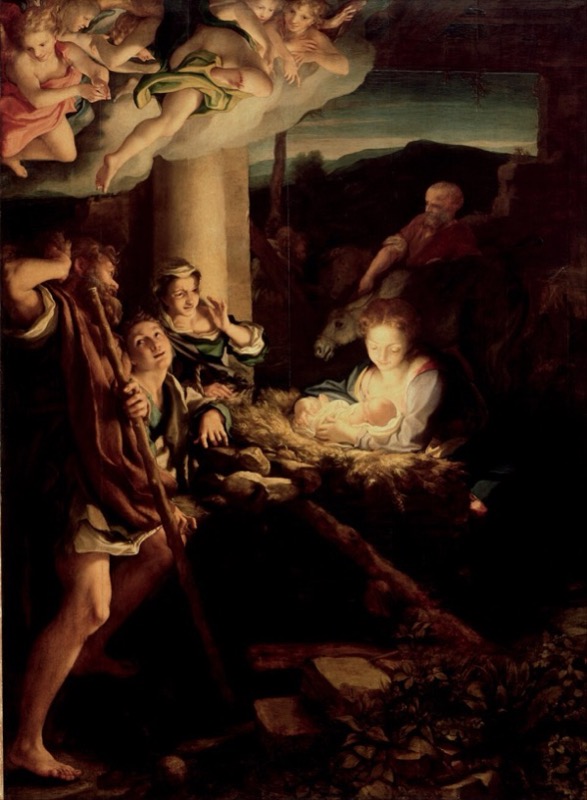
The Nativity 1529–1530 by Antonio da Correggio.