George Frideric Handel (1685–1759), despite his father opposing his study of music, successfully left his law studies at the University of Halle to become an organist at the Calvinist Cathedral in Halle.
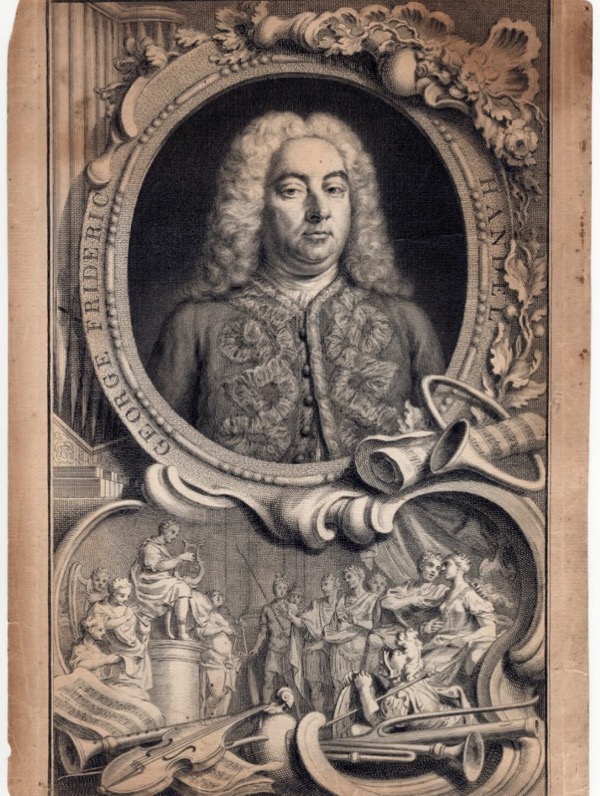
Jacobus Houbraken, by Hubert-François Gravelot: George Frideric Handel, 1738 (London: National Portrait Gallery)
He held that position for a year before moving to Hamburg, where he started as a violinist, then harpsichordist for the Hamburg Opera before becoming a composer for them. He wrote in the Italian operatic style and in 1706, was invited to Italy by the son of the Medici Grand Duke of Tuscany. He remained in Italy, where he was very successful, before being appointed as Kapellmeister to the Elector of Hanover in 1710. Commissioned for an opera in London, he left Hanover for a brief stay, returned, and then, in the autumn of 1712, returned to London. One last trip to Germany in 1716 was his last connection with the country: his life was now in London. It didn’t hurt, of course, that George I, the Elector of Hanover, succeeded to the English throne in 1715.
St Cecilia was a third-century Christian martyr who is celebrated as the patron saint of music and musicians. Her feast day, 22 November, has been celebrated by poets such as John Dryden and Alexander Pope, and by music by Henry Purcell, Marc-Antoine Charpentier, Handel, Britten, Finzi, and others.
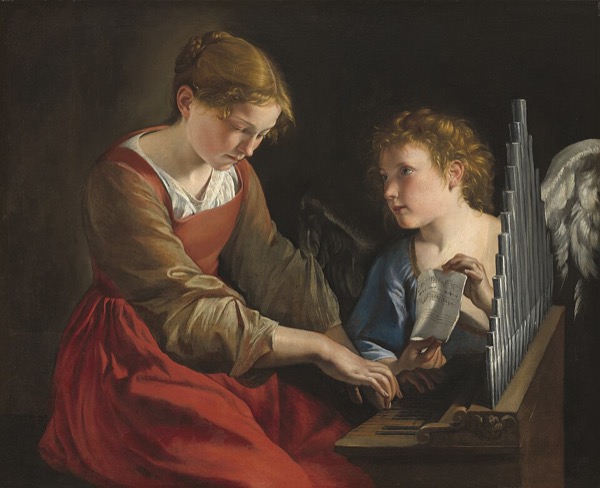
Orazio Gentileschi and Giovanni Lanfranco: Saint Cecilia and an Angel, ca 1617–1618 and ca 1621–1627 (Washington, DC: National Gallery of Art)
English Poet Laureate John Dryden (1631–1700) wrote two odes for the celebration of St Cecilia’s Day. The festival was celebrated in London from 1683 to 1703. Handel set both of them, Dryden’s ode ‘A Song for St Cecilia’s Day’ became the text for Handel’s 1739 work Ode for St Cecilia’s Day and the other ode, Alexander’s Feast, or the Power of Music (1697), had been used earlier by Handel in Alexander’s Feast in 1736.
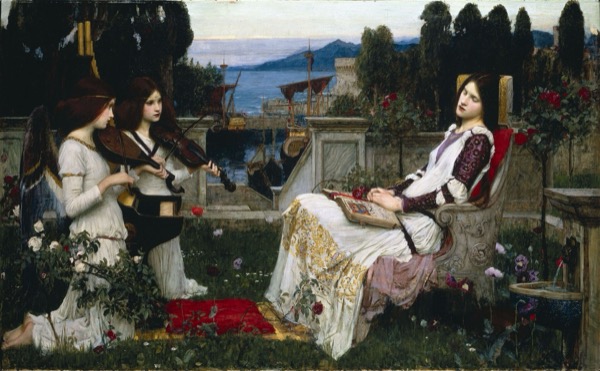
John William Waterhouse, Saint Cecilia, 1895 (private collection)
The Ode for St Cecilia’s Day premiered at the Theatre in Lincoln’s Inn Fields, London, on the saint’s feast day: 22 November 1739. Also on the program that evening were Handel’s other Cecilia ode, Alexander’s Feast, two new concertos for several instruments, and an organ concerto. As the winter was particularly cold (the Thames had already frozen), the audience was assured that the theatre would be warmed ahead of the performance.
The work, like an opera, has recitatives and arias, choruses, and a grand chorus ending. The overture is in three sections: Larghetto e staccato—Allegro—Minuet.
The Overture is in the French style, with the Larghetto filled with dotted rhythms, the Allegro section filled with fugues, and the concluding Minuet that contrasts the strings and woodwinds.
This record was made in October 1956 in London by The London Chamber Singers and London Chamber Orchestra, conducted by Anthony Bernard.
The English conductor Anthony Bernard (1891–1963) made his career as an organist and accompanist, and in 1919, with W. H. Reed (leader of the London Symphony Orchestra) as violinist, gave the premiere of Edward Elgar’s Violin Sonata in E minor. He was well-known to the composers of the day and gave premieres of many of their works.
He founded the London Chamber Orchestra (LCO) in 1921, with the goal of playing both music by the early masters and by contemporary composers, such as Frederick Delius. He made the first complete recording of Bach’s Brandenburg Concertos with the LCO, and the first recording of Delius’ Sea Drift. His recordings were often significant, including Francis Poulenc’s Piano Concerto with the composer as soloist and the Bach Double Violin Concerto with Yehudi Menuhin and Gioconda de Vito. He often accompanied soprano Teresa Stich-Randall (appearing on this recording) in her recitals of Handel, Mozart, and Schubert lieder.
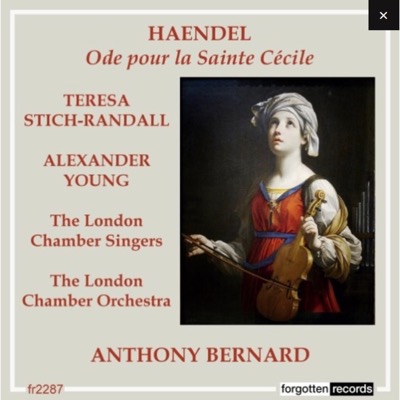
Haendel-Ode for St. Cecilia’s Day
Teresa Stich-Randall, soprano; Alexander Young, tenor; The London Chamber Singers; The London Chamber Orchestra, Anthony Bernard, cond.
Forgotten Records FR2287
Release date: 26 August 2024
Official Website
For more of the best in classical music, sign up for our E-Newsletter