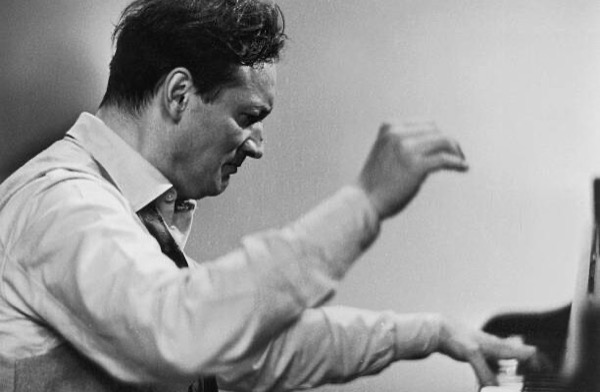
Stanley Sadie, editor of the Grove Dictionary of Music and Musicians, describes César Franck (1822–1890) as “a man of utmost humility, simplicity, reverence and industry.” The composer’s reputation rests largely on a few large-scale instrumental and orchestral works from his later years.
However, most of his compositions are associated with his work as an organist at Saint-Clotilde Basilica in Paris, a position he held for over 30 years. Naturally, he composed many organ works, but we also find numerous sacred vocal works.
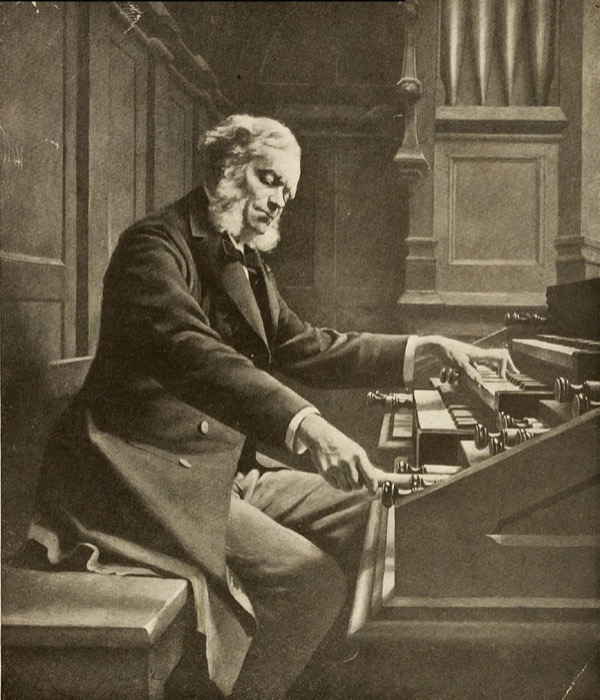
César Franck at the organ
Among his most celebrated compositions is his setting of “Panis Angelicus,” a serene piece that feels like a musical prayer. To commemorate Franck’s death on 8 November, let’s feature one of his most beloved and frequently arranged melodies.
César Franck: “Panis Angelicus”
A Medieval Hymn
“Panis angelicus”, Latin for “Bread of Angels”, is the penultimate stanza of the hymn “Sacris solemniis.” Saint Thomas Aquinas wrote it for the Feast of Corpus Christi as part of a complete liturgy.

Glorification of Saint Thomas Aquinas (Verheerlijking van de Heilige Thomas van Aquino)
Thus Angels’ Bread is made
the Bread of man today:
the Living Bread from heaven
with figures dost away:
O wondrous gift indeed!
the poor and lowly may
upon their Lord and Master feed.Thee, therefore, we implore,
O Godhead, One in Three,
so may Thou visit us
as we now worship Thee;
and lead us on Thy way,
That we at last may see
the light wherein Thou dwellest aye.
Amen.
César Franck: Messe à 3 voix, Op. 12: Panis angelicus (arr. L. Stokowski for orchestra) (BBC Philharmonic Orchestra; Matthias Bamert, cond.)
Baroque Devotion and Romantic Rapture
The prayer’s title refers to the Eucharist, and several Renaissance composers set the text. In the seventeenth century, Marc-Antoine Charpentier composed a setting between 1670 and 1675, but the text proved highly popular in late Romantic settings.
We find settings by André Caplet and Saint-Saëns, but the best-known is César Franck’s. He composed it in 1872 for tenor, harp, cello, and organ, as part of the Mass for Three Voices.
The music perfectly captures a sense of reverence and tranquillity, and the simple melody is surrounded by lush harmonies that give it an almost heavenly quality. Despite its immediate beauty, it has been described as evoking “serene anxiety.”
César Franck: “Panis Angelicus”
Spiritual Peace and Human Longing
An extended instrumental introduction, symphonic in breadth and scope, unfolds a rich tapestry of thematic material. Skillfully intermingling rhetorical and passive elements, the vocal line then unfolds an angelic melody.
Surprising harmonic inflexions and the occasional strain of chromatic intonation enrich the vocal line. As such, the melody’s otherworldly beauty is troubled by subtle harmonic tensions beneath its surface.
Perhaps that is the reason the piece is so compelling. The melody offers complete peace and spiritual reassurance, while the harmony introduces longing and unease. Spiritual consolation, after all, is not effortless bliss, but something we discover amid life’s uncertainties.
César Franck: Messe à 3 voix, Op. 12: Panis angelicus (arr. for chamber ensemble) (various artists)
A Melody Without Boundaries
It took almost 70 years, but during the 1940s and 1950s, “Panis Angelicus” surged to mainstream popularity. Apparently, it became a favourite of the World War II generation, especially at Catholic wedding celebrations.
As with other crossover hits, the piece reached a much wider modern audience through Luciano Pavarotti. He included it in his concert and recording repertoire and teamed up with Sting in 1992 for a fundraising concert in Modena.
More than 150 years after Franck composed “Panis Angelicus,” the piece continues to find new listeners. It is heard in the intimacy of the church, the concert hall, and large street festivals, yet the quiet message of faith and human longing speaks to us directly and individually.
For more of the best in classical music, sign up for our E-Newsletter