Recorded in May 2026 at the Philharmonie de Paris, Klaus Mäkelä takes the Orchestre de Paris on a musical journey through the exceedingly volatile musical environment Anton Webern succinctly described as “The Path to the New Music.”
Gustav Mahler’s first symphonic essay contains a compendium of musical memories that are provocatively, and often jarringly, juxtaposed. The work bridges the rich Austro-Germanic music tradition and the daring experimentation of early 20th-century modernism, as the composer crafted a deeply personal and strikingly diverse musical universe.
Klaus Mäkelä Conducts Mahler’s Symphony No. 1
Available until 24/04/2027
More Than a Gesture
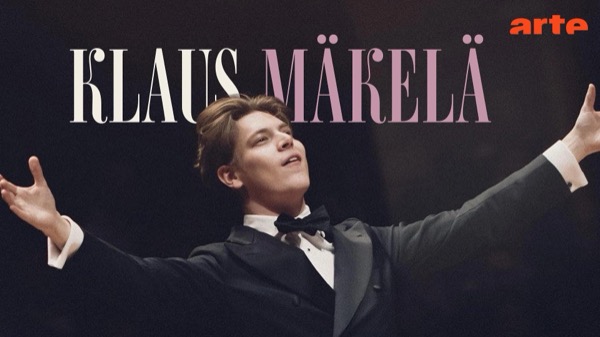
Klaus Mäkelä
Klaus Mäkelä became music director of the Orchestre de Paris in 2021, and his meticulous attention to detail and strong visual presence offer an interesting perspective on his conducting and his interpretations.
His rapid rise and striking podium presence have attracted considerable attention; as such, it is worth distinguishing between visible charisma and musical achievement. As a conductor, he uses his entire body to communicate his musical intentions.
His gestures can become expansive and physically emphatic at moments of high intensity, yet he also uses small movements to shape phrases or elicit instrumental entries. We might well say that his conducting style is highly expressive rather than being merely theatrical.
A Search for Identity

Klaus Mäkelä
Mahler’s First Symphony was premiered at the Hungarian Royal Opera House in Budapest on 20 November 1889. The work was greeted with animosity, indifference, bewilderment and rejection.
Mahler initially conceived this symphony in two parts, encompassing five movements. However, stunned by the severe reaction of the Budapest audience, Mahler quickly retitled his composition Titan: A Tone Poem in Symphonic Form.
Mahler also appended titles to individual movements, and audiences at performances in Hamburg and Weimar in 1893 and 1894, respectively, received a descriptive programme in which Mahler detailed the metaphorical content of each movement.
Beyond the Programme
Programmatic explanations did not alleviate the continued hostile reactions this work received from audiences. After a particularly hostile performance with Mahler conducting, the frustrated composer confided in his wife, Alma Mahler, “Sometimes it sent shivers down my spine. Damn it all, where do people keep their ears and their hearts if they can’t hear that!”
Mahler continued to refine the composition, and for a performance in Berlin in 1896 he suppressed the titles, expunged the programmatic explanations, and omitted the “Blumine” movement.
Newly christened the “Symphony in D Major, for Large Orchestra,” Mahler had at that time conceptually rejected the tone poem in favour of the symphony. Writing to a friend in 1897, he distinguished his compositional approach from Richard Strauss’s.
“You are right in saying that my music generates a programme as a final imaginative elucidation, whereas with Strauss the programme is a set task…” Eventually, Mahler published his first symphonic essay with the Viennese publisher Weinberger in 1899.
Caught Between Two Worlds
The work’s vast emotional depth and evocative power reflect not only the duality of Mahler’s personality, but also the cultural and artistic anxieties of a world in rapid transformation.
Mahler’s music navigates the delicate balance between the idealistic aesthetics of Romanticism, where music transcends social and racial boundaries, and the challenges of an increasingly secular, industrialised, and fragmented modern era.
Between Precision and Passion
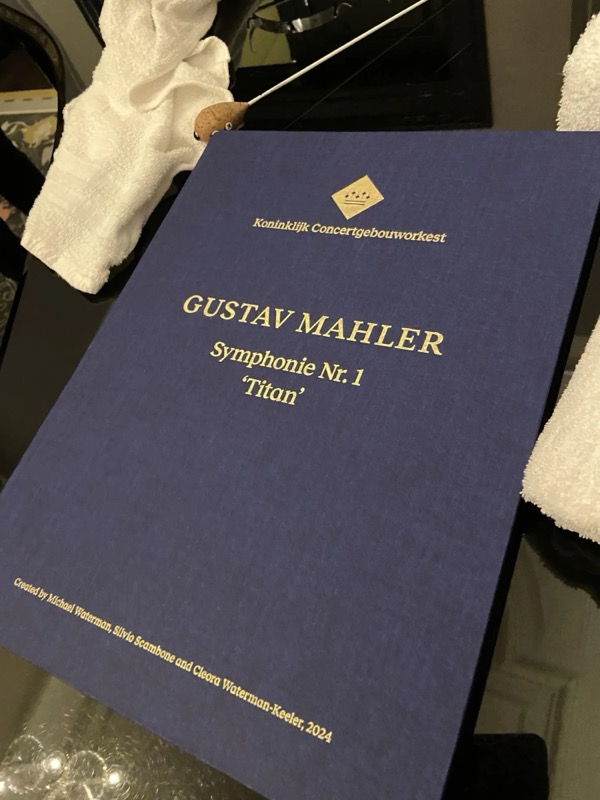
Klaus Mäkelä’s score of Mahler’s Symphony No. 1, “Titan”
Mäkelä’s reading falls somewhere between Georg Solti’s energy and Karajan’s emphatic grandeur. Everything flows organically in the opening movement, as nature awakens against a backdrop of cuckoo calls, and Mäkelä explores this enchanting yet deeply unsettling world.
Under Mäkelä’s guidance, the “Ländler” becomes what it should be: a heavy-footed dance. Yet there is elasticity in the rubato, which allows the music to push into the next measures. The “Funeral March” forgoes the bar lines completely, and the work concludes with a highly optimistic reversal.
Mäkelä finds a balance between orchestral discipline and expressive freedom, and the Orchestre de Paris plays with considerable precision and energy. Mahler’s contradictions, from innocence and irony to humour and despair, unfold with a clear sense of the larger musical picture. Yet, Mäkelä’s instinct for control seems to stifle some of the rawer impulses.
For more of the best in classical music, sign up for our E-Newsletter