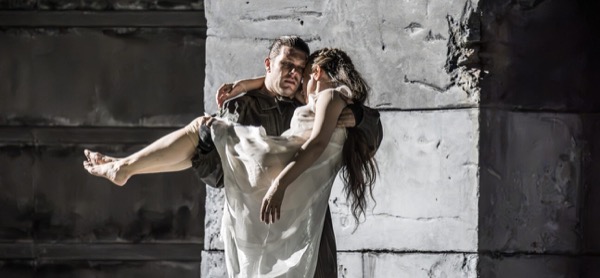
Mystery seems to lie at the core of Covent Garden’s latest Parsifal, directed by Evgeny Titov in his Royal Opera debut. Where Wagner indulges in sublime music built around bright major triads, Titov presents an almost relentlessly bloody and depressing staging; through his Regie touches, he entwines the work in a series of questions that may leave the audience bewildered, intentionally or otherwise. Regietheater seems, in recent years, to have moved increasingly to the forefront of the British operatic landscape.
Parsifal, Royal Opera House
Richard Wagner: Parsifal: Act I: Prelude (Hallé Orchestra; Mark Elder, cond.)
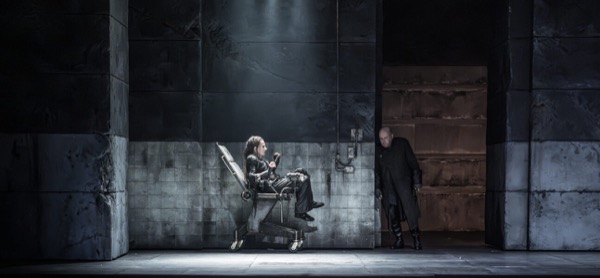
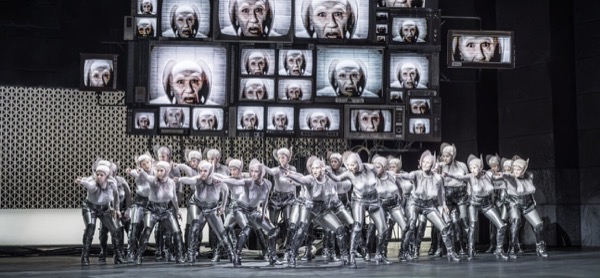
Much of the visual side of this production is stunning. Étienne Pluss’s stage design casts a dark hue over the Grail realm, set in an underground-bunker-like environment dominated by a large bank of CCTV screens and a gloomily greenish shower room. The slow, at times almost imperceptible, movement of the columns matches the music remarkably well, and reminds me of what Robert Wilson does in the backdrop of Glass’s Einstein on the Beach – is Wagner’s persistent variation on his core leitmotivic materials here not, in some sense, comparable to Glass? Klingsor’s kingdom and the wondrous Garden, on the other hand, are portrayed as a strange office, where Klingsor reaches the outside world through a telephone and an even larger array of screens, while exhibiting his collection of treasures: an Egyptian mummy, a crown, and the sacred Spear that Parsifal later reclaims.
The sense of cyberpunk mystery is enhanced by Esther Bialas’s costume design. The chorus of Knights, hooded or not in anoraks, presents the strong presence of an indifferent, even ferocious mob. In contrast, the female chorus of Flowermaidens in Act II appears as sci-fi fembots in otherworldly helmets, artificial breasts and silver-shine trousers, creating a striking visual clash against the backdrop of screens.
Richard Wagner: Parsifal: Act II: Komm’! Komm’! Holder Knabe! (Flower Maidens, Parsifal) (Sarah Castle, mezzo-soprano; Madeleine Shaw, mezzo-soprano; Elizabeth Cragg, soprano; Anita Watson, soprano; Ana James, soprano; Anna Devin, soprano; Lars Cleveman, tenor; Hallé Orchestra; Mark Elder, cond.)
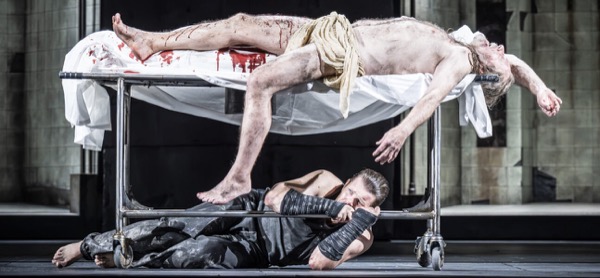
The production’s treatment of Wagner’s spirituality carries a sense of ridicule, and perhaps also ridiculousness. The Grail itself never seems substantially present; the wounded swan carried onstage by Parsifal appears as a toy-like prop in dramatic contrast to the rest of the staging; images of fembots and sacred figures – Adam and Eve as well as Christ – appear on the same screens, perhaps treated equally as forms of disguised temptation. Most hilarious, and indeed ironic, of all is the final scene: when Parsifal wields the Spear to “heal” Amfortas, he actually stabs him, and Amfortas appears to die in a spray of blood. Death becomes the ultimate healing, precisely as Amfortas has longed for earlier in the work.
Parsifal, Royal Opera House
Titov’s transformation of the magical Grail Ritual in Act I into a bloody physical sacrifice is perhaps the production’s most striking intervention. Amfortas, wounded, is placed at the centre of the stage in the position of Christ, while the Knights, one by one, drink a cup of blood drawn from his wound, making him quite literally a Christ figure who offers his own flesh and blood as nourishment. Parsifal’s “murder” of Amfortas at the end therefore seems less an act of absolution from guilt than a release through death, freeing him from the endless suffering of sacrifice.
Richard Wagner: Parsifal: Act I: Nehmet hin meinen Leib, nehmet hin mein Blut (Voices, Boys, Titurel) (Reinhard Hagen, bass; Hallé Youth Choir; Royal Opera Chorus; Trinity Boys Choir; Hallé Orchestra; Mark Elder, cond.)
Yet one may leave the opera house rather bewildered, confronted by several unanswered questions. Although Titov deconstructs parts of the plot and reshapes them into objects of ridicule or interrogation, he does not seem to offer a fully substantial alternative narrative. One wonders what precisely the relationship is between Amfortas and the Knights, who are largely absent from the final Grail Ritual; what role the Spear is meant to play if not as an instrument of healing; and why Parsifal is compelled to reclaim it. The visual and theatrical shock does not fully compensate for the essential absence of an ultimate Answer – one that might have given greater dramatic force to Wagner’s final music drama.
Parsifal, Royal Opera House
Musically, however, the production ranks among the finest Wagner performances London has seen in recent seasons. The orchestra, conducted by Music Director Jakub Hrůša at his best, produces a sound that combines weighty richness with a transparency of texture particularly suited to Parsifal’s orchestration and harmonic language. The Royal Opera Orchestra’s wind sections deliver tremendous solo playing, which is so important in this work. Hrůša’s mastery of the dramatic structure emerges through the vitality and breadth of individual phrases, greatly aided by his inspired handling of tempo changes and by his dynamic and timbral variety, all forming an engaging flow with a sustained sense of dramatic impetus.
Stanislas de Barbeyrac, in the title role, is a metallically robust young Heldentenor, offering a solid portrayal of the hero’s transition from the innocence of Act I to his glorious assumption of the new Grail king in the final scene. Brindley Sherratt’s Gurnemanz proves convincing with his moody, dark-hued tone and strong projection; the long narrative passages of Act I are executed with due solemnity, though one might wish for a little more vibrancy to make the storytelling fully compelling. Mark Stone’s Klingsor brings an appropriate rawness, while James Platt gives Titurel due majesty.
Parsifal, Royal Opera House
The true highlights of the cast come from Ekaterina Gubanova and Christian Gerhaher. Gubanova’s Kundry offers a lusciously transformative voice which, if not huge in volume, projects powerfully through the orchestra, while bringing out the full complexity of the character and the great conflict of the Garden scene. Gerhaher’s Amfortas is in a class of his own, and indeed a highly unique interpretation of the role, with a comparatively thin, bright voice far removed from what one normally expects of a Wagnerian baritone. One may question whether this voice is naturally suited to Wotan, which Gerhaher took into his repertoire recently, but it works strikingly well for Amfortas. Gerhaher’s signature crisp articulation lends the suffering character an almost neurotic quality, while his subtle use of vocal colour cuts through the orchestral texture with remarkably telling phrases.
Richard Wagner: Parsifal: Act III: Ja, wehe! Weh’ über mich (Amfortas) (Detlef Roth, baritone; Hallé Orchestra; Mark Elder, cond.)
For more of the best in classical music, sign up for our E-Newsletter