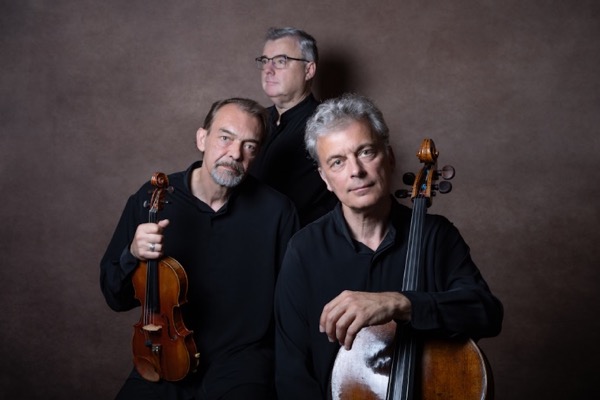
The UK-based Doric String Quartet has big plans for the 2027 Beethoven Year. They will bring Beethoven’s string quartets across Europe, including the Beethoven-Haus in Bonn. The third volume of their Beethoven album is out this September. In the past, Gramophone has lauded their CDs as Top 20 Haydn and Britten recordings.
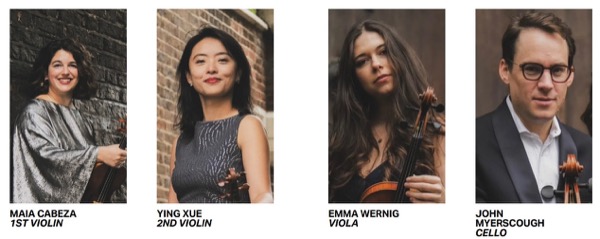
Hailing from the Americas, Asia, and Europe, first violinist Maia Cabeza, second violinist Ying Xue, violist Emma Wernig, and cellist John Myerscough have been mentored by renowned ensembles such as the Alban Berg, Artemis, LaSalle, and Hagen Quartets. In the following interview, the Dorics discuss their affinity for Haydn, Beethoven, and Britten. They also shared that they play Bach’s Art of Fugue on strings and recommended favourite quartet pieces.
Doric String Quartet
Can you tell us what instruments you play?
Maia plays a Michele Deconet violin made in 1754, Ying plays a Giovanni Battista Gabrielli Violin made in Florence in 1751, Emma plays a viola made in 2019 by Jason Viseltear, and John has the oldest instrument: a 1587 Brothers Amati cello. Everybody has a unique, personal relationship with their instrument. Something great about a quartet is how four instruments and sounds really try to create the sound of a new instrument as one.
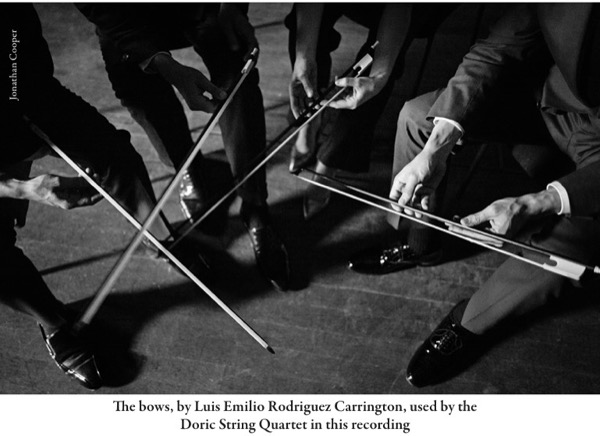
Since 2016, you have been using specially made Classical (transitional-period) bows.
Yes, we all use Classical bows for repertoire up to Mendelssohn. We also use them for Bach and Haydn. As a group, we love the distinctive sound they allow us to create. Using them brings us closer to how these pieces were approached at the time, and we find this hugely inspiring!
How did your mentors influence your approach to chamber music?
The biggest influence was Rainer Schmidt from the Hagen Quartet. He set us on a quest for clarity in textures, real sensitivity to harmony, and the confidence to push for dramatic extremes in our interpretations, while also linking music to a deep sense of humanity. The LaSalle inspired us to explore the Second Viennese School, and the Alban Berg concerts in London were a regular source of musical inspiration, as well as the excitement of an international string quartet career. The Artemis continued this as a younger-generation group, and they were such lovely, selfless people, which brought home the human side of dedicating one’s life to the string quartet.
You have already performed complete cycles of Haydn, Mendelssohn, Britten, and Bartók. Now you’re finishing a third Beethoven album and will feature the composer in 2027.
Recording one composer’s complete works for the string quartet is such a milestone. It’s like learning a language by one composer, living through their life journey. Our preparation for the Beethoven cycle has been the most immersive and demanding project of our career.
Beethoven’s Op. 18 quartets are filled with just as much wit as the Haydn quartets that inspired them. In recording these, we focus on the crisp, Haydnesque rhetoric, but also on the unpredictable energy that is already uniquely Beethoven.
His middle quartets become much more complex. Throughout the works, Beethoven shows not only his skill as a master and innovator of the genre in harmony and structure, but also his ability to write heartbreaking melodic lines equal to Mendelssohn’s.
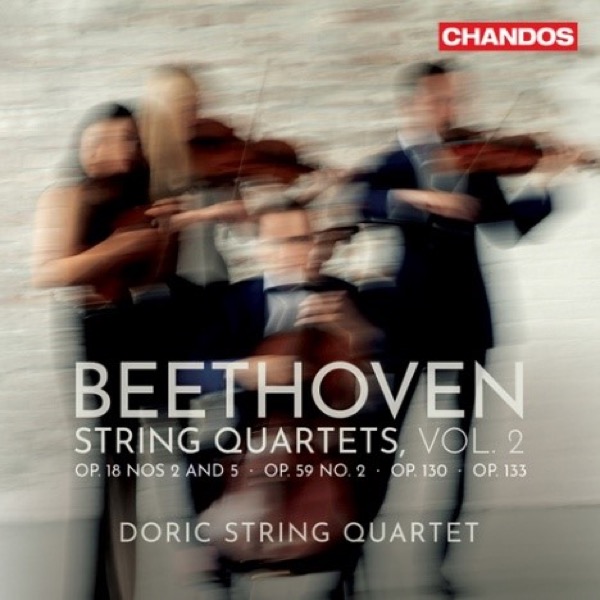
Regardless of the piece, Beethoven’s demands are immense. For example, the Große Fuge Op. 133 is a pure physical struggle which feels titanic, while the Cavatina from Op. 130 requires musicians to find the most vulnerable selves.
Ludwig van Beethoven: Grosse Fuge in B-Flat Major, Op. 133 (Doric String Quartet)
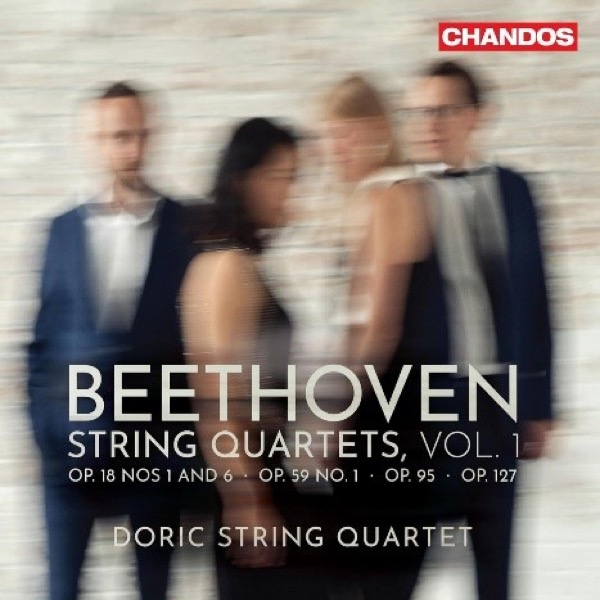
We are very excited about the latest release of our ongoing Beethoven CD cycle. This release brings together, once again, a wonderful selection of quartets from across Beethoven’s three periods. We are particularly pleased to have the op. 132 here with its monumental Heiliger Dankgesang slow movement. It was a very special experience to spend time with this movement in the studio, crafting each phrase into a coherent whole. Op. 135 is a remarkable piece. At times, it almost felt like a Haydn Quartet, but then it shifted sharply into wild, obsessive music. It is always a luxury to have time in the studio to immerse ourselves in the music. But especially with these great late Beethoven Quartets, it was an opportunity to deepen our understanding of the pieces, squeeze out every last bit of detail, and really challenge ourselves to find even more emotional meaning and variety of colours, sounds, and characters.
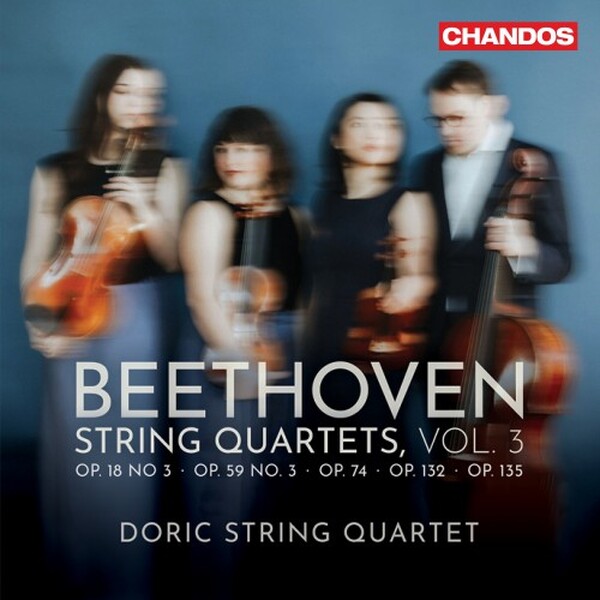
A focus on Beethoven definitely drives our 2027 season. We will play all the late quartets in the Netherlands, all the middles in Shanghai and a selection in Bonn, as well as many concerts featuring Beethoven on the programme. Performing at Beethoven-Haus-Bonn will certainly be a special experience; feeling the composer’s presence, being so close to the archives, and having so much knowledge about Beethoven will focus our concentration even more on the concert. Beethoven is always on our minds as quartet musicians, but this year gives us the chance to really foreground these works and also to perform these mini cycles. We feel very fortunate to have this opportunity in 2027!
As Beethoven’s predecessor, is Haydn a special favourite within your extensive repertoire? In the upcoming 2026/7 season, you will play Haydn String Quartet Op. 74 across many venues, including No. 1 at Wigmore Hall.
Haydn is definitely a special favourite for us to play. He really popularised the genre and is commonly known as the “Father of the String Quartet” because of his sheer output and complete mastery. We find his music full of joy and wit, and we especially celebrate its conversational quality. Haydn’s quartets are so perfectly distilled in their construction that they really allow for ultimate freedom and creativity, especially onstage. As a quartet, we always love coming back to Haydn to remind ourselves why we play quartets in the first place!
Doric String Quartet performs Haydn Op. 64 No. 3, IV. Finale Allegro con spirito
Can you say a bit more about one of Haydn’s early works, String Quartet in F minor, Op. 20, No. 5, that earned him the name as the “Father of the String Quartet”?
We absolutely love this piece, and it’s hard to choose just one Haydn quartet when they are all so great! This quartet in particular has an incredibly captivating last movement that is also a fugue. Haydn adds another layer to this fugue by marking the entire movement “sotto voce,” literally meaning “under the voice”. This creates a hushed tension and makes each passing voice feel like a whisper throughout the movement until it breaks out at the end.
Our Classical bows allow a natural release/decay of the sound, which fits Haydn’s music and the music of that period in general. They also allow clearer articulation, which is useful in the slow movement, where the accompanying voices are “staccato” or “detached” while the primary voice is cantabile. Each quartet approaches pieces differently, and we all bring our unique voices to everything we play.
Doric String Quartet performs Haydn Op. 64 No. 3, II. Adagio
Since you mentioned the fugue elements in Haydn and Beethoven, can you share your experiences playing Bach’s Art of Fugue on string instruments?
Bach was the first real master of this form. A fugue is a musical composition in which a subject is repeated, passed between voices, and transformed. Though most well-known on piano, the original instrumentation in Bach’s Art of Fugue remains a bit of a mystery: Bach writes only “soprano, alto, tenor, and bass” beside each part. These earlier Baroque vocal parts also match the registers of the four string instruments.
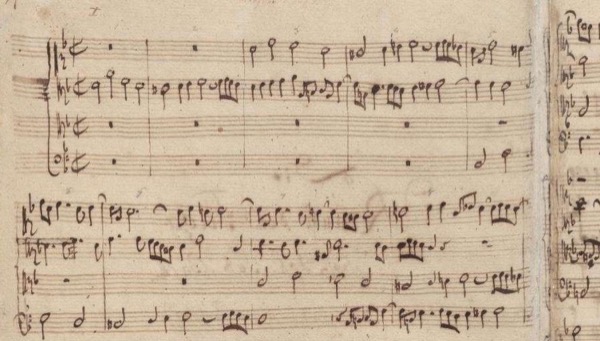
Bach’s Art of Fugue Manuscript (notice the four-voice parts)
As a string quartet, each voice is truly equal in presenting and developing this musical subject. The four fugues we chose become progressively more interesting as Bach demonstrates what he is capable of: No. 1 shows how Bach starts the fugues with a simple theme/subject and passes it around; No. 4 shows where the theme is inverted; No. 6 augments or diminishes the theme by tempo, and writes in the style of French music/overture at the time, which has this distinctive dotted rhythm; No. 9 adds another subject to become a double-subject fugue.
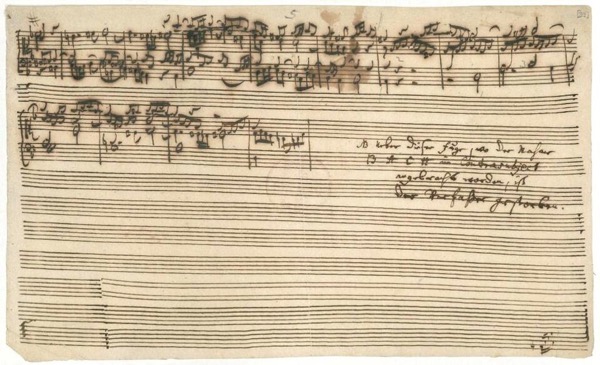
Final page of the Fuga a 3 Soggetti fragment
Besides the 2027 Beethoven Year, which you will take part in commemorating, 2026 marks the 50th anniversary of Benjamin Britten’s death, whose works you frequently perform. Your previous album also used Britten’s own viola and was recorded at Snape Maltings in Aldeburgh.
As a UK-based quartet, we always felt uniquely connected to Britten’s musical voice. We feel he writes for the string quartet in a truly distinctive way, and we’re blown away by the power of his three quartets and the Divertimenti every time we are lucky enough to return to them. Snape Maltings is a special place for the quartet, as it’s where Britten lived and composed so many of his works. We visit the area at least once a season either to perform or to record. By spending so much time surrounded by the scenery that so deeply inspired Britten, we developed a particular connection to his music.
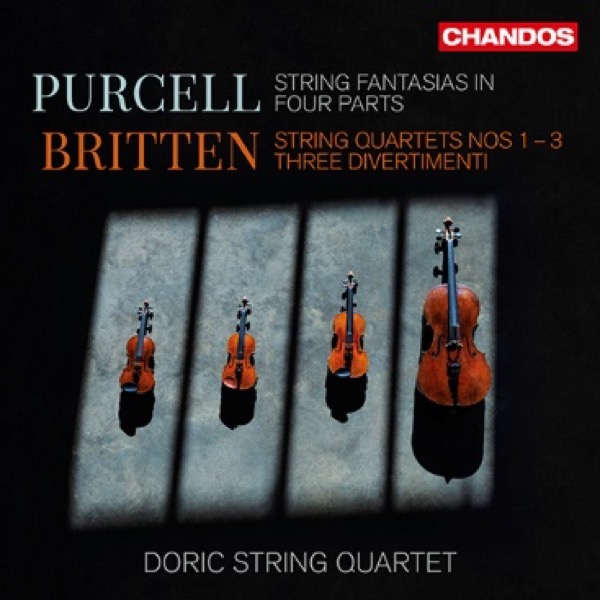
Can you say a few words about Britten’s String Quartet No. 3, Op. 94, written in 1975–76, among his final major works?
Britten returned to the string quartet 30 years after writing his masterful second string quartet. In the meantime, he wrote a great deal of vocal music, for which he is best known. What emerged is a five-movement exploration that ends on a chord that Britten called “a question”. One movement is a duo, one a violin solo, one a raucous Burlesque. This piece offers great contrasts and reflections, perhaps also on a personal level, as he heavily quotes his own opera “Death in Venice”. Audiences can, as with all Britten, expect a journey of emotion, sound, and texture that leaves no stone unturned.
Benjamin Britten: String Quartet No. 3, Op. 94: I. Duets: With moderate movement (Doric String Quartet)
How can we relate Britten’s string quartets to his vocal music?
In his vocal and string music alike, Britten is best known for creating a musical world of his own, defined by clarity and, in some ways, simplicity, but also by immense emotional depth. His quartets also include vocal components and singing, with very human melodies. Still, audiences will best recognise Britten’s musical world through the colours and sound world that could only be him.
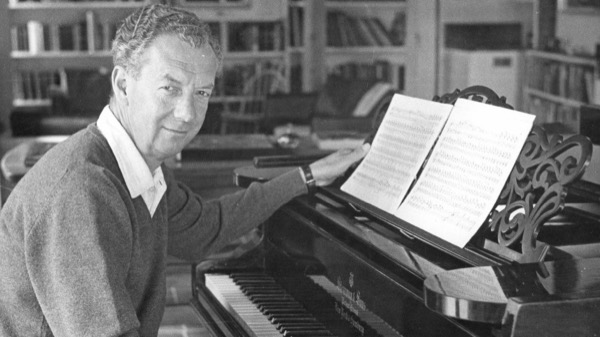
Benjamin Britten at his piano
Since your group’s formation in 1998, what have been the biggest changes in the string quartet music scene?
The biggest change is how small the world is getting, while the level of players keeps climbing. String quartets now need to be just as creative as solo artists with their programming, marketing, and career development and, if successful, plan for a truly global career, where a national one would have already meant success 25 years ago. Musicians also need to be much more versatile than they used to, which we think is a great thing! We all have different musical backgrounds and focus, and we find it hugely enriching to play in other contexts as well, whereas in the past a career quartet would likely have been limited to that.
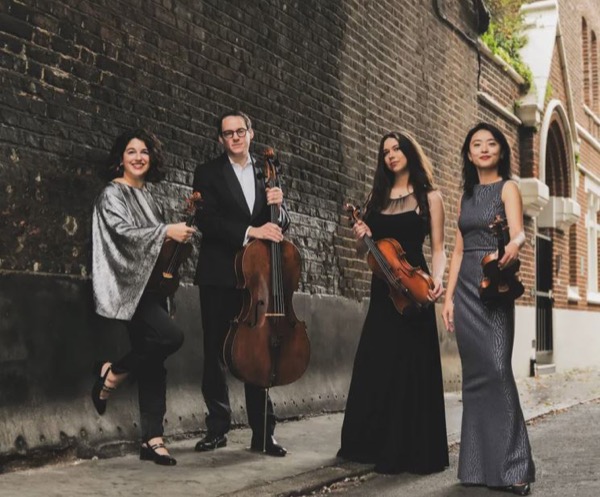
Doric String Quartet
Beyond the works mentioned above, can you recommend a few string quartet pieces that would serve as a good introduction to the genre?
We would recommend starting with Haydn. Haydn Op. 20 No. 2 is from his “Sun Quartets” and perfectly represents Haydn at his most joyful. The Cavatina movement from Beethoven’s Op. 130 is universally touching and never fails to bring us to tears. Schubert’s “Death and the Maiden” quartet is extremely dramatic, powerful and exciting. Borodin’s 2nd Quartet is a great overall introductory quartet because it’s not too long and each movement has such a beautiful melody. Ravel’s string quartet is another great one to start with. It’s so lush and vivid. For something a bit more adventurous, Bartók’s 2nd string quartet has an exciting, folk-music-inspired second movement.
Ludwig van Beethoven: String Quartet No. 13 in B-Flat Major, Op. 130: V. Cavatina: Adagio molto espressivo (Doric String Quartet)
Check out Doric’s Calendar: https://www.doricstringquartet.com/concerts
For more of the best in classical music, sign up for our E-Newsletter