Today we’re charting the tumultuous courtship between classical music’s most famous couple: composer Robert Schumann and pianist Clara Wieck.
Composer Robert Schumann was born on 8 June 1810, and his future wife Clara on 13 September 1819.
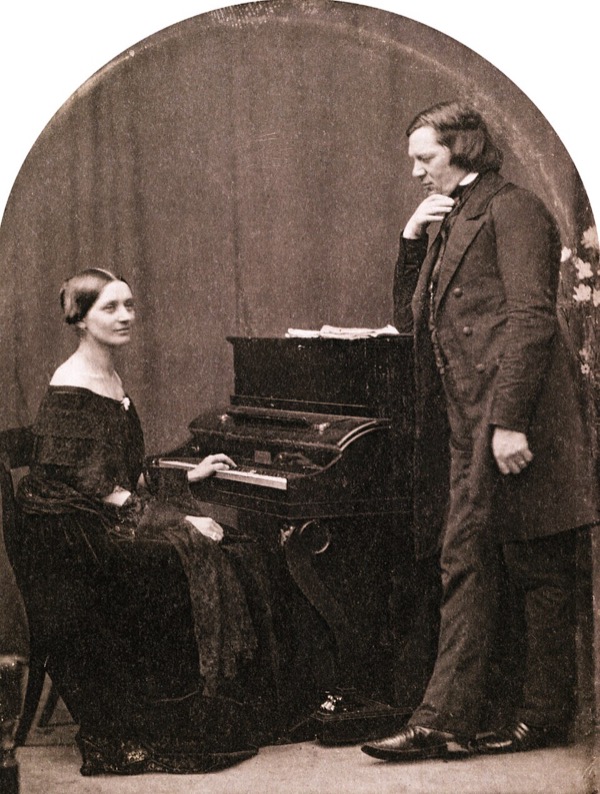
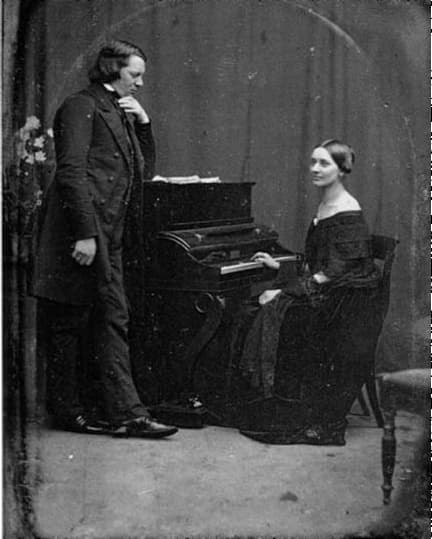
Robert and Clara Schumann, daguerreotype
They met in 1828 when Robert was a teenager and Clara an eight-year-old piano prodigy, and married in 1840.
Those twelve years between 1828 and 1840 witnessed friendship, courtship, composing, touring, jealousy, quarrels, reunions, separation, court battles, and more.
31 March 1828: Their First Meeting
Robert, 17, first met Clara, 8, and her father and teacher Friedrich Wieck at a house concert on 31 March 1828.
The performance changed the course of Schumann’s life. So impressed by Clara’s playing, he decided he wanted to study piano with Friedrich.
October 1830: Robert Schumann Moves In
Clara Wieck’s Polonaise in C major, Op. 1, No. 2 (1830)
A few weeks after Clara’s eleventh birthday, Robert Schumann, now 20, moved to Leipzig.
He had briefly studied law in Heidelberg, Germany, but ultimately decided he wanted to pursue a music career instead.
He moved into the Wieck household, renting two rooms, and began studying with Friedrich daily alongside Clara.
In a biography of her father, Robert and Clara’s daughter Eugenie Schumann wrote many years later of this time:
Now a glorious life began. The mornings belonged to work, to serious study under Wieck’s direction…
Evenings were the nicest time. Robert would fetch the children – Clara and her two brothers, Alwin and Gustav – to his room, and here he would become a child again with the children.
He told them his best stories and played charades with them; he teased and frolicked and had the little boys taking turns standing on one leg – the one who could hold out the longest received a prize.
Or he appeared clothed as a ghost, so that they ran from him shrieking; told the fearful Clara about the doppelganger, and about the pistol that he always carried with him, and she was the kind of child who believed everything he told her…
So, in this way, Robert was the biggest child of all and brought something of the sunshine of childishness to the serious life of his little friend. One can imagine how she loved him.
21 August 1831: Abuse from Friedrich Wieck
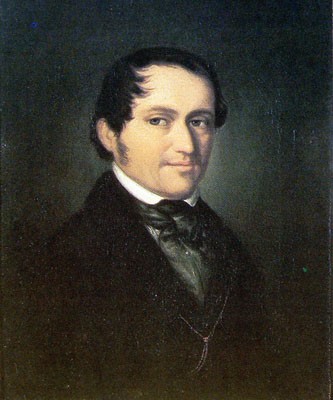
Friedrich Wieck
Despite his teacher’s pedagogical talents, Robert’s impressions of Wieck weren’t all positive.
The 21-year-old wrote in his diary on 21 August 1831:
Yesterday I saw a scene whose impression will be indelible.
Meister Raro [Wieck] is surely a wicked man. Alwin had not played well: “You wretch, you wretch – is this the pleasure you give your father” – how he threw him on the floor, pulled him by the hair, trembled and staggered, sat still to rest and gain strength for new feats, could barely stand on his legs anymore and had to throw his prey down, how the boy begged and implored him to give him the violin – he wanted to play, he wanted to play – I can barely describe it – and to all this – Zilia [Clara] smiled and calmly sat herself down at the piano with a Weber sonata.
A horrified Robert added:
Am I among humans?
Clara was just eleven then.
1833: The Flirtation Begins
Clara Wieck’s Piano Concerto (1833–1835)
We don’t have conclusive details about when Robert and Clara’s flirtation began. But later in life, when reading a book about their relationship that claimed their romance began in 1836, she noted in the margin: “Already in 1833.”
He would have been 23; she would have been 14 – the same time she was writing her piano concerto.
April 1834: Robert Meets His Fiancée

Ernestine von Fricken
In the spring of 1834, a 17-year-old pianist named Ernestine von Fricken arrived in Leipzig to study with Friedrich Wieck.
Fourteen-year-old Clara was excited to make a new friend of her own age and gender – but once it became clear that Robert and Ernestine were attracted to each other, she grew upset.
She began to flirt with other boys, claiming she fell in love with a cellist in Magdeburg while on tour.
Summer 1835: Robert’s Engagement Unravels
Robert Schumann’s Carnaval (1834–1835)
Robert and Ernestine were secretly engaged in the summer of 1834.
But soon the relationship began to cool – in part because he discovered Ernestine was illegitimate and not as wealthy as he’d once thought. He feared that supporting her would necessitate his pursuing menial labour and keep him from composing.
His attraction to Clara was also growing.
Robert and Ernestine’s relationship would limp along through the end of 1835, but Robert ultimately called it off in January 1836, devastating Ernestine.
13 September 1835: Clara’s Sixteenth Birthday
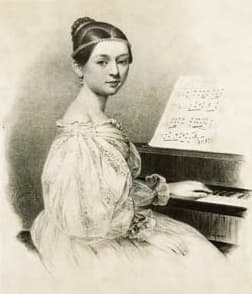
Clara Wieck at 15 years old
Clara had an exciting sixteenth birthday. Although he was still engaged to Ernestine, the 25-year-old Robert arranged with his musical friends to buy her a golden pocket watch, presented in a basket with a porcelain handle. Both Robert and Felix Mendelssohn stopped by the celebration, and Robert and Clara played piano for each other.
“It was marvellous,” she wrote to a friend. “I will not forget this day soon.”
Soon after, Robert told Clara that he was falling out of love with Ernestine and that she was engaged to someone else. (She wasn’t.)
November 1835: Their First Kiss
We know from Robert’s diary that the two exchanged their first kiss in November. Robert was 25, and Clara was 16.
Clara later wrote to him, “When you gave me that first kiss, I thought I would faint; everything went blank, and I could barely hold the lamp that was lighting your way out.”
He later wrote in his diary, remembering that fall and winter: “Lovely hours in her arms in the evenings in the Wieck house.”
February 1836: The Disapproval of Friedrich Wieck Begins
In January 1836, once Friedrich realised that Robert and Ernestine were no longer a couple and that Robert had designs on Clara, he forbade the two from interacting and brought the 16-year-old Clara to Dresden.
Robert’s mother died on February 4. Instead of travelling to her funeral, Robert, accompanied by a friend, went to seek comfort from Clara in Dresden. Friedrich happened to be away on a business trip on the 7th so that they could meet.
Friedrich was infuriated when he learned about it. According to the diary that Friedrich kept on Clara’s behalf, he threatened to shoot Schumann if she ever met him again, and arranged for her to go on tour.
February to April 1836: A Miserable Tour
Robert Schumann’s Fantasie in C major (1836)
Between February and April, father and 16-year-old daughter toured multiple cities in Germany, including Berlin, Weimar, and Hamburg.
Friedrich’s rage never abated, and Clara was miserable. Friedrich forbade Clara and Robert from communicating during this time. It would be a year and a half before they got in touch again.
The 25-year-old Robert was reduced to learning news of Clara from mutual friends, and distracted himself by composing music and writing articles for his music journal.
He told his sister-in-law:
I am in a critical situation and lack the calm and clear sight to pull out of it. As it stands, either I can never speak with her again, or she will be mine entirely.
May 1836: Robert Dedicates His Piano Sonata No. 1 to Clara
Robert Schumann’s Piano Sonata No. 1
In the middle of their separation, Robert published his F-sharp minor piano sonata anonymously and dedicated it to Clara.
He wrote to her that it was “a solitary outcry for you from my heart … in which your theme appears in every possible shape.”
Friedrich forbade Clara from acknowledging it, and forced her to return Robert’s letters.
January 1837: “The Darkest Time”

Robert and Clara Schumann
Their relationship struggles continued through early 1837. In January 1838, Robert described 1837 as “the darkest time, when I knew nothing of you and tried to force myself to forget you.”
I had resigned myself. But then the old pain broke out again – and I wrung my hands – and then I said to God on many a night – “Let but this one thing mercifully pass away, without my going mad”…
I hurled myself to the ground and cried aloud – then I wished to cure myself, to compel myself to fall in love with a woman who had already half drawn me into her net.
It is unclear who this woman was; nothing came of their relationship.
13 August 1837: Reestablishing Communication and Becoming Engaged
Robert Schumann’s Symphonic Etudes (1834)
In the months before her eighteenth birthday, Clara spent the summer with friends near Dresden. Her father arranged a homecoming concert in Leipzig on 13 August.
Robert – now 27 – was clearly still on her mind. For the Leipzig concert, she programmed Schumann’s Symphonic Etudes, and also engaged a mutual friend – Ernst Adolph Becker – to pass along a message to Robert.
This was the first time they’d communicated in eighteen months.
Robert wrote on the day of the concert:
Are you still firm and true?
As indestructible as my belief in you is, yet even the strongest spirit loses confidence when nothing is heard of the one who is loved more than anyone else in the world. And you are that to me.
I have thought it all over a thousand times, and everything says to us, “It must be, if we wish it and if we act.”
Write me just a simple “yes” if you will give your father a letter from me on your birthday [September 13]. Just now he is well disposed toward me and will not reject me if you add your pleas to mine.
Robert’s letter was asking for Clara’s hand. She replied yes. Consequently, they considered August 14 the anniversary of their engagement.
After this point, they began writing to each other in secret, in earnest.
October 1837: Triumphs In Vienna
Clara Wieck’s “Souvenir de Vienne” (1838)
In the autumn of 1837, Clara, newly 18, arrived in Vienna to give a series of concerts, to immediate critical and popular success. The Viennese even began selling desserts called “torte à la Wieck.”
Although she was apart from Robert, this tour was an important period of maturation for her, and gave her confidence that she could be a piano soloist without her father’s assistance.
Her concerts were so successful that, in March 1838, she was named the Royal and Imperial Virtuosa.
During this Viennese interlude, Clara and Robert corresponded in secret. Clara’s maid picked up the letters from the post office and passed them along.
Robert was upset that she didn’t write more often, but Friedrich got angry at Clara if she so much as locked her door.
Summer 1838: Clandestine Leipzig Meetings
At first, Robert didn’t want to spend time with Clara when she returned to Leipzig in the summer of 1838. He said it was too painful to meet her and not know if they could ultimately be together.
However, despite his reluctance, they couldn’t resist and often met.
On Robert’s 28th birthday, the 18-year-old Clara wrote in a love letter:
Be at our window at exactly 9. If I signal with a white cloth, walk slowly toward the old Neumarkt. I will follow soon after and go with you, since I have to fetch Mother at her mother’s. If I don’t signal, it means she hasn’t gone.
The secrecy, however romantic, was grating on Robert.
I have such an urgent desire to see you, to press you to my heart, that I am sad-and sick as well. I don’t know what is absent in my life, and yet I do know: you are absent.
I see you everywhere; you walk up and down with me in my room; you lie in my arms, and nothing, nothing is real.
I am ill. And how long will this all endure?
September 1838: Clara’s Gewandhaus Concert
Clara Wieck’s Scherzo No. 1 (c. 1838)
In September 1838, shortly before her nineteenth birthday, Clara played at the Gewandhaus and was received rapturously.
Robert, 28, attended. He was proud of her and awed by her artistry, but was also troubled, wanting her to fulfil a traditional role as a private housewife.
In a letter dated 9 September, he wrote to her:
You are too dear, too lofty for the kind of life your father holds up as a worthy goal; he thinks it will bring true happiness. What difficulties, what a long way, how many days – and just for a few hours!…
No, my Clara will be a happy wife, a contented, beloved wife.
I consider your art great and holy. I hardly dare think of the happiness you will give me with it; but if we don’t consider it necessary, you won’t lift a finger if you don’t want to, for people who aren’t even worth playing scales for, isn’t that so, my girl?
Autumn 1838: Robert’s Trip to Vienna
Robert Schumann’s Kreisleriana (1838)
Robert, now 28, and Clara, 19, thought they might marry and go to Vienna to make a living. Friedrich had already made clear he would not tolerate their remaining in Leipzig.
Accordingly, in the autumn of 1838, Robert travelled to the Austrian capital to scout out professional opportunities. It soon became clear that moving his music journal to Vienna would be too difficult because of censorship laws, so he returned to Leipzig.
On the way, he told friends that he was staying in his hometown of Zwickau for two weeks. He then snuck into Leipzig so he and Clara could spend time together.
Friedrich eventually found out and was furious. Clara’s maid, the woman who had been facilitating their communication, was fired, and Friedrich decreed he would not help her mount any additional tours.
That included her upcoming tour to Paris – the centre of the musical world.
January 1839: Clara’s Parisian Tour Begins
The following January, Clara departed for Paris with nobody but a French chaperone for company.
She gave concerts along the way, writing to Robert whenever her schedule allowed.
Clara ended up doing very well in Paris without her father…much to his fury. He escalated the conflict, declaring that she would not receive an inheritance from him unless she left Robert.
Summer 1839: Strain on All Sides
Clara Wieck’s Three Romances (1839)
Clara was under enormous strain, and Robert was struggling, too.
He wrote to her using alarmingly despairing language: “I feel as if I must lie down here, where so many of those I have loved are lying… There is no longer any joy here for me.”
Navigating Robert’s melancholia during this stage of her life was a terrifying new prospect for Clara.
She was not welcome at home in Leipzig, so after her Parisian sojourn concluded, she went to live with her mother in Berlin. Meanwhile, all of her things – including her piano – remained in the home with her father.
December 1839: Wieck Goes to Court
On 14 December 1839, Wieck filed a libellous declaration in court against Robert and Clara. Robert was 29, and Clara was 20.
He claimed Robert could not support a household, and Robert had to undergo the humiliation of proving otherwise in court.
Over the course of their legal battle, Friedrich made a series of unhinged claims, including that Clara was not playing at a high level and that she would ruin pianos by playing them.
January 1840: Stresses Mount
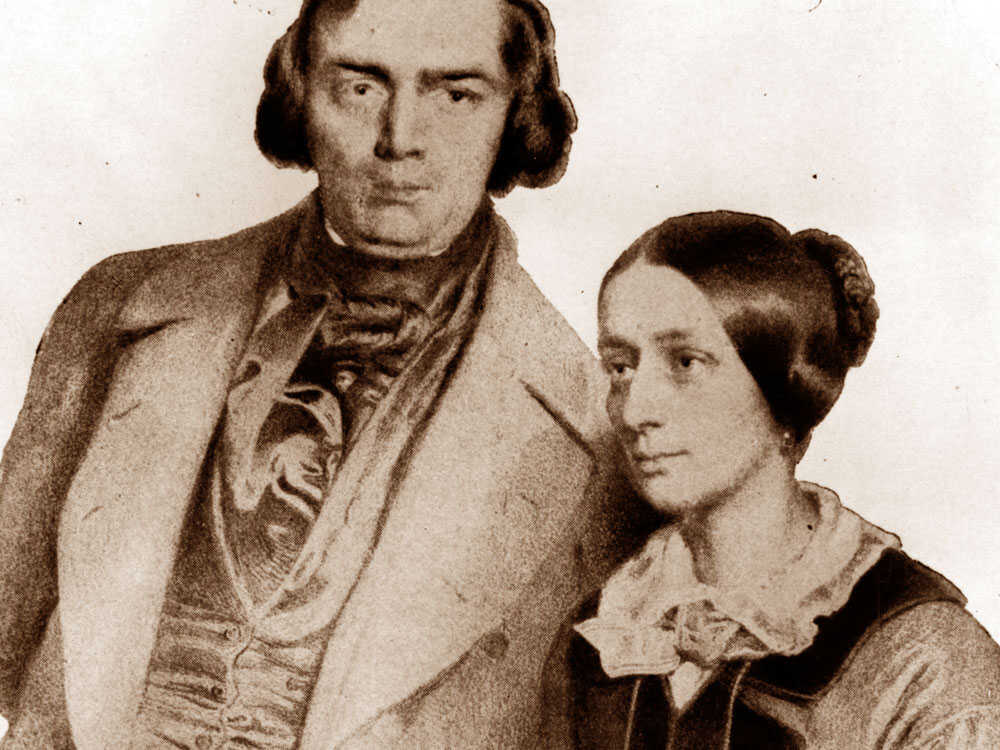
Robert and Clara Schumann
During the court case, Clara’s health began suffering under the strain, and she began experiencing fainting spells and aches.
However, to her surprise, none of this affected her playing, and her performances were well-received in Berlin.
But this success in her professional life didn’t make up for the continuing troubles of the court case.
She wrote in her diary on 15 January 1840:
Today a letter from Robert caused me to suffer one of the most painful hours of my life. He confirmed that the court case may not be over before Michaelmas [September] and, at the same time, wrote that he would not prevent my returning to Father if I wished, etc. That was worse than a stab-at first it put me in a state of insensibility, but then the tears came and flowed without ceasing. Oh, Robert, what an injustice you have done me.
July 1840: The Court Makes Its Decision
Robert Schumann’s Frauenliebe und leben (1840)
Finally, the court granted the couple permission to marry in July 1840. Robert had just turned 30, and Clara was 20.
They waited a little over a week to see if Friedrich would appeal the decision, going apartment-hunting and furniture-shopping in the interim.
However, Friedrich had exhausted all the legal options available to him, and dropped his objections.
On 19 July, they set the wedding date for 12 September, the day before Clara’s twenty-first birthday.
5 September 1840: Clara’s Last Concert as Clara Wieck
Clara’s last concert as Clara Wieck took place on 5 September 1840 in Weimar.
12 September 1840: Their Wedding Day
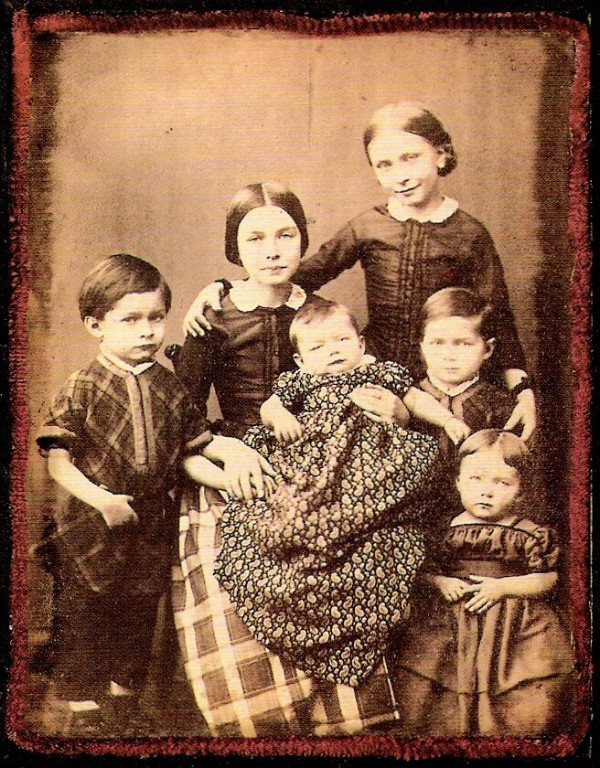
Robert and Clara Schumann’s children
After their tumultuous years-long romance, Robert Schumann, 30, and Clara Wieck, 20, were finally married in the town of Schönefeld, just outside of Leipzig.
Their marriage lasted until Robert died in 1856, and they had eight children together.
Robert would go on to become one of the leading composers of the Romantic era, his creativity unbounded, as evidenced in works as diverse as his symphonies and art songs.
Meanwhile, Clara would go on to solidify her position as one of the greatest pianists of the nineteenth century. She was especially celebrated for her interpretations of his works.
Their long-awaited marriage would bring its own joys and its own difficulties. But on 12 September 1840, the day before her twenty-first birthday, none of that mattered. They had won.
For more of the best in classical music, sign up for our E-Newsletter