With the advent of new recording techniques, an ancient dream came true for Edvard Grieg. When he visited Paris in 1903, he also made several recordings at the Paris branch of the Gramophone and Typewriter Company.
We have little idea of what actually happened on this historic day, except that Grieg managed to record nine 10-inch wax master discs, each containing one piece. In addition, between 1904 and 1906, he made approximately 25 piano-roll recordings for Aeolian, Hupfeld, and Welte-Mignon.
Like many of his colleagues, Grieg took advantage of this new technology to make his music available to a broader audience. To commemorate Grieg’s passing on 4 September, let’s briefly examine what modern listeners might learn from a historical audio document like this.
The Composer We Can Still Hear
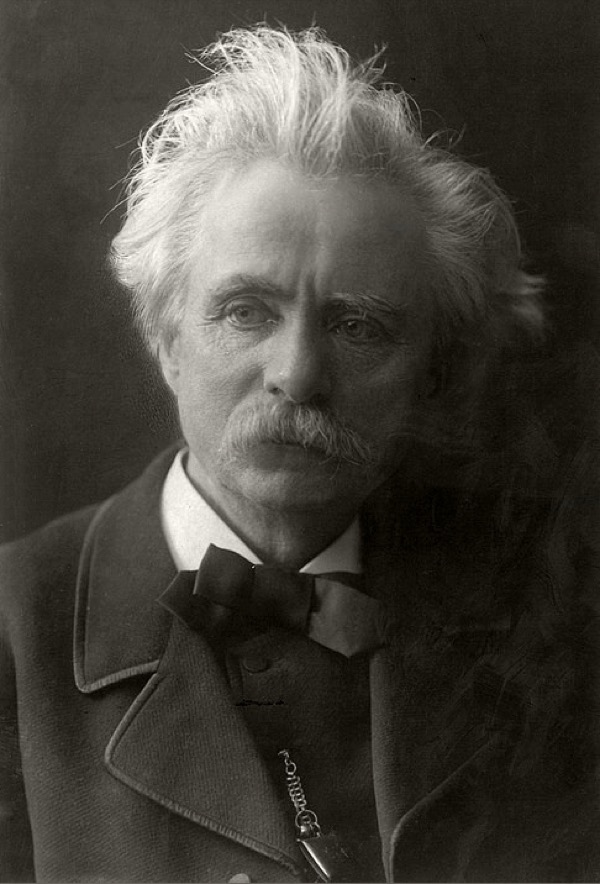
Edvard Grieg (Karl Anderson, 1900)
As Arnulf Christian Mattes writes, “Grieg’s recordings have, as any other mechanical sound reproduction, their interpretive limitations. However, they provide unique insight into what is the most emergent of all historical sources, musical performance, when analysed carefully.” (Mattes, What Else Can Grieg’s Historical Recordings Tell Us? (Studia Musicologica Norvegica, 2020)
The Grieg recordings were eventually issued as part of a three-CD set by the Norwegian company Simax in 1993. At the same time, contemporary reviews acknowledged the historical importance of the release, but many listeners didn’t know how to approach them.
However, as Sigurd Slåttebrekk and Tony Harrison note, it was Will Crutchfield, in a review in the New York Times, who put his finger right on the issue. “These are dashing, spirit-filled, tremendously rhythmic performances… In eight of the nine pieces, he plays faster – often far faster – than any subsequent pianist whose recordings I know, and in the ninth he is still faster than most…”
“The tempos tell us a lot, and what he does within them tells even more. The hesitations and rushings are High Romantic pianism at its most confident and appealing… If the records had not survived (and they barely did!), our understanding of how music sounded in the 19th century would be significantly diminished.” (Slåttebrekk/Harrison, Chasing the Butterfly, 2010)
When Technology Gets in the Way
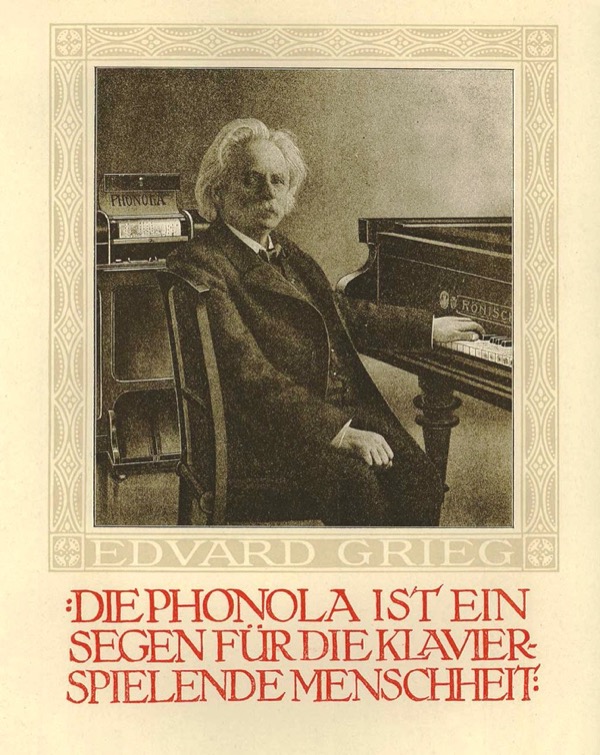
Grieg advertisement (1907)
The excellent investigation by Slåttebrekk and Harrison also acknowledges an astonishing array of technical recording problems. For one, there is pitch instability due to the turntable not turning at a constant rate.
“This pitch/speed variation occurs without rhyme or reason and is of such complexity as to be impossible to correct without the use of some kind of computer program that could be made to lock to some known pitch constant.” Only in 2008 did a recording issued by Marston Records stabilise the pitch for the first time.
The other main technical problem with the recording is that the piano was not close enough to the recording horn. It certainly took real skill to place the voice or instrument close enough to the horn to record, and to “achieve the best signal-to-noise ratio by getting as much volume as possible in the grooves.”
The Grieg discs have a very quiet piano sound and a lot of surface noise. “If we add to that the acoustic horn’s normal characteristics of severely limited frequency range… it is clear that we are moving even further away from the sound that Grieg himself made and heard in 1903.”
Grieg Picks the Programme
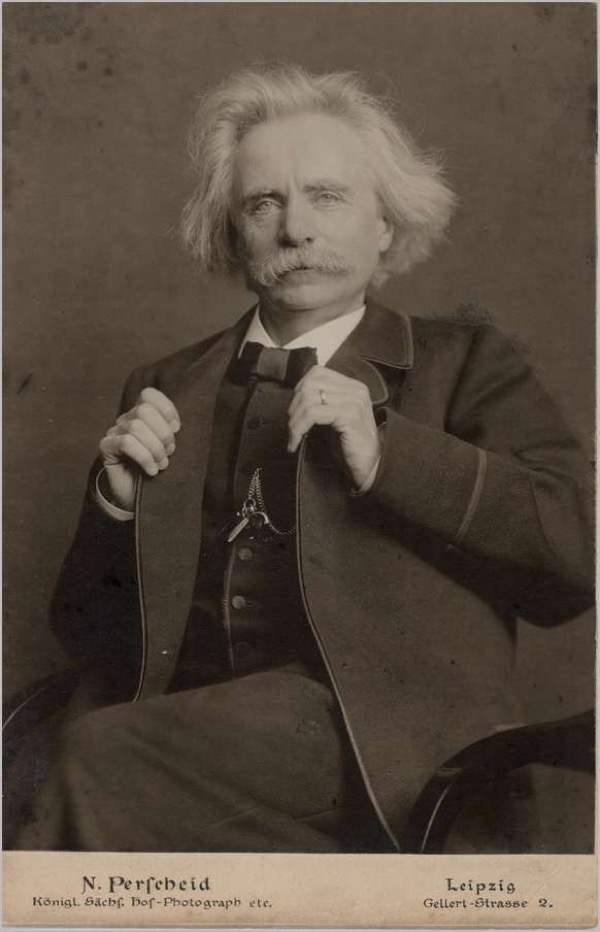
Edvard Grieg (Perscheid, 1905)
When it came to selecting music for his 1903 recording session, Grieg was limited to pieces shorter than three minutes, as this was the maximum duration on a standard 10-inch 78-rpm gramophone disc.
For his 1903 recording, he selected the following. “Butterfly” Op. 43, No. 1, “To Spring,” Op. 43, No. 6, “Remembrances,” Op. 71, No. 7, the third movement and the Finale from his Piano Sonata in E minor, Op. 7, “Gangar”, Op. 54, No. 2, “Wedding Day at Troldhaugen,” Op. 65, No. 6, the “Humoresque” Op. 6, No. 2, and the “Norwegian Bridal Procession,” Op. 19, No. 2.
Additional pieces are found on the 1904 and 1906 recordings, but in terms of style, the core feature of his playing is the so-called Romantic performance style. Grieg was highly critical of contemporary virtuosos, exclaiming, “The devil take these virtuosos and their I know better… they all suffer from the virtuoso-and-obnoxiousness disease.”
Beyond the Metronome
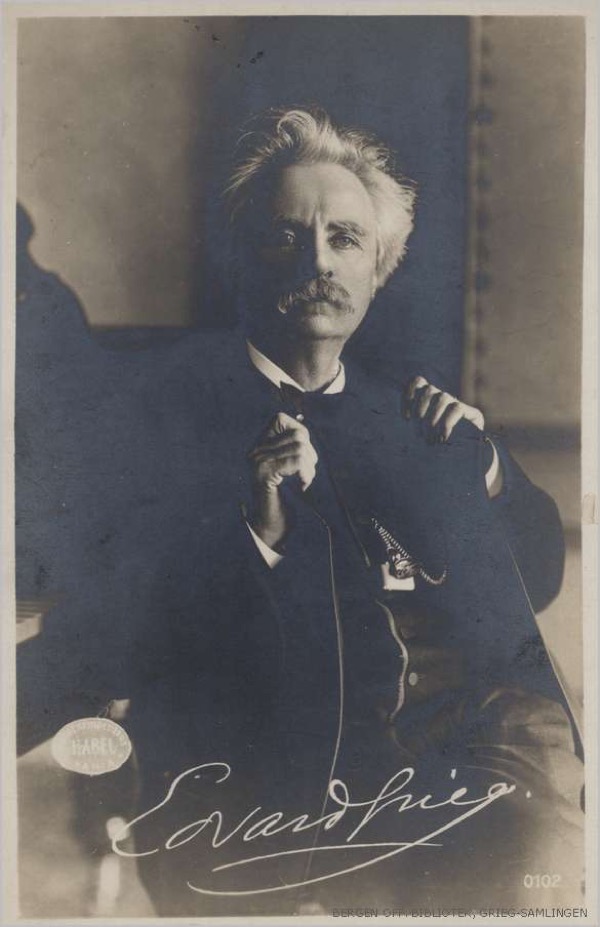
Edvard Grieg (Abel, 1903)
As we have already seen, Grieg plays at a shockingly fast tempo in his recorded performances. It follows that some performers and scholars assume that there was something wrong with Grieg’s metronome, and that he therefore chose faster tempi than it was reasonable to expect.
The question of Grieg’s fast tempi has not been definitively resolved. However, the discrepancy between the printed metronome marks and his recordings tells us something important about performance practice in the nineteenth century.
Fast tempi cannot simply be dismissed as technological errors. Grieg also substantially modified the tempo within individual passages. We hear not simply a composer playing too fast, but a performer using a highly flexible conception of tempo.
Grieg greatly disliked the exaggerated use of rubato, which he called the “virtuoso disease.” In his recordings, Grieg almost entirely refrains from employing conventional rubato, adding only a slight ritardando at the end of his pieces.
Mattes considers the creation of “theatrical imagery” one of the most fascinating features of Grieg’s recorded performance. “He did this by means of micro-fluctuations in melodic articulation, emphasised by dislocated accentuation on weak beats, prolongations of certain tones, and delayed punctuations of the dotted rhythms.”
Grieg’s Poetic License
This “structural swing,” for some commentators, becomes the hallmark of Grieg’s performance style, and we might easily find Grieg’s recorded performances unusually sentimental or eccentric. A 1974 critic suggested that Grieg “played like a sentimental schoolgirl.”
Be that as it may, the Grieg recordings offer a fascinating glimpse into a nineteenth-century conception of poetic music, in which works were transformed into something theatrical or literary. And while Grieg introduces subtle rhythmic inequalities and fluctuations that modern ears might consider eccentric, they may represent something much more meaningful.
His interpretations may also reflect Grieg’s broader artistic ideal of portraying Norwegian nature and poetry through music. To be sure, Grieg’s own recordings do challenge modern assumptions about correct performance. His flexible rhythms might well be understood as part of his conception of musical poetry and Norwegian folk life.
For more of the best in classical music, sign up for our E-Newsletter