Antonio Vivaldi is one of the most famous composers who ever lived. And yet, for most music lovers, he remains a mystery.
We know the Four Seasons. We may even know a concerto or two beyond that. But the man himself – the Red Priest of Venice, the impresario, the teacher of orphaned girls, the composer who died penniless in a stranger’s house in Vienna – is far less familiar.
This is the story of the hidden personal life of Antonio Vivaldi: the illness that freed him from the priesthood, the double life he led between a cloistered orphanage and the most glamorous opera houses in Europe, the woman at the centre of decades of rumour, and the tragic end of a career that helped define the Baroque era.
The Priest Who Didn’t Say Mass
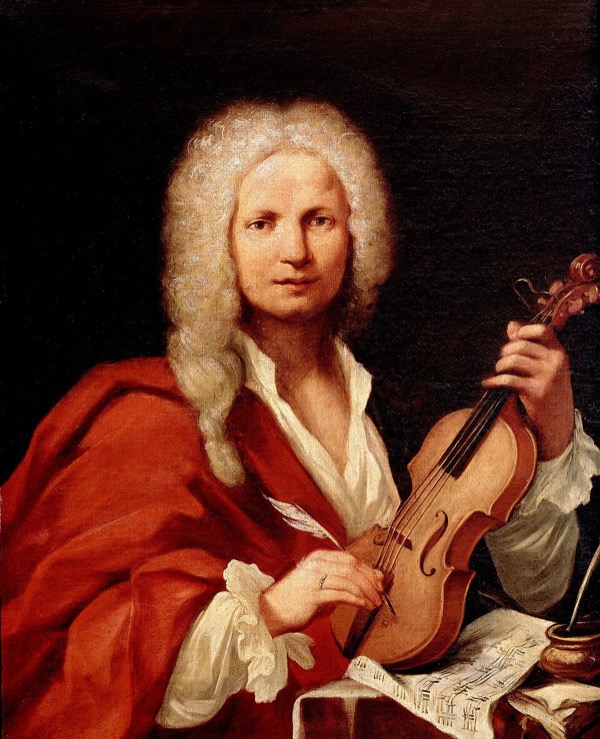
Antonio Vivaldi
Antonio Vivaldi was born in Venice in 1678.
Unusually, he was baptised the same day he was born, which has led historians to wonder if his health was poor from birth.
We know he dealt with health issues during his life. Records exist describing his “strettezza di petto” (“tightness of the chest”), which might have been a 17th-century term for asthma or angina.
His father was a barber who switched careers to become a professional violinist. He taught his son how to play the violin and even toured across Italy with him.
Antonio began studying for the priesthood in 1693, when he was 15, and was ordained in 1703, at the age of 25. He earned the nickname the “Red Priest” due to his ginger colouring.
Rumours soon began swirling that the Red Priest wasn’t totally devoted to his priestly duties. According to one legend, he once abandoned Mass to write down a musical theme that had come to him, leaving the congregation hanging mid-worship.
Ostensibly because of his chest tightness, within a year of his ordination, he was granted permission to abstain from celebrating daily mass, given the physical toll it took on him.
The Pietà and the Double Life
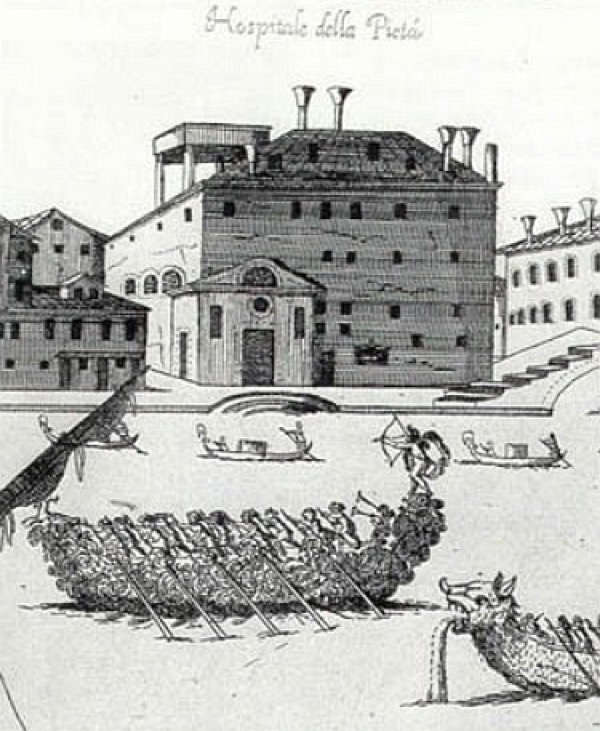
The Ospedale della Pietà
During Vivaldi’s life, Venice was a cultural hotspot where many wealthy young men came on their Grand Tour to see Venice’s art, architecture, music – and women.
The sex industry thrived, and there were many illegitimate babies.
To avoid unwanted infants being murdered in the canals, a charitable organisation called the Ospedale della Pietà was founded in the 17th century.
Under the auspices of the Pietà, boys would be sent to learn trades, and the girls would be taught music.
The most talented of the girls – and eventually women – would then perform concerts of sacred music at the Pietà behind metal grates to protect their modesty.
The standard of their music-making increased until they were among the best orchestras and choruses in Europe.
The organisation then charged admission for their astonishing performances, and tourists – many of whom were on the Grand Tour – came to listen to them in droves.
Vivaldi joined the staff of the Pietà in 1703, the same year he became a priest. He would work there until 1740, and it is theorised that many of his instrumental works were written with these talented women in mind.
Documentary: Vivaldi’s Women
Vivaldi had a freedom of movement that his female students and colleagues did not, and he took advantage of it. In 1713, a decade after joining the staff of the Pietà, he began writing for the most lucrative musical genre of all: opera.
The following year, he became impresario at the Teatro San Angelo, which was just twenty minutes away from the Pietà. There he did his best to attract the tourist trade.
He would go on to great fame and fortune in the operatic world, writing around 50 operas – that we know of. (He himself would later claim he’d written 94.)
Unfortunately, despite their close creative collaboration, it is highly unlikely that the Pietà women were ever allowed to see opera performed. It was important to the school that their reputations be spotless – and becoming involved with the seedy underbelly of the opera world would have run counter to that goal.
The Opera Smuggler?
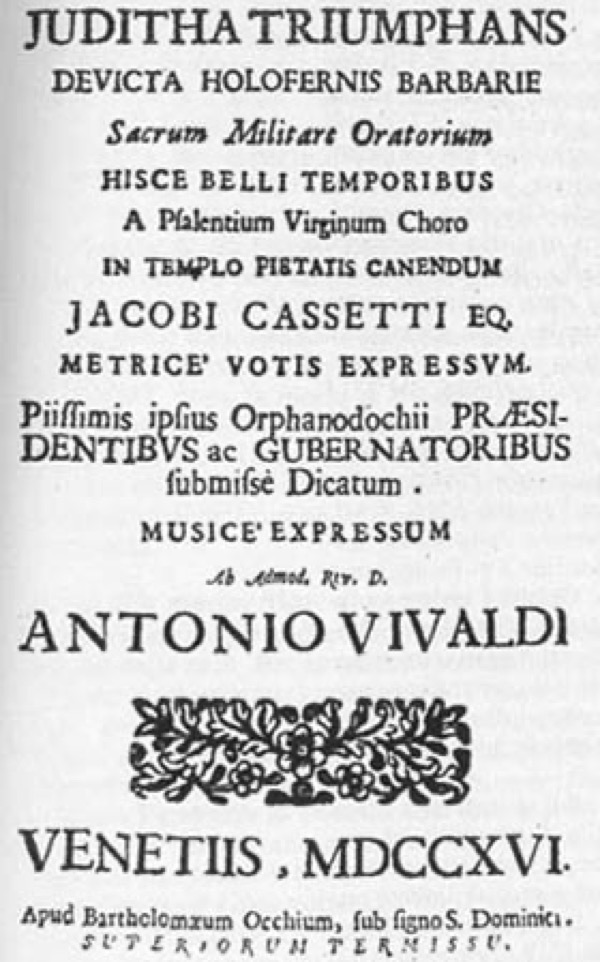
Vivaldi playbill
Vivaldi’s grand, operatic oratorios were basically unstaged operas on morally uplifting Biblical subjects. They were especially popular during Lent, when opera houses were closed.
In the BBC documentary Vivaldi’s Women, the possibility is floated that these works may have been inspired by Vivaldi’s desire to bridge the gap between the two worlds, bring the glamour and showmanship of the opera house to his colleagues at the Pietà.
The Pietà commissioned two oratorios from Vivaldi in the 1710s: Moyses Deus Pharaonis (RV 643), which is now lost, and Juditha triumphans (RV 644), which dates from 1716.
Vivaldi’s Juditha triumphans
Juditha is especially interesting. It was commissioned to celebrate a victory of the Republic of Venice over the Turks, so had political resonance.
It is written for all-female forces, with all roles, both male and female, being sung by women. Vivaldi also made sure to include prominent parts for recorders, oboes, violas d’amore, and mandolin: instruments not usually associated with women performers.
In Juditha, Vivaldi chose to dramatise the Old Testament story of the Israeli widow Judith, who seduces the Assyrian general Holofernes, watches as he falls asleep drunk, and then beheads him. It is a metaphor for the recent military victory: Venice itself – as symbolised by the women – is the unlikely underdog slaying the powerful Turkish forces.
This is normally the kind of gritty, grisly fare that seems more natural for an opera than an oratorio – but Vivaldi clearly wasn’t afraid to broach these kinds of topics, and apparently neither were the women at the Pietà.
Anna Girò
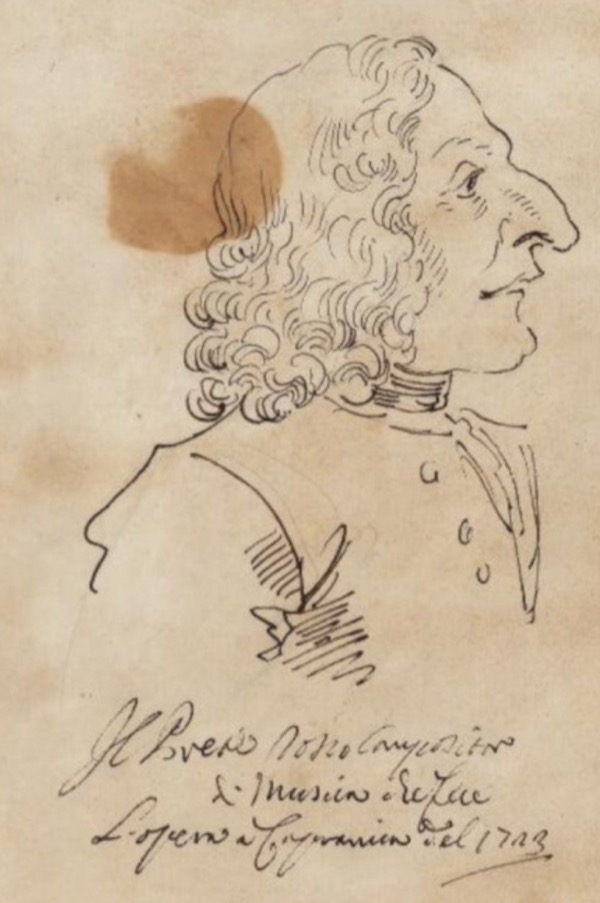
Caricature of Vivaldi, 1723
In the late 1710s, Vivaldi took an additional position as the Maestro di Cappella at the court of Prince Philip of Hesse-Darmstadt, governor of Mantua.
While there, Vivaldi met a child mezzo-soprano named Anna Girò. He was used to working with talented girls and women, and he was especially inspired by Girò.
Around 1722, she moved to Venice to study singing at the Pietà under Vivaldi and moved in with her much older sister Paolina. They eventually moved in with Vivaldi. It was common for a priest to have a live-in female servant, but tongues wagged regardless.
Girò made her Venice debut in 1724 at the age of fourteen, and she sang her first Vivaldi role in 1726, when she was sixteen.
Vivaldi’s aria “Così potessi anch’io” from Orlando furioso
One contemporary described her:
“She was not pretty, but she had charms, a very slim waist, beautiful eyes, lovely hair, a charming mouth, and a small voice, but a great deal of acting ability.”
The two musicians would continue working together for over a decade, until Vivaldi’s death in 1741.
Of course, music-lovers have long wondered whether there were any romantic or erotic undertones to this relationship. In 1737, Vivaldi famously claimed to a patron that there were not.
But the rumours grew so loud that in 1738, when one of his operas was being produced in Ferrara, the city’s cardinal denied him entrance for his association with Girò.
What’s the truth? Historians don’t know. Even after generations of scholarship, much about Vivaldi’s personal life remains a secret.
The Fall
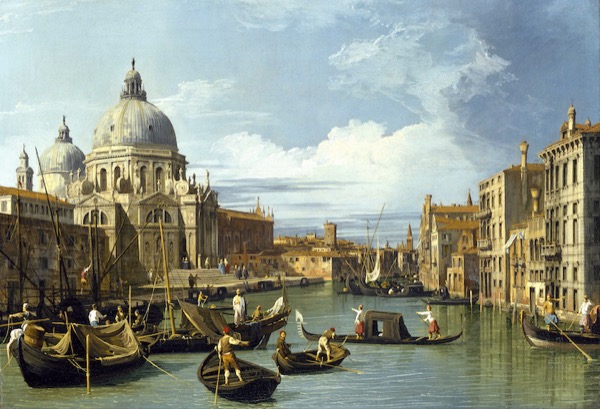
Venice, 1720s
As he aged, Vivaldi’s style of music became less and less marketable.
In 1740, when he was 62, he moved to Vienna after a warm meeting with Emperor Charles VI, going so far as to sell off his scores and manuscripts at low prices to finance the trip. It appears that he wanted to establish himself in the operatic or theatrical world there.
Unfortunately for Vivaldi, Charles died in October 1740, leaving him without a royal patron to smooth the transition between Venice and Vienna.
Vivaldi never got back on his feet. He died of an infection the following July, impoverished.
One contemporary wrote:
“Abbe Lord Antonio Vivaldi, incomparable virtuoso of the violin, known as the Red Priest, much esteemed for his compositions and concertos, who earned more than 50,000 ducats in his life, but his disorderly prodigality caused him to die a pauper in Vienna.”
His manuscripts were gathered and bound into a 27-volume collection, purchased by a count, and kept in storage for generations. They were only rediscovered in the 1920s – two centuries after the height of his career.
One of the works that was embraced in the twentieth century? The Four Seasons!
Vivaldi’s Four Seasons
Conclusion
Vivaldi’s manuscripts sat in storage for nearly two centuries. When they were finally rediscovered in the 1920s, the world slowly began to understand what had been lost – and found.
Today he is one of the most performed composers in history. The Four Seasons alone has been recorded over a hundred times. But the personal life behind that music remains elusive, full of questions that scholarship has never fully answered.
What drove him? What did he feel for Anna Girò? Why did he leave Venice? We may never know.
But the music – written in a city of canals, for girls who were never allowed to leave, by a priest who never said Mass – tells us something. We just have to listen.
For more of the best in classical music, sign up for our E-Newsletter