French composer Maurice Ravel was one of classical music’s supreme craftsmen, once famously compared to a watchmaker.
He was obsessed with details, and as a result, wrote less compared to many of his contemporaries.
The flip side of that perfectionism meant that almost everything he wrote was a masterpiece, whether he was writing for a string quartet, piano, or orchestra.
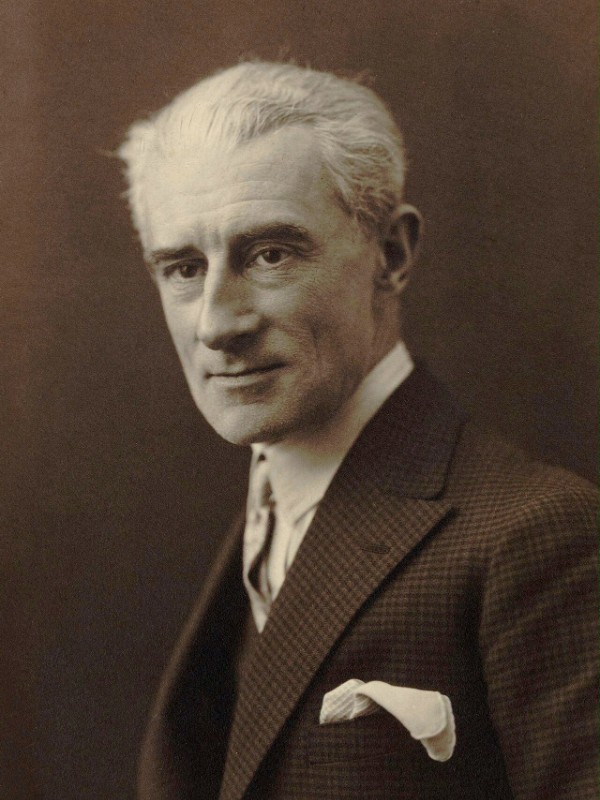
Maurice Ravel in 1925
If you want to understand Ravel in just one hour, the following six works trace his evolution from refined fin-de-siècle Parisian to a Frenchman teetering on the edge of a modernist rupture.
Taken all together, they paint a picture of one of the 20th century’s most precise musical minds.
Pavane pour une infante défunte (6 minutes)
Ravel was just twenty-four when he wrote the Pavane, originally for piano.
Despite the title, it is not a funeral piece. Ravel later insisted he simply liked the sound of the words “a pavane for a dead princess” – and consequently imagined a Renaissance dance drifting through a Spanish court.
The melancholy music moves with aristocratic restraint. The melody never becomes overdramatic or saccharine; even in its more dramatic orchestral version, the sound is always transparent and dignified.
He later urged performers not to let the tempo lag, yet another indicator of how carefully he planned his works.
This is Ravel at the threshold of a major career. He is refined, self-controlled, and already boasts an impressively well-developed creative voice.
String Quartet in F major – Movement 2 (6 minutes)
Composed just a few years after the Pavane, this string quartet helped to establish Ravel as a serious composer of multi-movement works.
The second movement – a plucky scherzo – is especially memorable, snapping with a tight rhythmic precision.
Spanish inflexions flicker in and out of the music, reflecting Ravel’s Basque heritage.
Unlike the warm demonstrative Romantic sweep of most 19th-century quartets, this music feels more intentional, more controlled. Here we hear Ravel the perfectionist: every note weighed, every colour exact.
It was an approach and a style that heralded trends to come in 20th-century music.
Gaspard de la nuit – “Ondine” (7 minutes)
With his piano suite Gaspard de la nuit, Ravel entered darker psychological territory.
Inspired by symbolist poetry, the suite depicts supernatural figures.
The first movement, titled “Ondine”, portrays a water nymph attempting to seduce a mortal man.
The piano writing glitters and ripples in liquid arpeggios. Harmonies shimmer without ever settling. It is seductive, elusive, technically demanding music.
Ravel once said he wanted to write something more difficult than Mily Balakirev’s Islamey, widely considered to be the most demanding solo piano work ever written.
But the virtuosity here isn’t just virtuosity for virtuosity’s sake. It’s also incredibly atmospheric – and it never loses its carefully planned structure.
Daphnis et Chloé Suite No. 2 (16 minutes)
Commissioned by the Ballets Russes and premiered in 1912, Daphnis et Chloé represents Ravel at the height of his powers as an orchestrator. In fact, this work marks him as one of the finest of his generation.
His Suite No. 2 consists of music from the ballet score arranged and adapted for the concert hall.
It begins with an aural depiction of one of the most luminous sunrises in music history. Strings murmur; winds shimmer; the chorus glows from within the texture.
The sound gradually expands until it erupts into the final Danse générale, ecstatic in its vitality.
Piano Concerto in G major – Movement 2 (9 minutes)
Almost two decades later, Ravel embarked on a tour of America. While there, he fell under the influence of the harmonies and rhythms of jazz music.
Consequently, this piano concerto, composed between 1929 and 1931, blends Parisian refinement with the vitality of American jazz.
The second movement is the heart of the work.
A long, unbroken melody unfolds over delicate accompaniment, serene and luminous. It feels almost Mozartean in its simplicity, but modern in its harmony and emotion – a striking, intoxicating combination.
After the earth-shaking brilliance of Daphnis, this movement feels deeply intimate and human.
La Valse (12 minutes)
The Pavane may have evoked mental imagery of a misty aristocratic memory, but La Valse demolishes it.
Originally conceived as a tribute to Vienna, the piece developed into something far darker after the destruction of World War I.
Ravel’s waltz seems to materialise from dust, elegant and seductive. It gradually accelerates, fractures, and finally spirals into a chaos that is both elegant and savage.
Many have interpreted it as a metaphor for a continent decimated by war. Ravel denied any explicit program, but the music’s violence is undeniable.
Conclusion
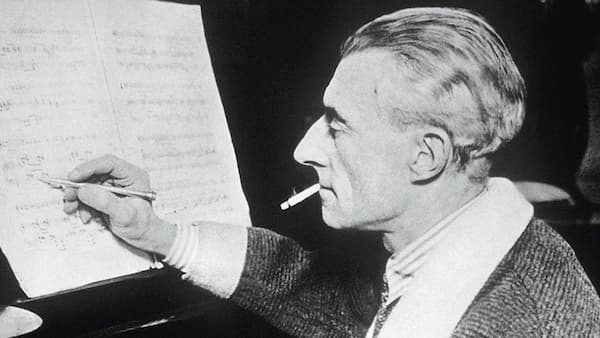
Maurice Ravel in 1928 © Fototeca Gilardi / akg-images
Few composers in 20th-century classical music balanced orchestral colour and structural control as effortlessly as Maurice Ravel.
Whether writing for piano, string quartet, concerto, or ballet, he fused radiant beauty with his meticulous craftsmanship.
Across these six Ravel masterpieces, we encounter a composer who could evoke elegance, jazz-inflected modernity, or even cultural collapse, all within a framework of exacting precision.
That rare fusion of colour and control is what makes Ravel’s music endure.
For more of the best in classical music, sign up for our E-Newsletter