
The narrator of Florence Price‘s achingly tender song “Brown Arms (To Mother)” seems to reach for something just out of reach. It is one of the most quietly devastating songs in the American art song repertoire – and once you know the full story behind it, it becomes almost unbearable to hear.
Price wrote both the words and the music herself, around 1931. She submitted it to the national Rodman Wanamaker Contest at a moment of enormous personal upheaval: she was divorcing her abusive husband, becoming a single mother, and beginning, finally, to receive serious recognition as a composer.
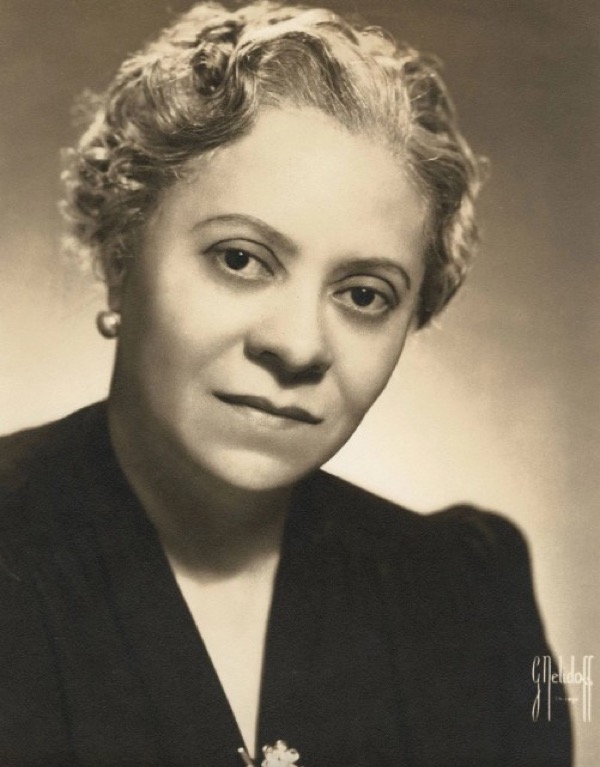
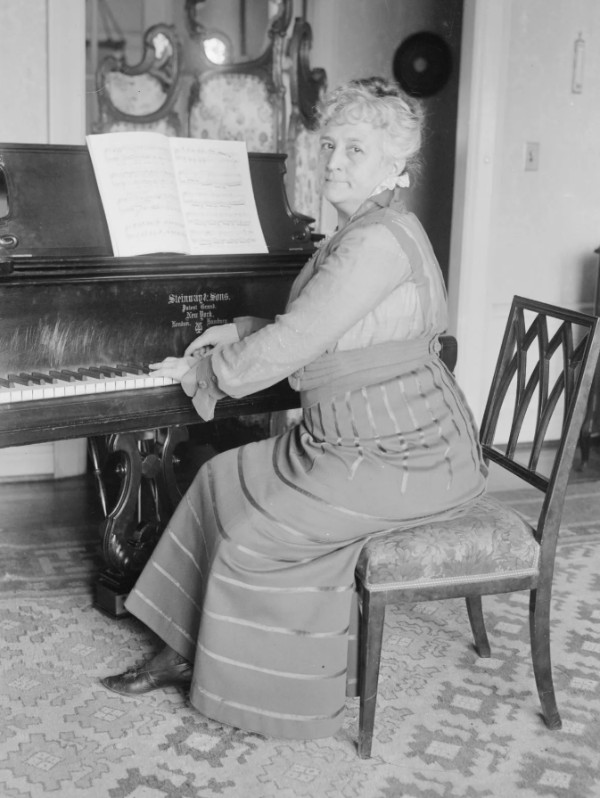
Florence Price
The song is addressed to her mother. But by that point, her mother had been absent from her life for nearly twenty years – still alive, but having started over, finding it easier to survive in America by hiding her Black ancestry and remaking her identity entirely.
To understand what “Brown Arms (To Mother)” really means, you first have to understand that heartbreaking mother-daughter story.
Florence Price’s Mother: A Life Defined by Race in America
As was common practice in the nineteenth century, Florence Price was named after her mother, also named Florence.
To make the story easy to tell, today we’ll refer to the composer as Florence Beatrice and the composer’s mother as Florence Irene.
Florence Irene Gulliver was born in Indianapolis, Indiana, in 1854. This was almost a decade before Lincoln issued his Emancipation Proclamation, freeing the slaves.
Her parents were William Gulliver, a prosperous barber, and Mary McCoy Gulliver. They had come from a small population of freed Blacks from North Carolina and had moved to Indiana in search of better economic and educational opportunities.
Both William and Mary had mixed racial ancestry – a common consequence of the sexual violence that white plantation owners inflicted on enslaved women, whose children grew up with lighter skin and an ambiguous social position.
How light-skinned were they? The census records are telling.
In 1860, the Gulliver household was recorded as “mulatto.” By 1870, it was listed as “white.” A 2023 article in the New York Times reported that a newly discovered photograph of Mary suggests she may have passed as white.
William, meanwhile, was described in newspaper accounts as “colored.”
The family occupied a genuinely uncertain space in the rigid racial taxonomy of nineteenth-century America.
That uncertainty would shape everything that followed.
The Lawsuit That Defined a Family
In 1870, when Florence Irene was sixteen years old, her father William did something remarkable: he sued the Indianapolis City Schools for refusing to admit his daughter to the white high school.
To build his legal case, he argued that his family’s Cherokee heritage meant they could not be excluded on racial grounds. The family lost.
The defeat was both a legal and a personal humiliation. But Florence Irene did not give up on her education. She understood, as her entire family did, that an education was the surest path to the kind of stability that racism kept trying to deny them.
She pressed on, becoming a pianist, an amateur singer, and eventually an elementary school teacher in Indianapolis.
It is believed she was the first Black teacher in a white Indianapolis school – a remarkable fact given that she had been legally barred from attending one as a student just years earlier.
Marriage, Little Rock, and the Birth of Florence Beatrice
In 1876, Florence Irene married Dr. James H. Smith, a dentist who had fought similarly hard for his own professional standing. At one point, he was one of just twelve licensed Black dentists in the entire United States.
The couple moved to Little Rock, Arkansas, where he established a thriving practice.

Downtown Little Rock
Their composer daughter, Florence Beatrice Smith, was born in 1887.
By then, the family had reached a comfortable, even prosperous position. Dr. Smith’s practice served patients of all races. They lived in an integrated neighbourhood in a beautiful home. And at the centre of that home sat a piano, on which Florence Irene began teaching her daughter to play from a very early age.
But their comfort proved precarious. Jim Crow laws were tightening across the South, and no amount of economic prosperity could protect a Black family from their reach.
In 1894, James and Florence Irene purchased first-class train tickets – and were forced to move to the segregated car anyway. Florence Irene formally complained that the accommodations were unfit for passengers and sought $5,000 in damages.
The outcome of the case is not recorded, but the incident illustrates both the indignities the family endured and their persistent refusal to accept them quietly.
Loss, Abandonment, and a Devastating Choice
Dr. James Smith died in 1910. Settling his estate was complicated. He had left behind debts, which led in turn to legal issues.
Once the grieving Florence Irene wrapped it all up, she’d simply had enough. Florence Price biographer Rae Linda Brown wrote that “she could take no more of being Negro, and worse, a southern Negro.”
She decided to take startlingly drastic action to reinvent herself: to renounce any element of her life that was Black. That included abandoning Florence Beatrice, her only surviving child.
Around 1912, when Florence Beatrice was in her mid-twenties, she withdrew completely from her daughter’s life. There is no evidence they ever communicated after this point.
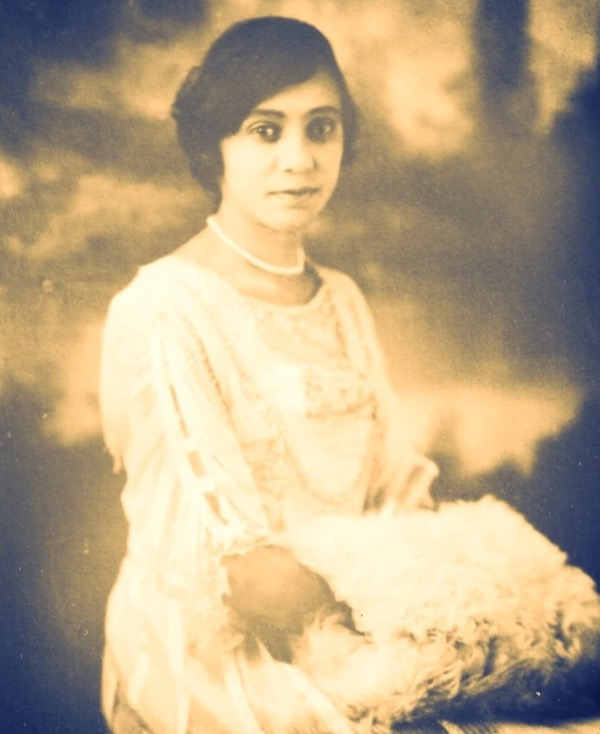
Florence Price
Florence Irene moved back north to Indiana and later to Pennsylvania. In Pennsylvania in 1925, she married a white florist. She died in 1948, just a few years before her daughter. She was counted as “white” in censuses.
The Choice Florence Beatrice Made Instead
Part of what makes Florence Beatrice’s story so extraordinarily moving is the choice she made in the face of what her mother had done.
Whereas Florence Irene had renounced her Black identity to survive, Florence Beatrice embraced hers, fully and publicly, and made it the very foundation of her art.
In a letter she wrote in the 1930s to conductor Serge Koussevitzky – who never replied – she described her compositional voice with quiet precision:
“Having been born in the South and having spent most of my childhood there, I believe I can truthfully say that I understand the real Negro music. In some of my work, I make use of this idiom undiluted. Again, at other times, it merely flavours my themes. And at still other times, thoughts come in the garb of my mixed racial background.”
Although she writes with characteristic modesty, this letter serves as a kind of artistic thesis statement. And it is, implicitly, a rebuttal to the path her mother had chosen.
Florence Beatrice was not going to disappear. She was going to make the fullest possible use of exactly who she was.
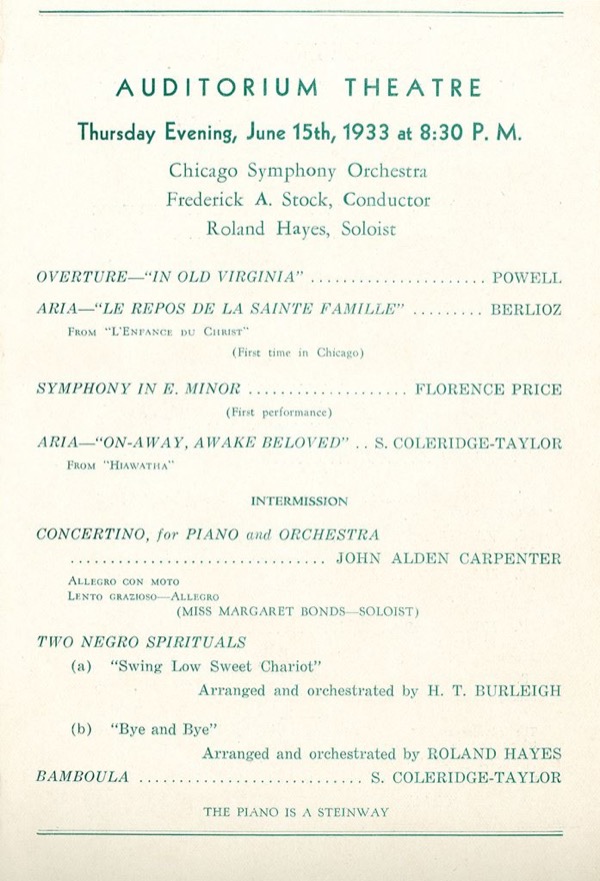
Price’s Symphony No. 1 in E minor was performed by the Chicago Symphony Orchestra in 1933
In 1933, her Symphony No. 1 in E minor was performed by the Chicago Symphony Orchestra, making her the first Black woman composer to have a work performed by a major American orchestra.
Price’s Symphony No. 1
“Brown Arms (To Mother)”: The Song She Wrote for the Woman Who Left
It was during this same period – the early 1930s, as her career was finally gaining recognition and her marriage was dissolving – that Florence Beatrice wrote “Brown Arms (To Mother).”
She wrote both the lyrics and the music and submitted them to the Rodman Wanamaker Contest.
The song is a lullaby in reverse: not a parent soothing a child, but a grown child longing for a mother’s arms.
It speaks of exhaustion, of the coldness of cities and strangers, of a deep need to return to something warm and elemental.
Price chose the word “brown” – not “dear” or “gentle” or “sweet” – and that choice, in the context of her life and her mother’s, does not feel accidental.
Price’s “Brown Arms (To Mother)”
The lyrics Price wrote read:
Listen, Oh brown kind mother,
I am weary, and I would rest.
Put your old warm arms about me,
Let me lie on your withered breast.
I am very sick of cities,
of faces cold and strange;
I long for your sun-washed spaces,
blue skies and wind-swept range.
I am sick of the huddled houses
And the selfish hearts of men.
Put your warm kind arms about me.
Let me lie on your heart again.
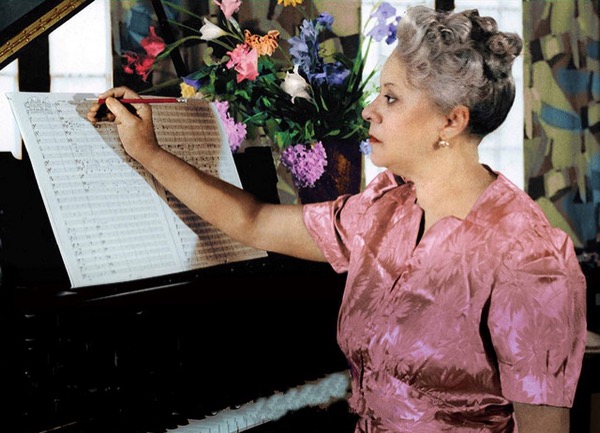
Florence Price
From the pen of Florence Beatrice, no doubt writing with the lost Florence Irene in mind, these lyrics become overwhelming.
We do not know for certain whether the song was addressed to Florence Irene specifically, or whether Price was also reaching toward something broader: the Black maternal tradition, the South she had left behind, the earth itself. Arguably, the lyrics support all of those readings.
But knowing the biographical reality behind it gives the song a specificity and a sorrow that is hard for a listener to shake.
Why “Brown Arms (To Mother)” Still Matters
Another performance of Price’s “Brown Arms (To Mother)”
“Brown Arms (To Mother)” is one of hundreds of works in Florence Price’s extraordinary catalogue.
She composed four symphonies, multiple piano concertos, chamber music, organ works, and more. All are fascinating, but not many carry the kind of autobiographical weight this art song does.
Florence Irene lived until 1948 – long enough, in theory, to hear her daughter’s Symphony No. 1 performed by the storied Chicago Symphony Orchestra, and long enough to know what Florence Beatrice had made of the identity she had fled. There is no evidence she ever did.
Still, the song remains.
For more of the best in classical music, sign up for our E-Newsletter






Thank you for this wonderful article! What a treasure this beautiful piece is, even more so with its poignant history.