Austrian painter Gustav Klimt (14 July 1862–6 February 1918) was an important figure in the development of the Art Nouveau style in Europe. His fascination was the female figure, and many of his works were considered obscene for their eroticism. While he was responding to the preoccupations of the world of late–19th-century Vienna, his patrons didn’t want to see it all paraded out in front of them.
The art of Klimt has inspired composers who respond to the intimacies and secrets in his paintings. Klimt shows us the surface of situations using closed eyes, intertwined positions, and flushed faces to indicate the emotions going on behind the visual. Composers have picked up on those intimations and feelings, and are able to put complex processes: flowing water, a golden rain, a triumphal murder, a passionate moment into their music to take the listener beyond the surface and into the art itself.
American composer Robert Xavier Rodríguez (b. 1946) took 4 of Klimt’s works and created Above All, Women: 4 Images of Gustav Klimt, a work for string quartet based on Water Serpents II (1904–1907), The Kiss (1907–1908), Judith and Holofernes (1901), and Danaë (1907–1908).
Movement I, Water Serpents II (Wasserschlangen II) is about the water women’s flowing movements. Bound up in red seaweed, the lithe bodies intertwine. In the music, a combination of rippling movement and instrumental pairs conveys Klimt’s shifting bodies.
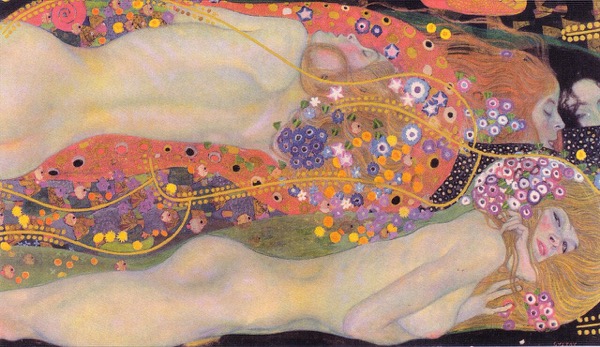
Klimt: Wasserschlangen II (Water Serpents II), 1904–1907 (private collection)
Robert Xavier Rodríguez: Above All, Women: 4 Images of Gustav Klimt: I. Sea Nymphs (Amernet String Quartet)
One of Klimt’s most famous pieces, The Kiss, captures a couple in a passionate embrace. Dressed in a bright golden robe, the man bends to kiss the kneeling woman, wrapped in the fabric. By use of a flat background, Klimt is cutting his ties with the Impressionists, who showed landscape details; the only suggestion of place in the painting is at the base, where a flowery meadow seems to trail upward into the material behind the couple.
The music starts with a gentle nuzzling between the two violins. As the intensity of the couple’s embrace increases, so does the tension in the music: each tempo increase brings a doubling of the motion until it reaches a climax of true passion. The release from the tension returns the nuzzling of the opening and a quiet close.
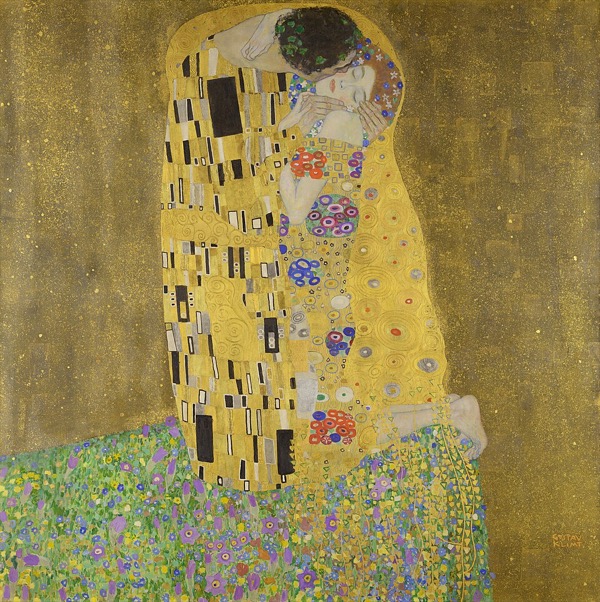
Klimt: Der Kuss (The Kiss), 1907–1908 (Vienna: Österreichische Galerie Belvedere)
Robert Xavier Rodríguez: Above All, Women: 4 Images of Gustav Klimt: II. The Kiss (Amernet String Quartet)
The earliest work in this collection of 4 paintings, Judith and Holofernes, takes us to the Apocryphal story of Judith, an Israelite widow who seduces the Philistine general Holofernes. In their intimate moment after meeting, she cuts off his head.
In the music, Rodríguez places us beside Judith as she creeps into the enemy camp, underscored by pizzicato strings. A cello outburst from Holofernes is soothed as he perceives her beauty and, literally, changes his tune. Their intense encounter is followed by a time of contented relaxation before Judith’s striking action against the sleeping general.
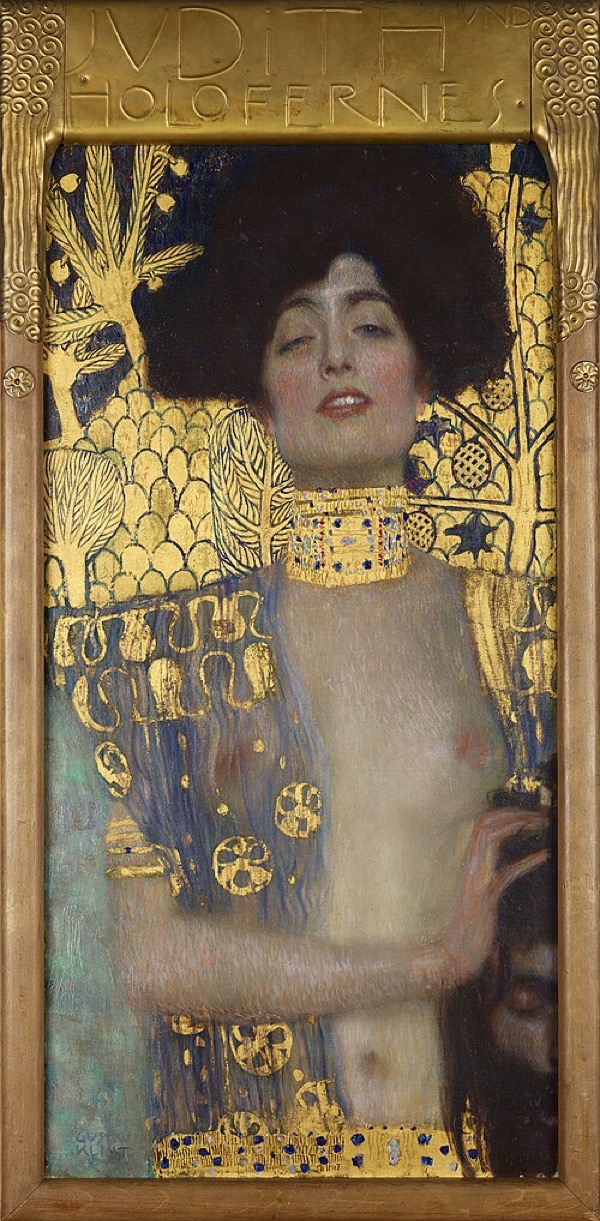
Klimt: Judith und Holofernes (Judith and the Head of Holofernes), 1901 (Vienna: Österreichische Galerie Belvedere)
Robert Xavier Rodríguez: Above All, Women: 4 Images of Gustav Klimt: III. Judith (Amernet String Quartet)
In Danaë, Klimt depicts the daughter of King Acrisius, imprisoned in a brass tower. The Delphi Oracle has indicated that Danaë’s son will kill Acrisius, and so he’s keeping her from any man. Zeus, of course, laughs at obstacles and descends on Danaë as a shower of golden rain. Her son, Perseus, fulfils the Oracle’s prophecy and kills Acrisius. The ways of Fate cannot be forestalled.
The shower of golden rain is musically portrayed by overtone glissandi on the instruments’ open strings. Zeus’ melody is in the cello while the upper strings shower down his favour. Danaë, as shown in the painting, is sleeping when the god enters her prison. After the musical climax, there’s a triumphal ending.
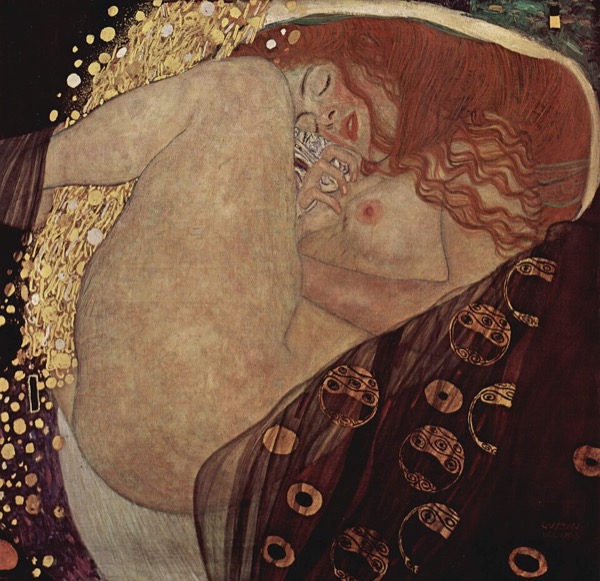
Klimt: Danaë, 1907 (Vienna: Collection Hans Dichand)
Robert Xavier Rodríguez: Above All, Women: 4 Images of Gustav Klimt: IV. Danae (Amernet String Quartet)
The Kiss was also the inspiration for one of Constantinos Y. Stylianou’s Preludes. The ecstasy of the couple’s embrace is very much a part of the musical imagery. It seems to whirl about, carrying us from the meadow to the stars. The moment of still passion in the painting is hidden by the motion of the music, reflecting their internal joy.
Constantinos Stylianou: 12 Preludes, Book 1: No. 9. Der Kuss (Gustav Klimt) (Nicolas Constantinou, piano)
Klimt’s art shocked contemporary Vienna and, at the same time, let it examine itself in a new way. The stripped-down imagery with the backgrounds removed, and the focus solely on the subject, permitted the artist to give his women a depth of feeling that was new to the genre. A subject such as Judith is never shown as powerful and triumphant, and so full of her own sexuality, as Klimt has depicted her. There’s pride in her lifted head while her half-closed eyes and open lips are full of a replete sensuality. A contemporary critic said about the piece, ‘with a sultry fire in her dark glances, cruelty in the lines of her mouth, and nostrils trembling with passion. Mysterious forces seem to be slumbering within this enticing female’. She’s more than just a willing widow….
For more Interlude articles on Klimt, see:
https://interlude.hk/gustav-klimt-1862-1918-born-on-14-july/
https://interlude.hk/gustav-klimt-1862-1918-all-art-is-erotic
https://interlude.hk/the-vienna-secession-in-art-and-music/
https://interlude.hk/korngold-suite-wittgenstein-klimt-music/
https://interlude.hk/musicians-and-artists-gil-shohat-and-modernism/
For more of the best in classical music, sign up for our E-Newsletter