
The legendary Italian tenor Carlo Bergonzi (1924-2014) is widely considered one of the finest interpreters of Giuseppe Verdi‘s tenor roles in the twentieth century. His elegant vocal technique combined nobility with great expressive warmth.
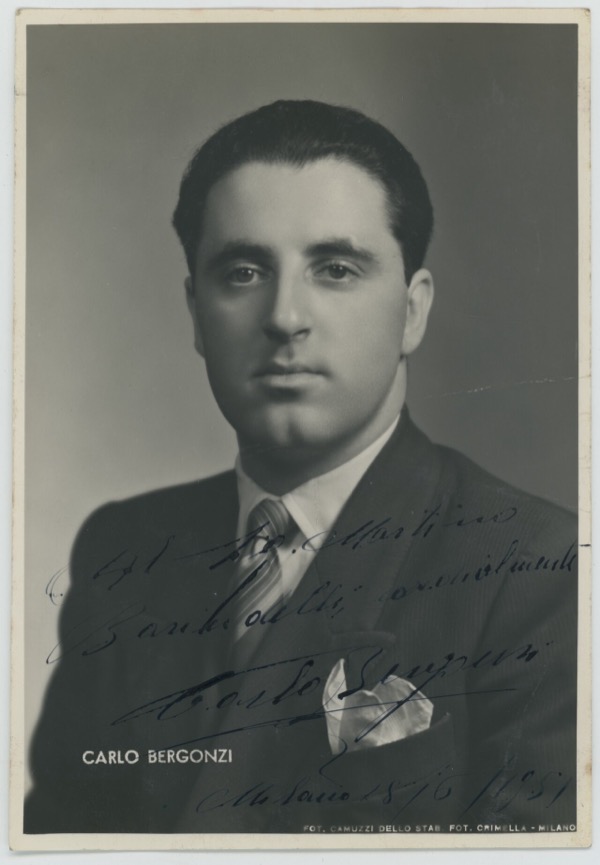
Carlo Bergonzi, 1951
To celebrate his birthday on 13 July, let us highlight a tenor whose flair for creating an instant Verdian atmosphere became legendary, as he convinced audiences they were in the presence of the characters he portrayed.
Carlo Bergonzi sings Verdi: Luisa Miller, “Quando le sere al placido”
Shaped in Verdi’s Homeland
As David Salazar relates in his 2018 feature, “He is often cited as a textbook example of great Verdi singing, his voice possessing both the heft for some of the heavier passages, and the lightness for some of the refined moments in the composer’s oeuvre.” (Salazar, Supreme Verdi Tenor, 2018)
Carlo Bergonzi was born in the hamlet of Vidalenzo, near Verdi’s birthplace, Busseto, on 13 July 1924. His father was a cheesemaker and an ardent opera lover. Apparently, he took his six-year-old son to a performance of Il Trovatore at the local theatre.
He sang in local churches and at the local theatre, and in 1938, at the age of fourteen, he decided to become a professional singer. Bergonzi recalls that he was working in the same cheese factory as his father when his supervisor told him to either work or sing. With his father’s blessing, he went to audition for Edmondo Grandini, who was singing Rigoletto in Busseto.
Carlo Bergonzi: “De’ miei bollenti spiriti” (Verdi’s “La traviata”)
From Baritone to Tenor
Grandini assessed him as having a promising voice, but classified him as a baritone. Early lessons were interrupted by World War II, but when he returned to Italy from a German prisoner-of-war camp, he enrolled at the Boito Conservatoire in Parma.
Ettore Campogalliani, who had also taught Tebaldi, Scotto, Freni, Pavarotti, and Raimondi, likewise classified Bergonzi as a baritone. He made his debut in Lecce as Figaro and sang baritone roles for three years.
When he was singing Sharpless in Madama Butterfly in Livorno, he made a bet with himself to try to reach a high C while vocalising before the performance, and he succeeded effortlessly. He began to retrain his voice for the tenor register using recordings of four great tenors, namely Caruso, Gigli, Schipa, and Pertile.
Carlo Bergonzi sings Verdi: Rigoletto, “Questa o quella”
Career Breakthrough
It was his second debut, in 1951 as Chénier in Bari, that established him as a tenor of great promise. In that year, he was engaged by Italian radio to take part in performances marking the 50th anniversary of Verdi’s death.
From his early days, his singing was a model of unfailing sensitivity and refinement. He first sang at La Scala in 1953, creating the title role of Napoli’s Mas’Aniello, and appeared there for the next twenty years.
His big international break came in 1955 when he made his American debut at the Chicago Lyric Opera. He sang regularly at the Metropolitan Opera from 1956 for 30 years, making one of his final appearances there in 1988 as Rodolfo in Luisa Miller.
Giuseppe Verdi: I Masnadieri: “O mio castel paterno” (Carlo Bergonzi, tenor; New Philharmonia Orchestra; Lamberto Gardelli, cond.)
The Ideal Verdian Tenor
When Bergonzi sang Verdi, the listener became aware of a fusion between the composer and his interpreter. Everything about his singing seemed ideally suited to Verdi, including the timbre, the colour of his voice, the accents, and the special way of declaiming.
Most importantly of all, he was able to project the proud and noble virility of Verdian phrasing. As Alan Blyth writes, “His voice was of beautiful quality, well-modulated and well defined; he used it with taste, discretion and an elegant sense of line.”
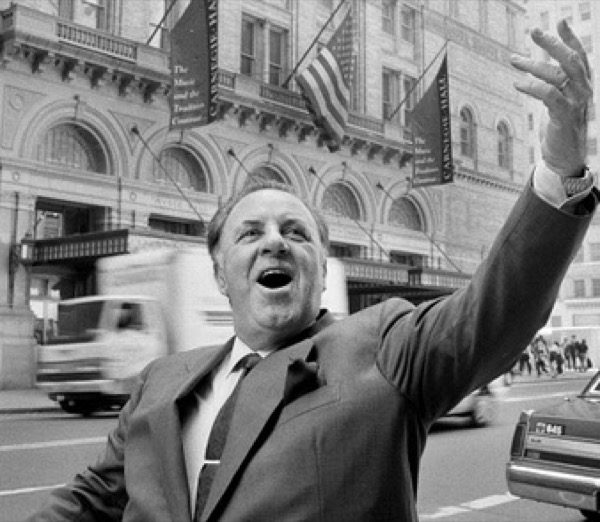
Carlo Bergonzi
Bergonzi championed not only Verdi’s best-known operas, but also appeared in neglected works such as Giovanna d’Arco and I due Foscari. An eminent laryngologist, who has treated many great singers over the past decades, suggests that all students of tenor singing should, as an obligatory part of their education, listen to Carlo Bergonzi singing Verdi.
For more of the best in classical music, sign up for our E-Newsletter
Giuseppe Verdi: Messa da Requiem: “Ingemisco” (Carlo Bergonzi, tenor)






Thank you for remembering dear friend Carlo Bergonzi. It melts my heart to hear his voice that he addressed to me so many times!!