In 1878 and 1886, Antonín Dvořák (1841–1904) created his Slavonic Dances, Opp. 46 and 72. In this series of 16 dances, Dvořák picked up on the idea from Johannes Brahms‘ Hungarian Dances. Dvořák originally wrote this for piano four-hands, and, at the request of his publisher, they were orchestrated shortly thereafter.
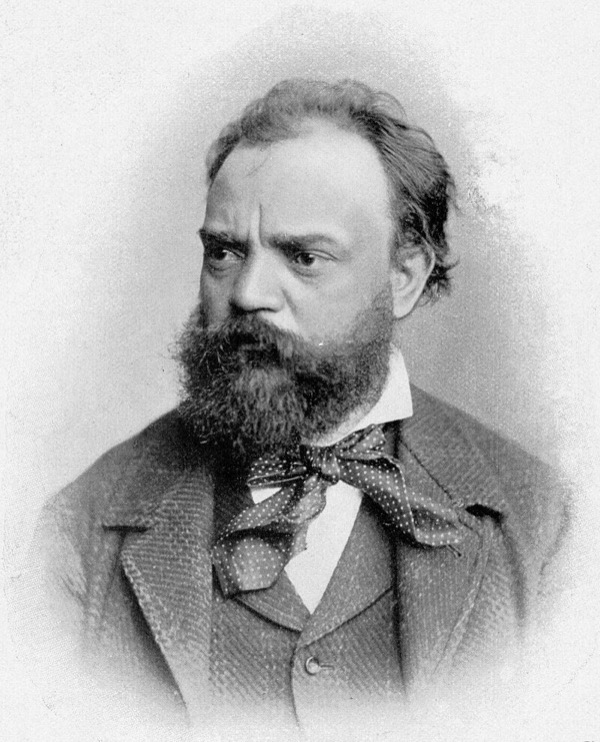
Antonín Dvořák, 1892 (Gallica: btv1b8417521d)
Despite the ‘Slavonic’ title, which would imply dances from anywhere in central, southeastern, or eastern Europe (covering Poland, Croatia, Ukraine, Russia, among many other countries), the style of these dances is solidly Czech. In point of fact, Dvořák was really writing using styles and forms from his native Bohemia. As with so much of his work, he’s not quoting real folk music as much as writing in the style of, capturing Bohemian rhythms and folk-dance structures.
The release of the Slavonic Dances was Dvořák’s introduction to the musical world outside his native land. Dvořák had applied for the Austrian State Prize to support his composing work and won it three times: 1874, 1876, and 1877. Brahms, as one of the award committee members, stepped in and was enormously helpful in bringing Dvořák to the attention of his own publisher, Simrock.
Simrock was impressed with Dvořák’s four-hand Slavonic Dances and requested the orchestral version; both sets were successful and became the start of Dvořák’s international reputation. In the end, it led him to the United States and the founding of the short-lived National Conservatory of Music of America in 1892.
The seventh number of the Op. 72 Slavonic Dances was based on the Bohemian dance called the kolo. This is a chain dance for anywhere from 3 to 15 people, with all dance movements happening with the feet while the body moves little. People may hold hands or hold each other around the waist to form the chain. Dancers move to the left and right with side steps and little hops, gradually moving the line to the left. Each of the South Slavic regions will have its own variation on the kolo dance, and experienced dancers can dress up the steps with syncopation or higher hops. It’s a fast dance!
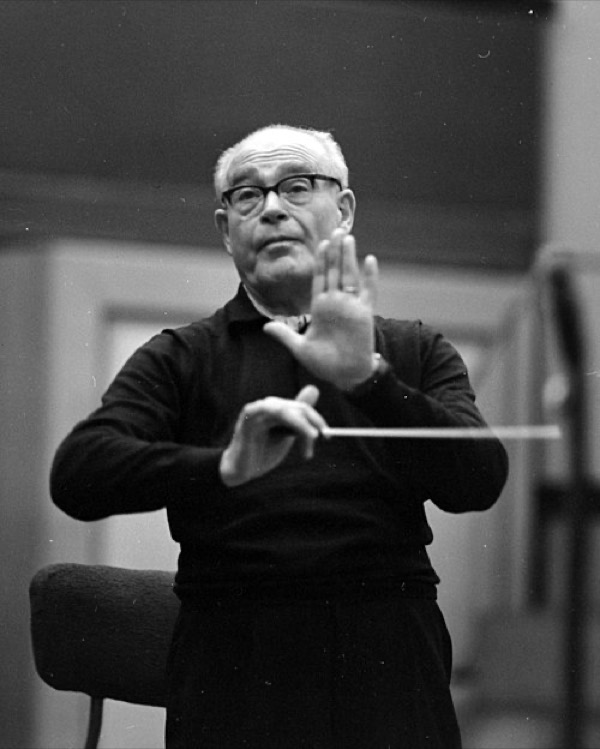
Paul Kletzki, 1965
This was recorded in 1961 by the National Orchestra of the RTF under the direction of Paul Kletzki. Polish conductor Paul Kletzki (1900–1973) spent WWII avoiding the Nazis, leaving Berlin, where he had conducted the Berlin Philharmonic under the guidance of Wilhelm Furtwängler, for Milan, Italy. Eventually, he fled to Russia to escape Italian antisemitism. In 1946, he returned to Milan for La Scala’s reopening and eventually settled in Switzerland, becoming a Swiss citizen in 1949. He was known for his championing of the works of Gustav Mahler after the war. In 1954, he was appointed chief conductor of the Liverpool Philharmonic Orchestra, and in 1955, he led the first recordings of the Israel Philharmonic Orchestra. From 1958 to 1961, he was principal conductor of the Dallas Symphony Orchestra and from 1967 to 1970, was the General Music Director of the Orchestre de la Suisse Romande. His death in 1973 came while he was conducting a rehearsal of the Liverpool Philharmonic.
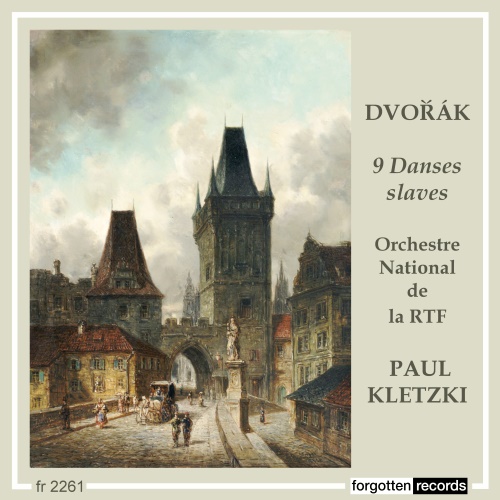
Performed by
Paul Kletzki
National Orchestra of the RTF
Recorded in 1961
Official Website
For more of the best in classical music, sign up for our E-Newsletter