Learning the violin isn’t just about what you practice; it’s about how you practice.
Many beginners spend hours playing through scales, etudes, and repertoire, yet still feel stuck with scratchy tone, shaky intonation, or persistent tension.
That frustration often comes from a simple problem: no one ever explained what effective practice actually looks like.
Good practice isn’t mindless repetition. It’s deliberate, focused, and sometimes mentally tiring, but it’s also the fastest path to real progress.
Whether you’re just starting out or trying to break through a plateau, these practical violin practice tips will help you build better habits, improve your sound, and make the most of every minute you spend with your instrument.
1. Learn how to practice scales.
Stefan Jackiw’s video on “The Art of Practicing Scales”
There is a reason why professionals play scales daily. Scales are not finger drills; they’re ear-training and sound-training.
However, beginners often aren’t taught how to practice scales, or don’t understand what they’re supposed to get out of doing so.
First off, focus on creating a beautiful tone.
Second, practice intonation by recognising that there is a built-in way to check intonation. Open strings resonate with the same notes in different octaves.
For instance, play G on the D-string with your third finger in first position. When that finger is in tune, the open G-string will actually vibrate in resonance.
This is how resonance works on a violin: open Gs, Ds, As, and Es will all vibrate in sympathy with any stopped Gs, Ds, As, and Es.
These ringing, vibrating strings are the start to training your ears and fingers to improve your intonation.
2. Recognise that practice makes permanent, not perfect.
If you are playing a passage and are not happy with it, it’s a common beginner’s mistake to keep playing to fix it.
Don’t!
This is difficult at first, and everyone resists it. But you will not improve by just playing the same passage over and over again. In fact, it’s actually harmful.
Slow down. Pinpoint specifically what’s going wrong, even if you’re only working on one or two things, like a particular note being consistently flat, or an uneven string change.
Now that you’ve figured out those one or two things, repeat while paying attention to how you can improve them.
Does that sound mentally exhausting? It should. Unfortunately, it’s the only way to improve.
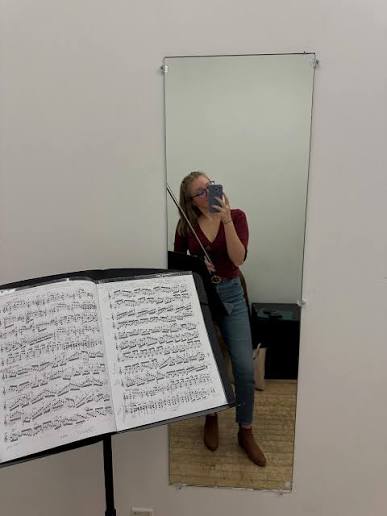
3. Practice in front of a mirror.
© Kristen Barrett on Instagram
Vi Wickham’s video on How to Practice in Front of a Mirror
First off, bring a full-length mirror into your practice space and place it where you can see your whole body.
Next, spend time learning and observing how professional players stand and sit while playing their instruments.
Your teacher will also probably have lots of advice about how to work on your specific posture and body use.
Regularly look in the mirror and observe how you look throughout your practice session. You will catch tension, slumping, incorrect angles, and more when you play in front of a mirror.
4. Isolate the difficult parts.
If you hang out on r/violinist on Reddit, you will find a lot of players posting the sheet music to their etudes, solos, or orchestral parts and asking, “How do I play this?”
The answer is: one note at a time. It’s genuinely that simple.
When a passage seems tricky, bring it down to an absurdly slow speed. Take a cluster of two notes, then three notes, then four. Gradually speed those up.
Then take the next cluster of four.
And so on.
Eventually, you’ll be able to start stringing those clusters together.
That is how you learn.
5. Relax your right arm.
Violinna’s Video on How To Have A Relaxed Bow Hand
It may look delicate, and in some ways it is, but your bow can support more weight than you might think.
Experiment by making your right arm as heavy as possible, then try lifting it and moving it around with your left hand.
Be aware that all of that weight can rest on your bow. This is why you should never feel like you need to be pressing into the string or forcing your bow into it.
Pressing will introduce unnecessary tension. Gravity can do so much work for you!
6. Experiment with pressure with your left hand, and only use as much as you need.
Augustin Hadelich – Ask Augustin segment on left hand relaxation
From there, let’s switch hands.
Gravity can also be your friend when it comes to your left hand. Of course, fingers don’t weigh as much as an entire bow arm, but the same general concept applies.
One fun exercise is to press down on the fingerboard as hard as you can while playing.
Now, gradually relax until the tone quality finally deteriorates.
You will probably be shocked at how little pressure is truly needed to stop a string.
Once your left hand becomes more relaxed and fluid, you will be able to play faster and longer without hurting yourself.
7. Play as quietly as you can, and play as loudly as you can.

© Hoffman Academy
While practicing, try experimenting with extremes. Play with them; have fun experimenting to see what kinds of sounds you can make.
Play something as restrained and quiet as possible. Then play the exact same passage as loudly and as extrovertedly as possible.
It’s easy to get stuck playing with the same character. This exercise helps you switch things up, giving you more tools you feel comfortable using when learning and interpreting music.
8. If you hurt, you’re doing something wrong. Stop.
If you start hurting, take note and stop. Immediately let your teacher know. He or she will help you diagnose what’s going on.
Playing the violin isn’t like being in gym class; you’re not supposed to dig deeper and power through it.
You’re using lots of small and vulnerable muscles and are holding them in very unnatural positions. Overuse injuries in this context are real and can be dangerous.
To look like you’re playing effortlessly, you need to put in a lot of effort learning how.
9. Explore the violin repertoire.
Bach’s Sonata for Solo Violin No. 1
Your violin learning doesn’t need to end after you put it back in its case for the night.
Use YouTube, Spotify, or even TikTok to find performances of the violin repertoire.
Active listening to recordings of master players – perhaps accompanied by a free score from imslp.org – can help you absorb good habits, good tone, good intonation, and more by sheer osmosis.
10. Go to live music performances.

A classical concert performance
Hilary Hahn playing Dvořák’s Violin Concerto live
Recordings are important for learning, but so are live performances of all kinds.
Hearing first-rate musicians is an important rite of passage for every aspiring violinist. Hopefully, you’ll come home feeling freshly inspired by the possibilities of the instrument.
Conclusion
There’s no shortcut to learning the violin – but there are smarter ways to practice.
When you focus on tone, intonation, relaxation, and problem-solving instead of just “getting through” your music, improvement becomes easier to achieve.
Practicing slowly, isolating difficulties, using mirrors, listening critically, and respecting your body aren’t optional extras; they’re core skills every successful violinist develops.
Over time, your thoughtful habits will compound – and one day, the things that once felt impossible will feel effortless.
That’s when practicing stops feeling like a chore and starts feeling like progress.
For more of the best in classical music, sign up for our E-Newsletter