The Philharmonie de Paris and the Paris Mozart Orchestra joined forces in 2019 to create an International Competition for Women Conductors. The La Maestra Competition and Academy aims to give greater visibility to women conductors and support them during the process of building their careers.
Essentially, La Maestra is both a high-level artistic contest and a broader reflection of the ongoing shift in the visibility and opportunities for women in orchestral leadership.
We have already met the four finalists, Molly Turner, Alizé Léhon, Jiajing Lai, and Mojca Lavrenčič, in the first part of the final, where each conducted a contemporary commissioned work by Diana Soh as well as movement of either Brahms or Beethoven, decided by lucky draw.
Larger Forces—Higher Stakes
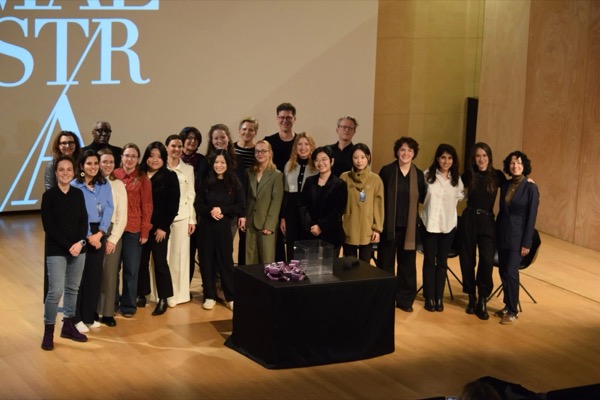
La Maestra 2026 finalists and jury
In terms of audience reception and critical opinion, Alizé Léhon and Jiajing Lai were the clear standout performers in Part 1. Indeed, Lai was arguably considered the most compelling across both works.
For the second part of the finals, each finalist had to conduct the “First Tableau” from Igor Stravinsky’s Petrushka, and one work by Maurice Ravel, either La Valse or the movements “Habanera” and “Feria” from the Rhapsodie espagnole, again decided by lucky draw.
La Maestra 2026: The Final, Part 2
Available until 27/02/2028
Between Potential and Readiness
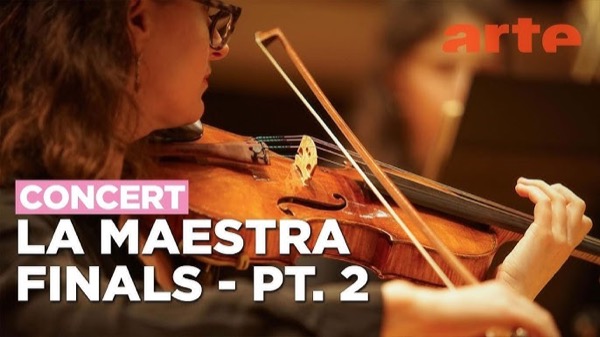
La Maestra Finals, Part 2 (ARTE Concert)
Critical reaction to Molly Turner was the least enthusiastic of the four finalists, consistently so across multiple reviewers. If critics did not like her performance in Part 1, opinions became more openly critical for Part 2. It was felt that she lacked real control, and that the orchestra was not especially responsive to her gestures. Turner was the youngest finalist, and her performance at this stage was seen as more a question of artistic maturity than a lack of talent or potential.
A Favourite Tested by La Valse
Throughout Part 2, Alizé Léhon remained one of the favourites. Vincent Guillemin, writing in ResMusica, suggested that she offered a strong interpretive narrative and clear artistic vision. Christophe Huss, writing for Le Devoir, called her performance of Stravinsky lively, without exaggeration, and eloquent. However, it was suggested that she struggled with La Valse, as the score demands both dance-like elegance and apocalyptic collapse simultaneously.
Convincing Artistic Proposal
Jiajing Lai was again praised for her mature vision and her sensitivity to orchestral colour. Her combination of precision and flexibility, achieved once more without a baton, was enthusiastically praised. Her Stravinsky was described as rhythmically alive and naturally characterised, while the Rhapsodie espagnole was called beautifully chiselled, revealing unusual orchestral colours and details. Guillemin wrote that he and the majority of fellow critics present found Lai’s artistic proposals most convincing.
Fluency Tested in Petrushka
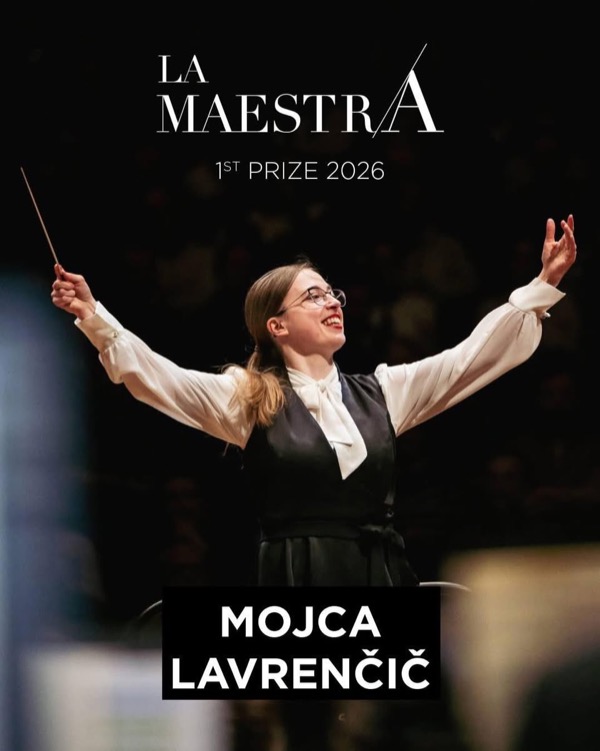
Mojca Lavrenčič, 1st Prize, La Maestra 2026
Mojca Lavrenčič was once again acknowledged for her varied gestural palette and an especially flexible left hand. Huss praised her overall arc and qualities like deep sensitivity and overflowing imagination, while others did not find her Petrushka particularly exciting. Guillemin compared aspects of her podium style to jumping about, describing her as a highly kinetic contemporary conductor. It was not obvious to me, but apparently she missed a key passage before the “Russian Dance” in Petrushka because of her tendency toward too many ideas and an overload of information.
The Talent is There—The Visibility Still Isn’t
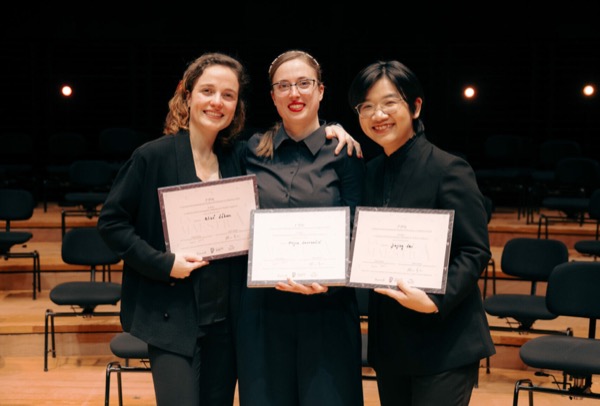
La Maestra 2026 prize winners: Alizé Léhon (3rd), Mojca Lavrenčič (1st), Jiajing Lai (2nd)
The jury had slightly different ideas, and majority voting returned the results of Lavrenčič 1st, Jiajing Lai 2nd, and Léhon 3rd. Mojca Lavrenčič also won five additional awards, most notably the Orchestre de Paris Musicians’ Prize. This commendation comes directly from the musicians of the Orchestre de Paris, suggesting that the players responded strongly to her leadership.
We have learned from the 2026 La Maestra Competition that there is no single “female conducting style,” as the finalists presented markedly different musical personalities. With 225 applicants from around the world, it is equally clear that the problem is no longer a lack of highly qualified and motivated women conductors.
The exceptional talent of women conductors is becoming more difficult to overlook. Yet the limited presence of serious English and German-language criticism beyond reporting results and prizes deprives these artists of the one thing they most desperately need: visibility.
For more of the best in classical music, sign up for our E-Newsletter