On weekends, I just love to get up late and lounge in my pyjamas for most of the day. After making plenty of coffee, I like to sit down at the piano and explore pieces I don’t play every day.
It’s a kind of musical browsing and exploring, an opportunity to revisit forgotten scores or discover some unfamiliar works.
Recently, I came across a cycle for solo piano by Robert Schumann. A cycle I knew by name, but one I had never looked at in any detail. As we celebrate Schumann’s birthday on 8 June, let’s have a closer listen to his Waldszenen (Forest scenes), the last major cycle for solo piano that Schumann composed.
Robert Schumann: Waldszenen, Op. 82: No. 1. Eintritt (Entering the Forest) (Rolf Lindblom, piano)
Poetry Left Behind
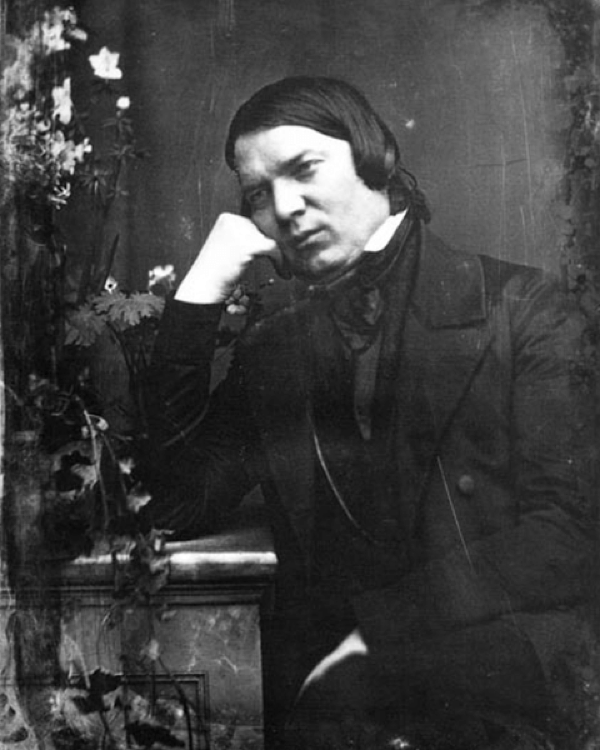
Robert Schumann
Robert Schumann wrote his Waldszenen (Forest scenes) in a matter of days over the New Year of 1849. He was not well, as he had suffered from severe mental instability for much of his life. As we know, he committed himself to an asylum in Endenich in 1854, and he died two years later.
In all, Waldszenen is a set of nine short solo piano pieces with descriptive and occasionally enigmatic titles. I read that Schumann originally wanted to add fragments of poetry to five of the pieces, but he removed all but one of these fragments before publication.
Robert Schumann: Waldszenen, Op. 82: No. 2. Jäger auf der Lauer (Hunter on the Look-out) (Rolf Lindblom, piano)
The Problem with Titles
Was Schumann worried that being too specific in an intentionally evocative musical excursion might, after all, be rather limiting? Something about giving his titles clearly worried Schumann.
As he writes, “The titles for pieces of music, since they again have come into favour in our day, have been censured here and there, and it has been said that good music needs no signpost.”
Robert Schumann: Waldszenen, Op. 82: No. 3. Einsame Blumen (Solitary Flowers) (Rolf Lindblom, piano)
Beneath the Surface
Certainly not, but neither does a title rob it of its value, and the composer, by adding one, at least prevents a complete misunderstanding of the character of his music. What is important is that such a verbal heading should be significant and apt. It may be considered the test of the general level of the composer’s education.
Schumann is a slippery fellow when it comes to his verbal explanations, and he gets even more mysterious in his music. The sequence of small character pieces in Waldszenen initially feels like a continuation of his Album for the Young. However, that would be a grave misrepresentation, as subtle literary and extramusical references form the background to this set.
Robert Schumann: Waldszenen, Op. 82: No. 4. Verrufene Stelle (Haunted Spot) (Rolf Lindblom, piano)
The Hidden Narrative
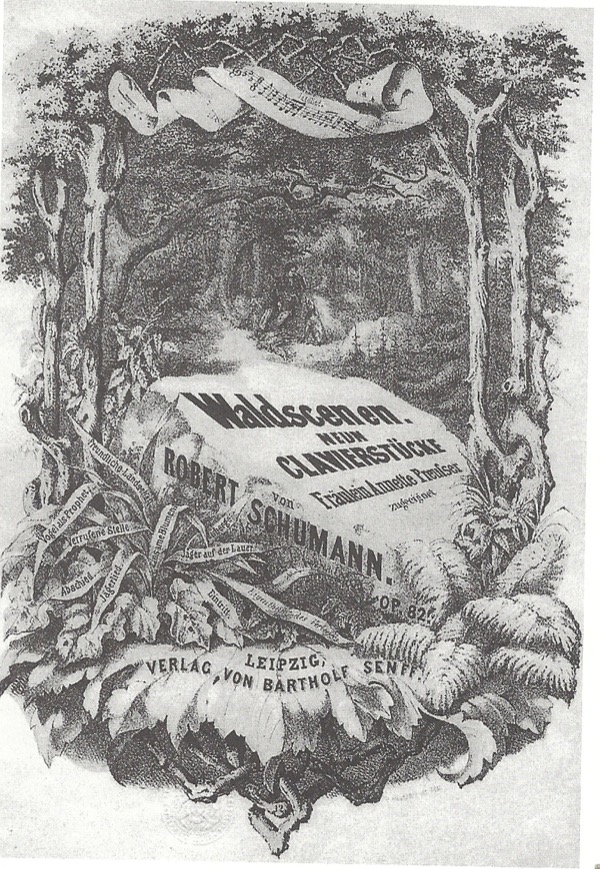
Waldszenen, Op. 82 — title page (Leipzig: Bartholf Senff)
Just how much goes on behind Waldszenen has been the topic of a fascinating dissertation by Wing Yin Li. She argues that the literary narrative technique of the Romantic writer Jean Paul remains relevant in Waldszenen, and she demonstrates how Schumann used musical connections and Romantic musical topics such as fantasy, pastoral, and hunting scenes to create a literary-inspired journey through the forest. (Li, Narrative and Representation in Schumann’s Waldszenen, 2009)
Li finds motivic and tonal cross-references, including tonal departure, to suggest the forest journey. Schumann also manipulates formal conventions through problematic closure and ambiguous formal function. And finally, he alludes to earlier works, essentially telling a “Kunstmärchen,” a fairy tale intentionally authored by a known writer rather than passed down anonymously through oral folk tradition.
Robert Schumann: Waldszenen, Op. 82: No. 5. Freundliche Landschaft (Pleasant Scenery) (Rolf Lindblom, piano)
The Piece Clara Wouldn’t Play
There are many literary and analytical details to be gained by reading Li’s dissertation, but we only need to look at the fourth piece, “Verrufene Stelle” (Haunted Spot), to find a seriously dark prefatory motto by Friedrich Hebbel. Apparently, Clara Schumann always excluded this piece from her concert performances.
The flowers, so high they grow,
Are pale here, like death;
Only one in the middle
Stands there in dark red.
Its colour is not from the sun:
Nor from its heat;
It is from the earth,
And it drank human blood.
The cycle opens much more atmospherically, as the harmony in “Eintritt” shifts between tonic and related keys. As the title (Entering the Forest) implies, the music creates a sense of uncertainty rather than arrival. Just listen to those transparent, flowing inner voices to know you’re entering a shifting sound world.
Robert Schumann: Waldszenen, Op. 82: No. 6. Herberge (At the Inn) (Rolf Lindblom, piano)
Tension and Fragility
There is sudden harmonic tension in “Hunter on the Look-out,” as repeated figures and restrained dynamics suggest immobility. Brief harmonic switches suggest sudden movement just outside the frame, and this miniature has been described as an “affectionate depiction of the sinister.”
“Lonely Flowers” features seemingly clumsy split notes scattered throughout, while a highly ornamented melody floats by. If you ever wanted to experience fragile isolation in music, this is the place to be.
Robert Schumann: Waldszenen, Op. 82: No. 7. Vogel als Prophet (Bird as Prophet) (Rolf Lindblom, piano)
From Shadow into Light
“Haunted Spot,” as we have seen from the poetic inscription, is the darkest movement in the cycle. Dissonant harmonies and abrupt shifts create a feeling of unease, and you might also hear references to Schumann’s Symphonic Etudes and his Kreisleriana.
More diatonic harmonies and open textures welcome us into the “Friendly Landscape.” After the turbulent character of the virtuosic pieces, the music here softens to a sunny interlude located between melancholy and release.
Robert Schumann: Waldszenen, Op. 82: No. 8. Jagdlied (Hunting Song) (Rolf Lindblom, piano)
Dance and Vision
“At the Inn” unfolds dance-like, as the music is almost a Ländler in character. Even in the accompaniment, with its repeated patterns, it suggests rustic simplicity. Compared to the outdoor scenes, this piece has an almost conversational indoor intimacy.
The famous and magical “Vogel als Prophet” (Bird as Prophet) clearly imitates bird calls with its high, flute-like motif. It all starts in a rather sombre minor key, while the bright and choral-like middle section brightens into G Major. For some reason, the music for this section seems to originate in an imagined place.
Robert Schumann: Waldszenen, Op. 82: No. 9. Abschied (Farewell to the Forest) (Rolf Lindblom, piano)
Into Silence
The “Hunting Song” uses fanfare-like figures and horn-call gestures. There is certainly plenty of outdoor excitement on offer, while “Farewell” gradually withdraws into reflection. We find no dramatic closure, only a gentle disappearance as if the forest recedes behind the listener.
Playing the piano on a slow weekend, and scrambling my way through Schumann’s Waldszenen, I am just in awe of how many things Schumann allows to remain half-spoken. I found no definite answers or conclusions, only impressions and allusions, either imagined or real. It seems to me that Schumann’s music always leaves behind fragments of emotional resonance, very much like memory.
For more of the best in classical music, sign up for our E-Newsletter