Claudio Monteverdi‘s final masterpiece, L’incoronazione di Poppea (1642), stands as a singular monument in the history of Western music. Departing from the mythological allegories that defined early opera—such as his own Orfeo (1607)—Poppea is the first major operatic work to find its breath in the gritty reality of historical human affairs. Based on accounts by Tacitus, Suetonius, and Dio Cassius, it remains a stark, fascinating study of power, depicting a world where traditional virtue is systematically dismantled by ambition and raw desire.
The Venetian Context: From Courtly Ritual to Public Commerce
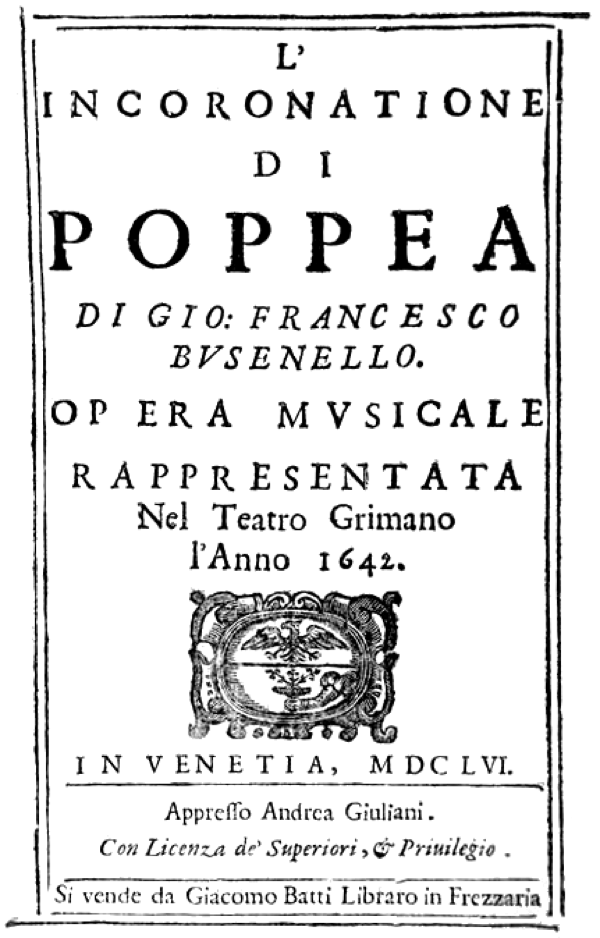
Claudio Monteverdi – L’incoronazione di Poppea – title page of the libretto – Venice 1656
To understand the visceral nature of Poppea, one must look to its birthplace: Venice. The work represents a seismic shift in the history of the medium, marking opera’s migration from the exclusive, courtly entertainments of Mantua to the democratic, ticket-paying bustle of the Venetian public stage.
In the early 17th century, opera was a private luxury of the nobility, often performed just once to celebrate a royal wedding or a princely birth. However, in 1637, the opening of the first public opera house in Venice changed the trajectory of the art form. Venice was a republic of excess, satire, and commerce. For the first time, composers had to please a diverse audience of merchants, travellers, and commoners who voted with their coins. Consequently, the gods of Olympus were replaced by the recognisable vices of men and women. This commercial environment allowed Monteverdi and his librettist, Giovanni Francesco Busenello, to explore themes of political corruption and moral ambiguity that would have been censored in a monarchical palace.
Busenello’s Irony: The Satire of Imperial Rome
The libretto of Poppea is arguably as important as its music. Busenello was a prominent Venetian lawyer and a member of the Accademia degli Incogniti, a group of libertarian intellectuals known for their scepticism of traditional morality and religious dogma.
Busenello crafted the script as a sharp, calculated political weapon. By depicting the moral rot of Imperial Rome, the opera functioned as a subtle endorsement of the Venetian Republic’s perceived superiority. To the Venetian audience, the decadence of Nero’s court was a pointed allegory for the contemporary Papal Rome, which Venice viewed with deep political suspicion.
The script is heavily layered with dramatic irony. While the characters on stage celebrate the triumph of love, the audience—well-versed in classical history—was acutely aware of the grim aftermath. They knew that Nero would eventually murder a pregnant Poppea, that the empire would crumble, and that the harmony achieved at the end of the opera was a fleeting delusion. This tension between the beautiful music and the historical reality is the engine of the work’s enduring power.
The Plot: A Subversion of Moral Order
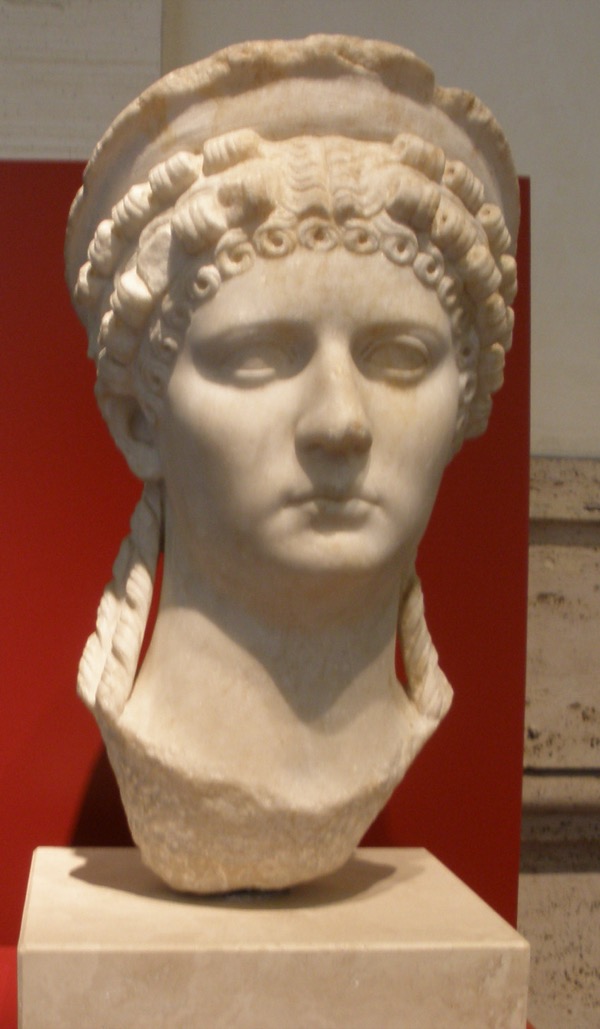
Marble bust of Roman Empress Poppaea Sabina, held by National Museum of Rome, Rome, Palazzo Massimo alle Terme. (Wikipedia Commons)
The narrative follows the historical rise of Poppea Sabina, who manoeuvres her way to the throne by seducing the Emperor Nerone (Nero). Unlike the operas of the later 18th century, which typically adhered to a Poetic Justice where the good are rewarded, Poppea presents a world where virtue is a fatal liability.
The Fall of the Stoic: Seneca, the philosopher and Nero’s former tutor, represents the only moral anchor in the play. When he opposes Nero’s plan to divorce Empress Ottavia, he is ordered to commit suicide. His death scene is the emotional pivot of the opera, yet it is treated by Nero and Poppea as a mere bureaucratic obstacle to be removed.
The Humiliation of the Just: Empress Ottavia, the rightfully wedded wife, is exiled after a failed attempt to protect her status. Her farewell to Rome, “A dio Roma,” is a haunting lament of a woman whose world has been destroyed by a regime that no longer values fidelity.
The Reward of the Cruel: The opera concludes not with the punishment of the adulterers, but with their magnificent coronation. They are surrounded by the gods of Love and Fortune, suggesting that in the theatre of human life, success is often independent of morality.
Musical Architecture: The Resurgence of the Countertenor
Monteverdi’s musical language in Poppea is a sophisticated blend of stile recitativo (speech-like singing) and more lyrical arioso passages. The music does not merely accompany the text; it psychoanalyses the characters.
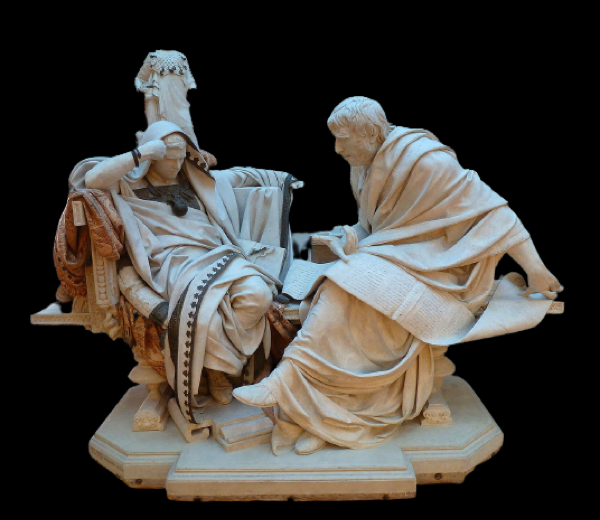
Emperor Nero being instructed by Seneca, work by Spanish sculptor Eduardo Barrón (Wikipedia Commons)
The role of Nerone was originally written for a castrato, a choice that carries significant psychological weight. The high, piercing, and almost otherworldly timbre of the castrato voice underscored Nero’s erratic, infantile, and dangerously unpredictable nature. In modern performances, this role has become a cornerstone of the countertenor repertoire. When we hear a crystalline, high voice ordering a bloody execution or throwing a tantrum, the contrast is chilling. It reminds the listener that Nero’s cruelty is not grounded in masculine strength, but in a shimmering, high-pitched hysteria.
The Mystery of Pur ti miro: A Collaborative Masterpiece?
One of the most intriguing aspects of Poppea for the musicologist is the question of authorship. No original manuscript in Monteverdi’s hand exists; the two surviving scores (the Venice and Naples scores) date from after his death and contain numerous discrepancies.
Modern scholarship suggests that the octogenarian Monteverdi likely collaborated with a circle of younger composers—including Francesco Sacrati, Benedetto Ferrari, and Francesco Manelli—to finish the score for its 1642 premiere. Even the opera’s most famous moment, the final duet “Pur ti miro”, is now widely attributed to Ferrari.
MONTEVERDI: L’incoronazione di Poppea “Pur ti miro, Pur ti godo” (Jaroussky, De Niese)
Far from diminishing the work’s stature, this realisation reinforces its identity as a product of the Venetian commercial system. Poppea was not a static museum piece; it was a living, breathing theatrical production designed for immediate impact. The fact that its most transcendent melody might be a “patch” by a secondary composer only adds to the opera’s aura of beautiful, calculated deception.
The Seduction of the “Beautiful Lie”
L’incoronazione di Poppea survives because it refuses to lie to its audience. It suggests that history is not a steady march toward justice, but a cycle driven by appetite, ego, and the whims of Fortune. Monteverdi and Busenello hold up a mirror to a society where the loudest, most beautiful voices are often the most dangerous.
As the final, shimmering notes of the love duet fade, the listener is left with a profound sense of unease. We have been seduced by the villains, charmed by the usurpers, and moved by a love that thrives on the suffering of others. In the theatre of Nero’s Rome—and perhaps in our own—a beautiful lie is often more seductive than the plain truth.
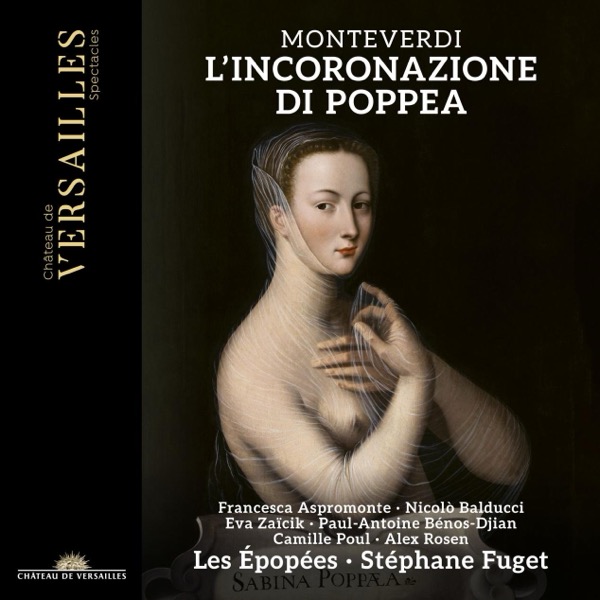
For the latest audiophile choice, Stéphane Fuget and Les Épopées (2024/25) deliver a revolutionary recording. Fuget’s interpretation is unapologetically decadent, prioritising lush, improvisational ornamentation that captures the opera’s carnal heat. Meanwhile, the Royal Danish Opera’s 2026 production, directed by Christoph Marthaler, offers a stark, modern contrast.
For more of the best in classical music, sign up for our E-Newsletter