The harp is one of the oldest forms of string instruments, with multiple birthplaces and a long presence throughout the history of music, from ancient civilisations to the present day. Yet despite this long lineage, it is not as commonly seen — or heard — as many later string instruments, such as those of the string quartet. Even after centuries of evolution and refinement, the harp often remains somewhat outside the main cast.
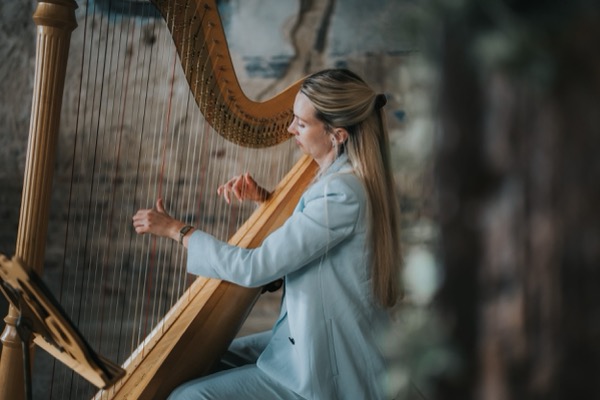
Harpist with pedal harp © images.squarespace-cdn.com
In Western classical music, it frequently occupies a secondary role within the orchestra and only rarely steps into the spotlight. In other cultures, however, the situation is quite different. In parts of West Africa and China, for instance, harp-like instruments often take centre stage and are just as likely to appear in solo or intimate settings as they are in ensembles.
The origins of the harp are multiple and somewhat difficult to pinpoint precisely. Some sources trace its beginnings to regions of South and West Asia, others to ancient Egypt or Greece. What is certain is that early depictions of harps appear across a wide geographical area — in ancient Iraq, Iran, Egypt, India and China. Over time, the instrument spread across Europe and later reached the Americas, while developing in parallel across the African continent. In many traditions of folk music around the world, some variation of the harp emerged naturally.
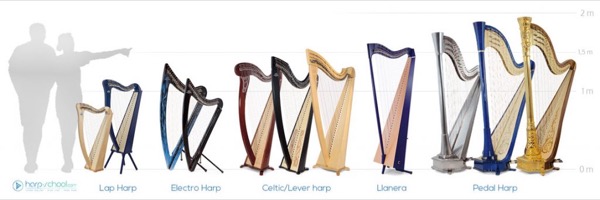
A chart of harp types and sizes © harp-school.com
This global journey produced an impressive family of related instruments. Among them are the Celtic harp of northern Europe, the Greek epigonion, as well as the lyre and kithara, the West African kora, the Chinese konghou, the claviharp, and, of course, the modern pedal harp used in Western classical music today. Each of these instruments reflects its own cultural environment while retaining the fundamental principle of plucked strings stretched across a resonant frame.
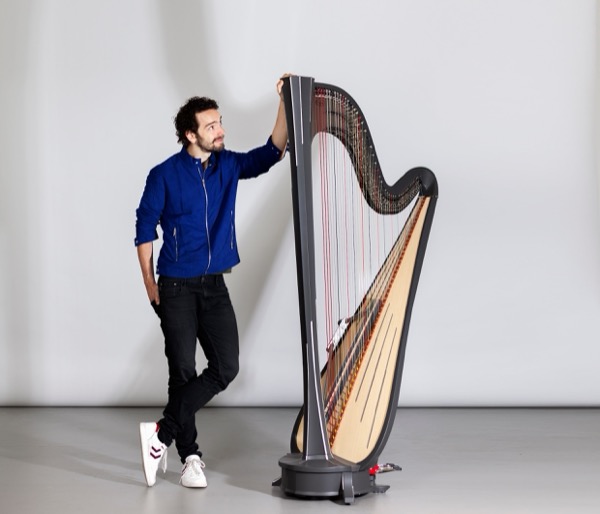
Dutch harpist Remy van Kesteren © image.trouw.nl
When it comes to the harp as we know it in Western classical music, it is surprisingly rarely treated as a solo instrument, despite possessing a wide musical range and expressive potential. One reason may lie in its relatively limited dynamic range, which can make it harder for the instrument to project on its own — a challenge similar to that faced by the guitar. In large concert settings, the harp can easily be overshadowed by louder instruments. Modern recording techniques, however, have opened new possibilities, allowing its subtle colours and delicate textures to be captured with much greater clarity. Contemporary performers such as the Dutch harpist Remy van Kesteren have explored these possibilities extensively, bringing the instrument into new musical contexts.
Within the orchestra, the harp gradually gained visibility during the nineteenth century. Franck‘s Symphony in D minor is often cited as one of the works that helped bring the instrument more clearly into the orchestral foreground. Before that time, it had generally played a more decorative role, despite occasional appearances in the music of composers such as Mozart and Beethoven.
Toru Takemitsu: Rain Spell (1982)
Over the years, a number of important works have placed the harp more prominently. These include Britten‘s A Ceremony of Carols, Cowell‘s Harp Concerto, Debussy‘s Sonata for Flute, Viola and Harp, Hindemith‘s Harp Sonata, and Takemitsu‘s atmospheric Rain Spell. More recent works also continue to explore the instrument’s possibilities, such as Cohen’s Nuance for Harp and Live Electronics, Einaudi‘s Stanze, Hisaishi’s Harp Concerto, and Rautavaara’s Harp Concerto.
Ludovico Einaudi & Cecilia Chailly – Stanze (Official Album Sampler)
Like the guitar, the harp has also developed a repertoire through transcription. Many works originally written for the piano have found a natural second life on the instrument. Some of the most frequently arranged pieces include Debussy’s Clair de lune, Satie‘s Gymnopédies, Beethoven’s Moonlight Sonata, and Pachelbel‘s Canon. The harp’s resonance and ability to sustain harmonies often lend these familiar works a new colour and atmosphere.
Outside Western classical music, the harp appears less frequently as a central instrument, though it occasionally emerges in unexpected places. One well-known example is The Beatles’ She’s Leaving Home, where the harp provides the song’s distinctive accompaniment. More often, however, the instrument works quietly in the background. Its shimmering sound has long been associated with moments of reflection, dreamlike atmospheres, or subtle emotional shifts.
If one listens carefully, the harp is almost everywhere — particularly in film music, television soundtracks, and ambient textures. It often provides small but striking gestures: a glissando to mark a transition, a cluster of notes to suggest wonder, memory, or magic. Rarely dominating the musical landscape, the harp nonetheless continues to shape it in quiet and often unnoticed ways.
For more of the best in classical music, sign up for our E-Newsletter