The Greatest Musician You May Not Know
In her Grove Music Online article on George Enescu (1881-1955), Valentina Sandu-Dediu hails her compatriot as “Romania’s greatest composer, the leading figure in Romanian musical life in the first half of the 20th century, and one of the best-known violinists of his generation.” (Sandu-Dediu, GMO, 2015)
Yet, despite his high status within Romanian musical culture, Enescu remains relatively unknown to the wider international public today. His works are far less frequently performed, and they have really never entered the standard Western canon.
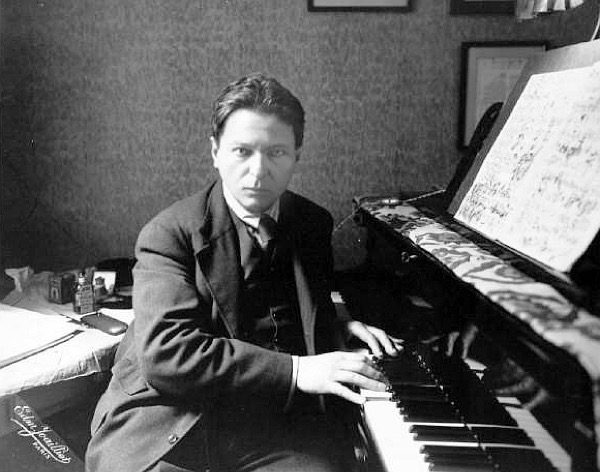
George Enescu, 1930
Sandu-Dediu’s scholarly assessment, however, is confirmed by a number of high-profile musicians. Pablo Casals described Enescu as “the greatest musical phenomenon since Mozart, and one of the greatest geniuses of modern music.” (Dickerson, Musicweb-International, 2014)
And Yehudi Menuhin, Enescu’s most famous student, said about his teacher, “he will remain for me the absoluteness through which I judge others… Enescu gave me the light that has guided my entire existence.” (Muzeul National “George Enescu”) Such testimonies clearly suggest Enescu’s capacity to shape the artistic worldview of an entire generation of musicians.
To commemorate the passing of George Enescu on 4 May 1955, let us take a closer look at his extraordinary legacy as a performer, teacher, and composer.
George Enescu: Romanian Rhapsody No. 1
The Making of a Genius
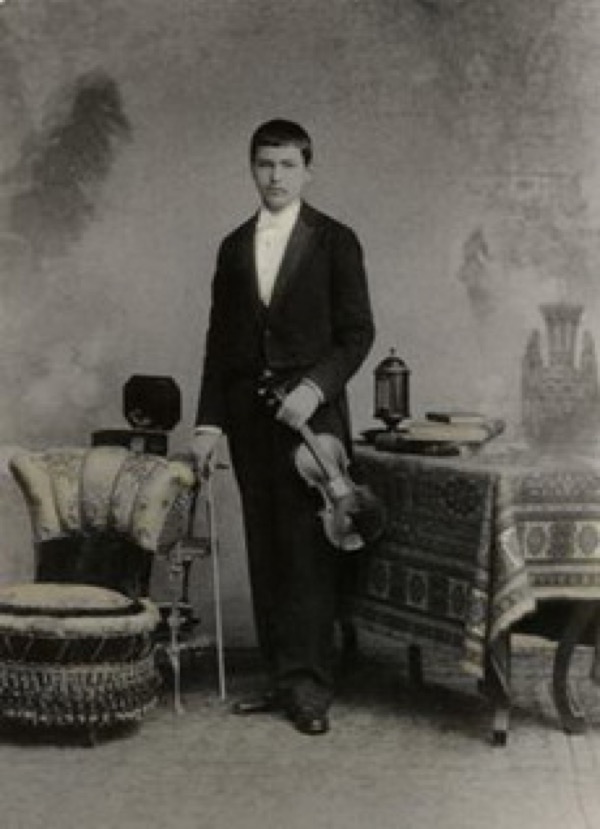
Young George Enescu
George Enescu was born on 19 August 1881 in the village of Liveni, Romania. His father, Costache Enescu was an estate manager, and his mother was Maria Enescu (née Cosmovici), the daughter of an Orthodox priest. Enescu’s ancestors in a direct line were all musical and primarily active as church musicians.
George was the eighth child born into a marriage where all previous siblings had died in infancy. His musical genius was discovered early, as he was able to reproduce with absolute fidelity all the melodies he heard. Auditory memory would eventually become one of the defining foundations of his interpretive and compositional approach.
He started to play the violin, taught by a neighbour, at the age of four, and he almost immediately started to compose. As he recalls, “And I began to compose, almost unconsciously…I knew nothing, I had heard practically nothing…yet from my childhood my one idea was to be a composer.” (Enescu, His Life in Pictures)
In 1888, George played for the Romanian opera composer Eduard Caudella, who advised Costache to take his son to Vienna to study. As such, Enescu became the youngest student ever admitted to the Vienna Conservatory on 5 October 1888.
George Enescu: Poème Roumain, Op. 1
Among Masters and Legends
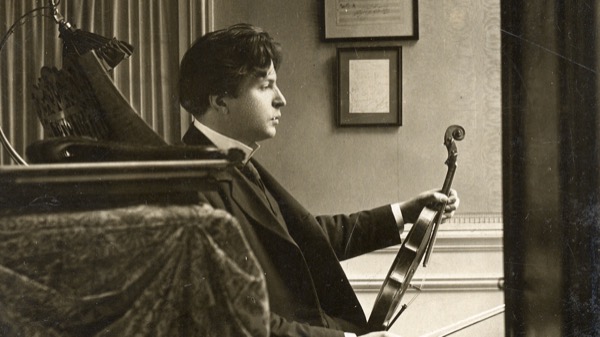
George Enescu
His teachers included Joseph Hellmesberger Jr. and Sr., Robert Fuchs, and Ernst Ludwig. The director Joseph Hellmesberger Sr. took young George under his wing, and he introduced him to his hero Johannes Brahms.
Between 1888 and 1894, and as the leader of the first violins in the student orchestra, Enescu played Brahms for Brahms. Greatly enthralled by the music of Brahms, Enescu also got to know the music of Wagner, performed at the Hofoper under Hans Richter.
After three years of study, Enescu graduated with honours at the age of 12, but decided to remain in Vienna for an additional year to further his studies of composition under Fuchs.
Recitals in Vienna featured works by Brahms, Sarasate, and Mendelssohn, and Hellmesberger suggested that George might benefit from spending some time in Paris.
Enescu arrived in Paris in 1895 to continue his studies at the Paris Conservatoire. He studied composition under Massenet and Fauré, and counterpoint under André Gédalge. Fellow students and friends at the Conservatoire included Ravel, Schmitt, Koechlin, Casella, Cortot, and Thibaud.
George Enescu: Octet in C Major, Op. 7
Juvenilia and Early Mastery
Enescu’s main interest was in composition, and on 6 February 1898, at the age of 16, he presented his Op. 1, the Poème Roumain. The work was given in Bucharest two months later, with Enescu conducting, and the composer was quickly hailed as a figure of national importance.
By the time Enescu had reached the age of sixteen, he had composed at least fifty works.
Suggestions of immaturity and youthful doodling, however, are completely out of place when speaking of Enescu. By 1895, if not before, he was already a thorough master of the art of composition.
We know that Enescu composed many youthful study works, including a substantial number of symphonic essays. It is hardly surprising that Massenet described Enescu’s first symphony in D minor as a very remarkable work with an extraordinary instinct for development.
None of Enescu’s works produced before 1897 seems to have been written with publication in mind, and indeed nearly all of them are still unpublished. Thankfully, Enescu preserved the manuscripts of most of them, and they are now in the Enescu Museum in Bucharest.
George Enescu: Symphony No. 1, Op. 13
Search for Artistic Identity
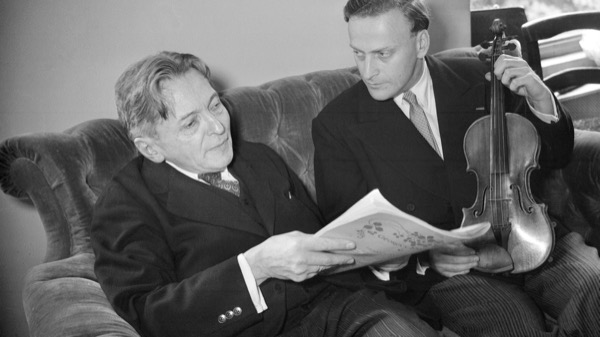
George Enescu with Yehudi Menuhin
George Enescu graduated in 1899 with the Grand Prix du Conservatoire, yet his professional and creative paths were still undecided. In his student works from Vienna and early Paris, we find the heavy influence of Schumann and Brahms.
His love for Wagner and his contact with French music made Enescu’s compositional style more clearly defined. As he explained in his Memoirs, “With my Second Sonata for Violin and Piano and with my String Octet, I felt myself evolving rapidly; I was becoming myself.” (Constantinescu, George Enescu, 1981)
The prospects of a career as a composer in Paris were not encouraging, and the same was certainly true of Romania. As such, Enescu led a divided existence between France and Romania, with his energies divided between performance and composition.
As a pianist and violinist, he made Paris his main base, forming a trio with Casella and Louis Fournier in 1902 and the Enescu Quartet in 1904. He toured several European countries as a violinist and conductor.
George Enescu: Violin Sonata No. 2 in F minor, Op. 6
Between Composition and Service
Enescu primarily composed during the summer months in the Romanian countryside, and he became an active figure in the musical life of that country. As Noel Malcolm writes, “Enjoying the special patronage of the royal family, he founded the Enescu Prize for Romanian composers in 1912… He formed a symphony orchestra in 1917 and, in 1921, created the first national opera company in Romania.” (Malcolm, GMO, 2001)
The composition of his opera Oedipe took a number of years, interrupted by regular visits to the United States as a violinist. He also had the opportunity to conduct and was even considered a replacement for Toscanini at the New York Philharmonic.
Enescu never contemplated a career as a pedagogue. However, a young Yehudi Menuhin convinced him to accept him as a student from 1927 onward. In due course, Ferras, Gitlis, Grumiaux, and Haendel were greatly influenced by his teaching, and he eventually accepted an appointment at the Mannes School of Music in 1948.
In terms of composition, Enescu freely switched between a variety of styles. Ambitious and sweeping Romantic works are interspersed with neoclassical or neobaroque compositions.
George Enescu: Piano Suite No. 2, Op. 10
Folk Influences and Compositional Technique
Current assessments of Enescu’s musical development place great emphasis on the elements of Romanian folk music, which appear in his works at an early stage. Most prominently, we find his two Romanian Rhapsodies of 1901.
Their popularity notwithstanding, Enescu bitterly resented the way they had dominated and narrowed his reputation as a composer. As he remarked in 1924, the only thing a composer could do with an existing piece of folk music was to rhapsodise it, with repetition and juxtaposition.
All protestations aside, Enescu did draw on the flexible and ornamented style of traditional folk melodies in his works. Instead of quoting folk tunes directly, he primarily absorbed their character.
Of particular influence is the “doina,” a traditional Romanian song form marked by melancholy with a flexible line in which melody and ornamentation merge into one. Melodies, superimposed on one another, represented the vital principle of his music.
Malcolm writes, “In his mature works, however, Enescu made increasing use of the less mechanically contrapuntal, more organic technique of heterophony—a form of loose melodic superimposition which was also rooted in Romanian folk music.” (Malcolm, GMO, 2001)
George Enescu: Chamber Symphony in E Major, Op. 33 (members Tampere Philharmonic Orchestra, Ensemble; Hannu Lintu, cond.)
Exile and Farewell
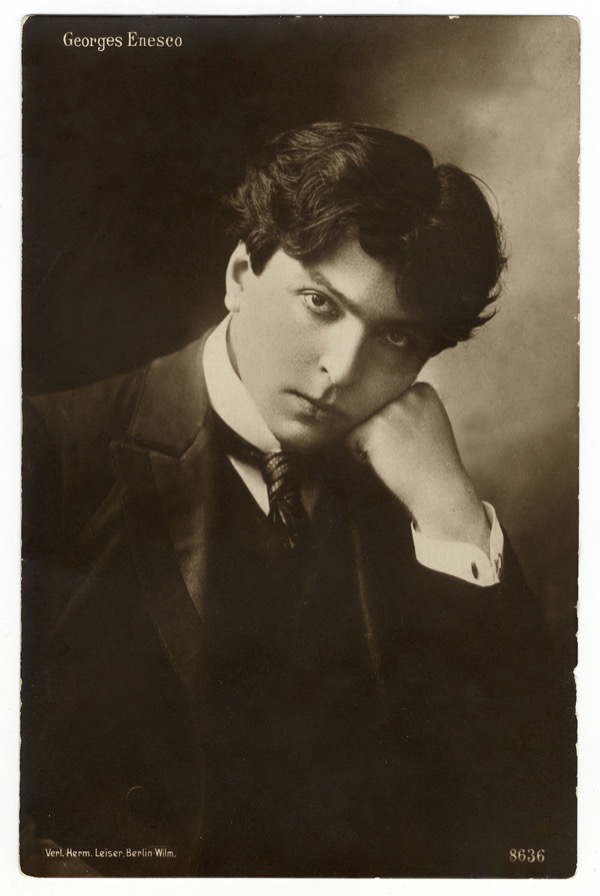
George Enescu (© Muzeul Național George Enescu)
During World War II, Enescu stayed in Bucharest and lived in the Cantacuzino Palace, now the George Enescu museum, as he had married the aristocratic Princess Maruca Cantacuzino, née Rosetti-Tescanu. Enescu produced several important recordings of his own works with his godson, Dinu Lipatti.
After the Communist takeover, the couple went into exile in Paris in 1947. Enescu was suffering from heart trouble, curvature of the spine, and a hearing problem, which affected intonation. He briefly resumed his career as a violinist and made several important recordings.
Enescu suffered a severe stroke in July 1954 that left him partially paralysed, and he died on 4 May 1955. He was interred in Père Lachaise Cemetery in Paris.
A Life in Service to Music
George Enescu was a musical phenomenon, and he left a profound personal impression on nearly everyone he encountered. He had an extraordinary memory and apparently knew every note in Wagner’s Ring and the complete works of Bach by heart.
As a performer, and avoiding all forms of showmanship, his violin tone was modelled after the human voice, and he had a deep humility towards the music of other composers.
Enescu regarded his own works with great modesty, “and his career as a composer suffered from his dignified but damaging reluctance to engage in any form of self-promotion.” (Malcolm, GMO, 2001)
George Enescu was perhaps the most versatile and most comprehensively gifted musician of his time. It is no accident that Yehudi Menuhin described him as the greatest musician he had ever experienced.
George Enescu was brilliant in everything he touched, excelling as composer, violinist, pianist, conductor, teacher, and musical thinker, all in the service of music itself. His legacy endures in his works and also in the artistic ideal he transmitted to those who followed him.
For more of the best in classical music, sign up for our E-Newsletter