Anton Webern (1883–1945) fulfilled the roles of a composer, a conductor, and a musicologist. As a student of Arnold Schoenberg, he took his teacher’s twelve-tone technique to a radical end. His musical studies ranged from the medieval period, studying the music of the Franco-Flemish school with Guido Adler, to the most modern, with Schoenberg. Schoenberg’s emphasis on structure led his students through the works of Bach, Haydn, Mozart, and Brahms. When Schoenberg relocated to Berlin, Webern remained in Vienna and declared his independence through increasingly confident works.
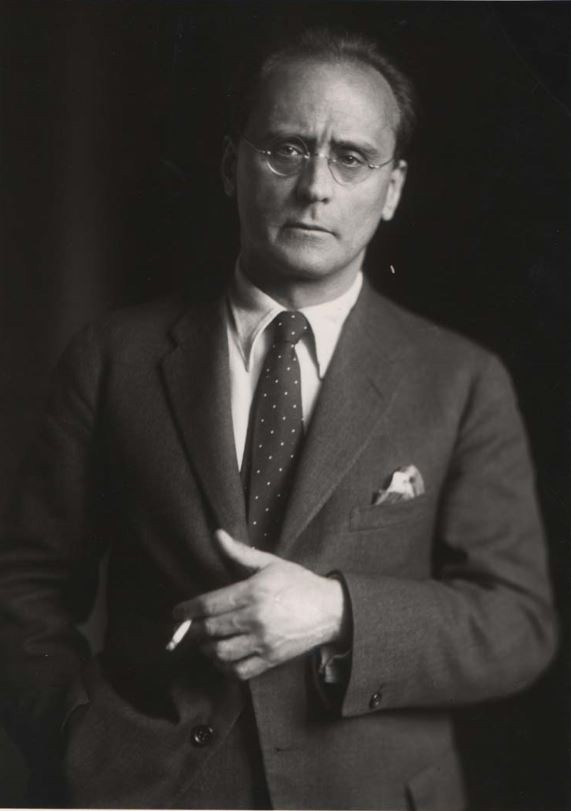
Anton Webern
In 1904, Webern began his work with Schoenberg as a private pupil, and a few weeks later, Alban Berg joined. The three composers, the master and his two students, formed the core of the Second Viennese School. Webern was devoted to Schoenberg but only studied formally with him until the end of 1908, after that, both he and Berg acted as Schoenberg’s assistants: copying parts, making piano reductions of his works, making arrangements for his private and professional needs, and raising money to support Schoenberg and his family so he could be free to compose without needing to hold down a job.
The year 1909 was a compositional year for Webern. He completed his Opp. 5, 6, 7, 8, and parts of Opp. 9 and 10, with each work becoming smaller and more condensed. Some works might be very short indeed. Opus 7, his Four Pieces, was a work for violin and piano. No. 1, marked Sehr langsam, is only 9 measures long and requires an extremely quiet performance. The violin is muted, and its dynamics range from pp (pianissimo) to ppp (pianississimo). It closes with a ppp chord on the piano. When the violin has a set of repeating notes, it is to be played ‘col legno’, i.e., with the wood of the bow, meaning that the bow is inverted. This gives a very dry sound.
The work as a whole was described as having a chaotic spontaneity that belies the scrupulous precision. All 4 works are brief and full of pent-up tension, leaving the listener looking for a resolution to the questions they pose. One writer heard the work as ‘uncovering the musical moment prior to its encasement in a pre-meditated structure’, noting that the work actually pre-dates Webern’s work in the 12-tone style, but anticipates a great deal of its coming presentation.
Anton Webern: Four Pieces, Op. 7 – No. 1 Sehr langsam
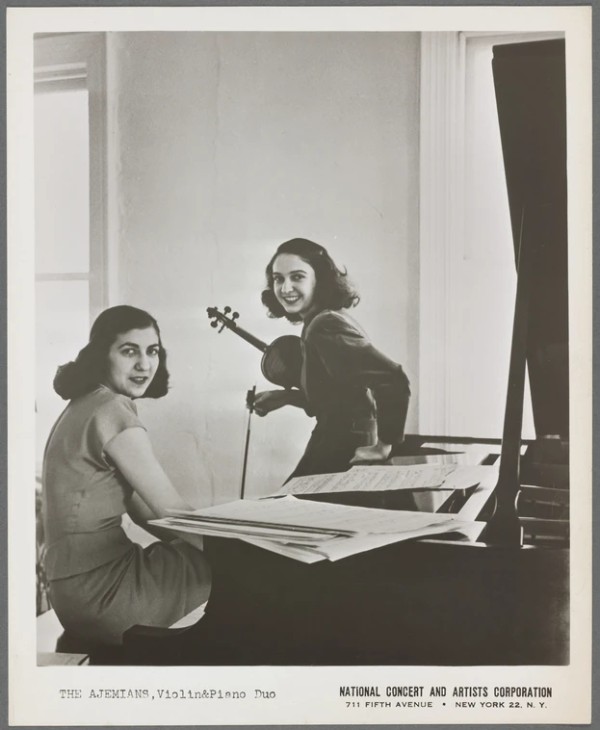
The Ajemian sisters, ca. 1948
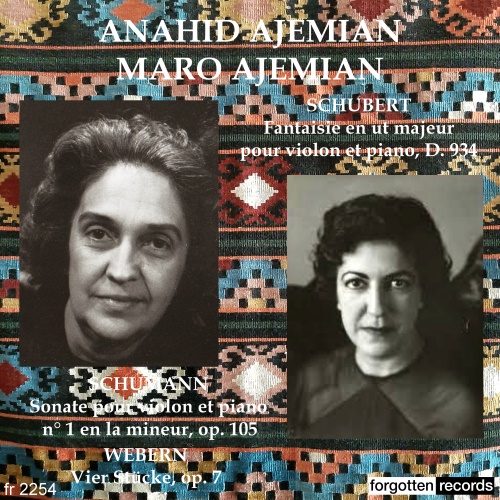
This recording was made in 1955 with Anahid Ajemian (violon), Maro Ajemian (piano). Anahid Ajemian (1924–2016) and Maro Ajemian (1921–1978) were sisters. Born in the US to Armenian parents, the sisters were particular champions of contemporary music. Maro made her name performing the US premiere of Aram Khachaturian’s Piano Concerto across the US. With her sister Anahid, they championed the music of John Cage, Alan Hovhaness, Henry Cowell, Ernst Krenek, Lou Harrison, and Gunther Schuller. Both sisters were graduates of The Juilliard School and toured together and separately in North America and Europe.
Performed by
Anahid Ajemian
Maro Ajemian
Recorded in 1955
Official Website
For more of the best in classical music, sign up for our E-Newsletter