The viola may be the less flashy sibling of the violin, but in the hands of these seven great women composers, the viola truly shines as a solo instrument.
From the bold modernism of Marga Richter and Peggy Glanville-Hicks to the spiritual depth of Sofia Gubaidulina and the poetic inspiration of Sally Beamish, women have written some of the most compelling and imaginative works for viola and orchestra of the 20th and 21st centuries.
Today, we’re looking at seven unforgettable works for viola and orchestra by women composers that every classical music lover should know.
Marga Richter – Aria and Toccata for Viola and String Orchestra (1956)
Marga Richter is a largely forgotten American composer who deserves more attention.
She was born in small-town Wisconsin in 1926, studied at the MacPhail School of Music in Minneapolis, and then enrolled at the Juilliard School in 1945.
While there, she studied composition with William Bergsma (who taught Steve Reich and Philip Glass) and Vincent Persichetti (who also taught Reich and Glass, as well as Einojuhani Rautavaara and Peter Schickele).
She received both a bachelor’s and a master’s degree from Juilliard, graduating in 1951.
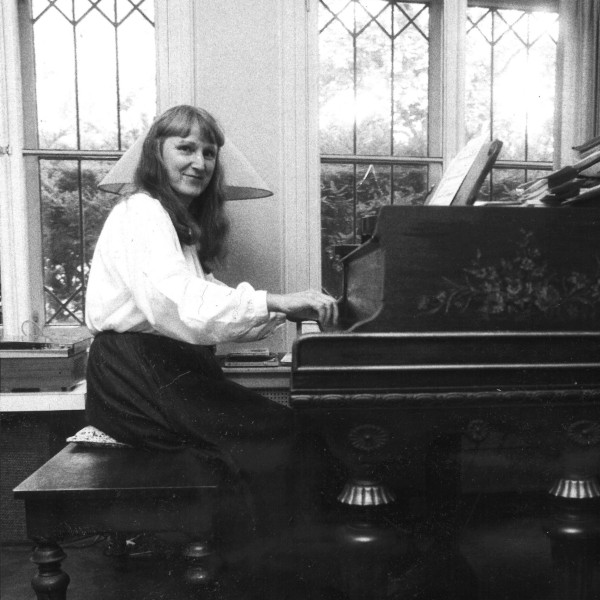
Marga Richter
Five years later, at the behest of MGM Records, she wrote her Aria and Toccata for Viola and String Orchestra.
She went on to use this work as the basis for a ballet, Abyss, for socialite Rebekah Harkness’s notorious Harkness Ballet.
Peggy Glanville-Hicks – Concerto Romantico (1956)
Peggy Glanville-Hicks was born in Melbourne, Australia, in 1912. She began studying piano and composition at a conservatory there.
Between 1932 and 1936, she attended the Royal College of Music in London, studying composition with Ralph Vaughan Williams (who, she later claimed, stole an idea from her when writing the opening of his fourth symphony).
She moved to New York and worked as a critic at the New York Herald Tribune between 1949 and 1955. During her stay, she gained her American citizenship.
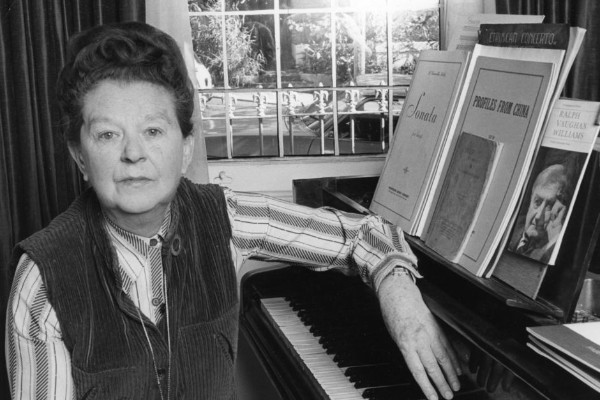
Peggy Glanville-Hicks
She wrote this viola concerto in 1956. More and more attention is being paid to it today. Violist Roselyn Hobbs has been preparing a new edition with the assistance of the Glanville-Hicks Trust and Peters Edition.
Grażyna Bacewicz – Viola Concerto (1967-68)
Grażyna Bacewicz was born in 1909 in present-day Łódź, Poland. She was a musical prodigy, giving her first concert at the age of seven and composing her first music at thirteen.
She studied at the Warsaw Conservatory, focusing on violin, piano, and composition. After she graduated, she went to study composition with Nadia Boulanger and violin with Carl Flesch.
Between 1936 and 1938, when she was just in her twenties, she served as concertmaster of the Polish National Radio Symphony Orchestra.
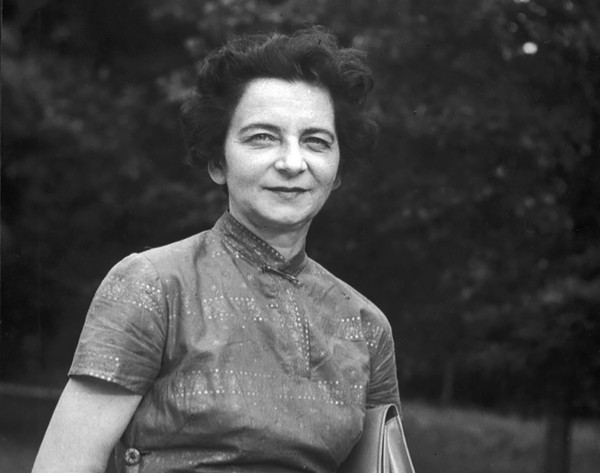
Grażyna Bacewicz
During World War II she took part in illicit underground concerts, hiding from the Nazis. Later, after the Soviets took control of Polish territory, she, like her contemporary Shostakovich, was forced to consider the preferred aesthetics of Soviet officials while writing her music.
Despite this, her career continued to flourish, and she composed prolifically.
She wrote her viola concerto between 1967 and 1968, commissioned by Polish violist Stefan Kamasa, who wanted to play a specifically Polish concerto.
It became one of her last works; she died in June 1969.
Thea Musgrave – Concerto (1973)
Thea Musgrave was born in an Edinburgh suburb in 1928.
Her early education took place at a girls’ boarding school, and then at the University of Edinburgh. After she graduated, she went to France to study with Nadia Boulanger.
In the summer of 1958, she went to the Tanglewood Music Festival outside of Boston to study with Aaron Copland.
In 1970, she became a guest professor at the University of California, Santa Barbara. The following year, she married American violist Peter Mark, cementing her American ties.
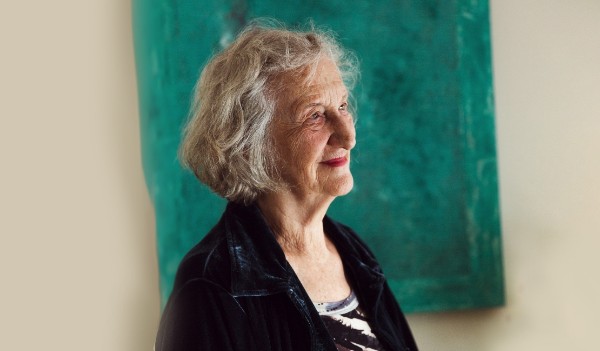
Thea Musgrave
Her viola concerto was commissioned by the BBC. It was premiered in 1973 at a Proms concert at the Royal Albert Hall, with Musgrave conducting and her new husband soloing.
In the words of her publisher, “The Viola Concerto explores the dramatic interplay of the solo viola with different small orchestral groups, and, equally important, the relationship of the soloist with his colleagues in the viola section. To this end, the viola section is seated where the first violins normally sit, thus focusing attention on them right from the start.”
Elizabeth Maconchy – Romanza (1979)
Elizabeth Maconchy was born to Irish parents in Hertfordshire in 1907. When she was ten, the family returned to Ireland.
She began studying music in Dublin. Then, at sixteen, she moved to London to study composition at the Royal College of Music under Ralph Vaughan Williams.
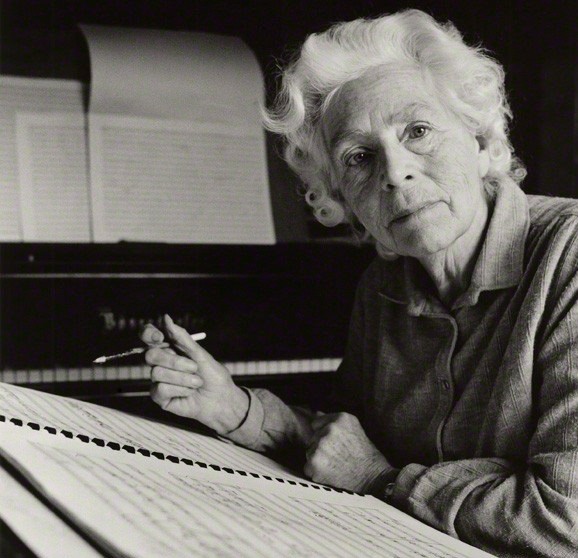
Elizabeth Maconchy
She wrote this dreamy Romanza for viola and orchestra in 1979. She penned a note describing the work:
I have long been in love with the viola, and find myself giving it the best things, for instance, in my String Quartets.
Now I have gone one further and written a Romanza for solo viola with an ensemble of five winds and strings. In its single movement of about twelve minutes, it displays a considerable variety of themes and moods…
Sofia Gubaidulina – Two Paths (1999)
Sofia Gubaidulina was born in 1931 in the present-day Republic of Tatarstan.
She began studying music at a very early age, eventually graduating from the Kazan Conservatory in 1954 and going on to study at the Moscow Conservatory.
During her studies, many composers were banned by the authorities. The students went around their teachers, finding access to forbidden scores by Igor Stravinsky, Charles Ives, and other experimental composers.
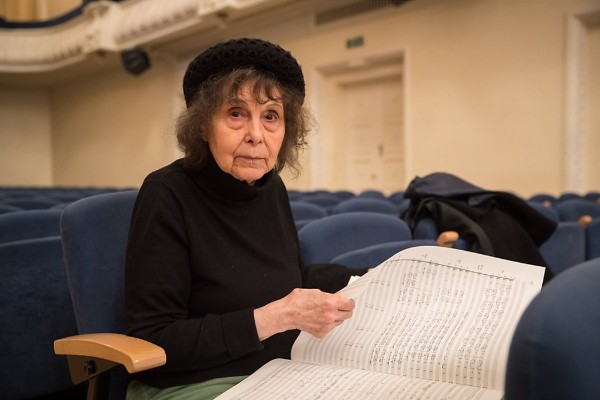
Sofia Gubaidulina
Over her decades-long career, she embraced experimentation and spiritual themes in her music.
Here’s how she described her double viola concerto, Two Paths, dating from 1999, and referring to the Gospel story of Mary and Martha visiting with Jesus.
The work owes its existence to the conductor Kurt Masur and his wife, Tomoko Masur. They invited me to compose a piece for two violas and orchestra. In other words, from the very outset, I appreciated that the soloists would be two identical string instruments manifesting themselves through two female personas.
Under the circumstances, it was entirely natural to choose a theme familiar from centuries of artistic experience, the theme of two types of love – of Mary and of Martha. It is a theme of two ways of loving: 1) to love taking upon oneself worldly cares and by so doing ensure the foundation of life, and 2) to love dedicating oneself to the sublime, to experience together with the Beloved the route of terrible suffering to the cross, so as to procure light and blessing for life.
Sally Beamish – Viola Concerto No. 2 (2001)
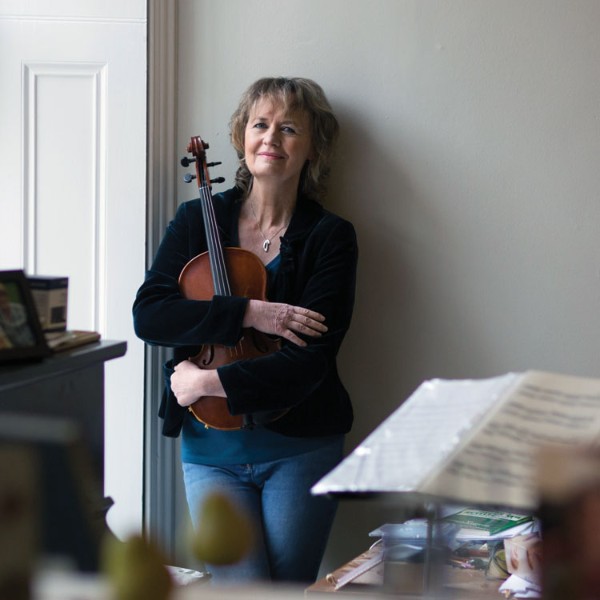
Sally Beamish
Sally Beamish: Viola Concerto No. 2, “The Seafarer” (Tabea Zimmermann, viola; Swedish Chamber Orchestra; Ola Rudner, cond.)
Sally Beamish was born in 1956 in London. She studied music at the Royal Northern College of Music and the Hochschule für Musik Detmold.
In addition to studying composition, she became a professional violist, playing in the string sextet the Raphael Ensemble, so the viola has always been close to her heart.
She has written two viola concertos. Her second is nicknamed “The Seafarer” and is based on a ninth-century Anglo-Saxon poem.
She wrote:
I first came across the 9th century Anglo-Saxon poem The Seafarer, when artist Jila Peacock sent me a new translation by Charles Harrison Wallace, whose Scottish and Swedish ancestry has led to a very Nordic take on the poem, using words which resonate in both Scandinavian/North Scottish languages, and reflecting a Nordic view of life’s journey, using the metaphor of a sea voyage that comes to rest in ‘Heaven’s haven’. I was struck by its vivid imagery and wrote a short piece for solo violin inspired by the text.
In 2000, I was asked by the ‘Summer on the Peninsula’ Festival to make a setting of the poem for narrator and piano trio with Jila’s Seafarer prints projected as part of the work, and in so doing, I began to hear more orchestral textures and to want to explore the material further. The Viola Concerto is the third part in my ‘Seafarer’ Trilogy and is in three movements.
The first suggests wave shapes, seabirds, and ideas of conflict and exploration.
Conclusion
Taken together, these seven works demonstrate how the viola has been championed by incredible women composers over the past seventy years.
Do you have a favourite work for viola and orchestra written by a woman?
For more of the best in classical music, sign up for our E-Newsletter