On 21 March 1925, Monte Carlo staged the first performance of L’enfant et les sortilèges (The Child and the Spells), by Maurice Ravel. The première of Ravel’s second and final opera was a resounding success, and the composer praised an extraordinary production that followed the principles of American musical theatre, where dancing is continually intermingled with the action.
As expected, however, critics were not convinced and missed the profoundly serious feeling at the heart of this entertaining work. Some complained that his music was artificial, with Ravel responding, “Does it not occur to these people that I may be artificial by nature?” (Nichols, 1992)
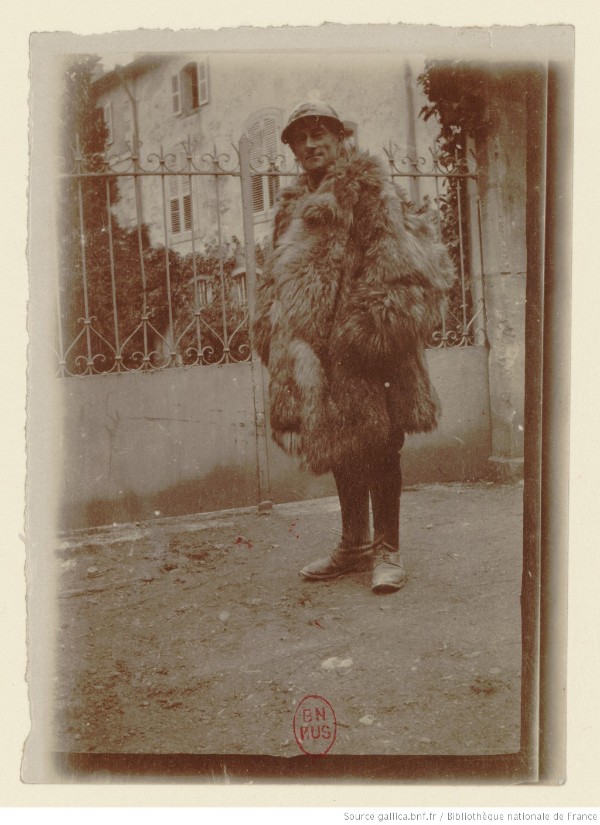
Maurice Ravel as a soldier
The story of this fairy-tale stage work that is far removed from conventional opera finds a young child confined to the room for his refusal to do his homework. He throws a tantrum, tears up his books, smashes a tea-set and terrorises a cat.
But then, as if by magic, the objects come to life and sing of the distress the child has inflicted upon them. They are out for revenge, but will the young boy learn his lessons before it is too late?
Maurice Ravel: L’enfant et les sortilèges (excerpts)
A Modern Fairy Tale
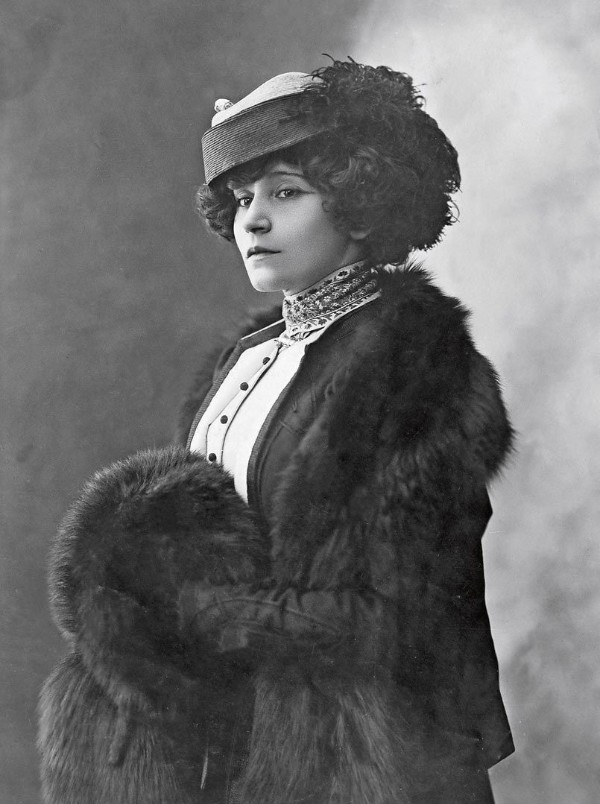
Sidonie-Gabrielle Colette
During World War I, Jacques Rouché was appointed director of the Paris Opéra. He approached Sidonie-Gabrielle Colette, better known simply as Colette, to write a scenario for a fairy ballet.
Colette, famous for her novels, and a well-recognised figure among those who frequented the Parisian music halls, accepted with enthusiasm. She crafted the libretto in little over a week, and it was agreed that Ravel would compose the music.
The libretto did not reach Ravel until 1918, while he was still serving in the war. He was intrigued by the libretto and accepted the task of composing the music. Yet, he saw in the scenario an opera rather than a ballet, and Colette turned out a complete libretto.
Ravel was of poor health at the time, greatly mourned the death of his mother, and he was actively working on the Sonata for violin and cello. As time passed, the project also migrated from the Paris Opéra to Monte Carlo.
Raoul Gunsbourg had previously mounted a highly successful production of L’heure espagnole and was keen to feature another opera by Ravel. Ravel worked on the opera throughout 1924, and it was ready just in time for the première. It had taken the better part of 10 years to make L’enfant et les sortilèges a reality.
Maurice Ravel: L’enfant et les sortileges – Votre serviteur, humble Bergere (The Armchair, The Bergere, The Clock, L’Enfant) (José Van Dam, baritone; Sophie Koch, mezzo-soprano; François Le Roux, baritone; Magdalena Kožená, mezzo-soprano; Berlin Philharmonic Orchestra; Simon Rattle, cond.)
When Objects Revolt
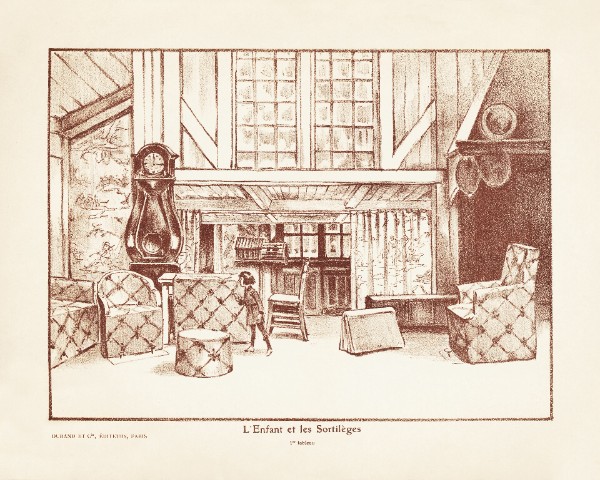
Maurice Ravel’s L’enfant et les sortilèges opening scene
The opening scene is set in a low-ceilinged room of a country house in Normandy. An atmosphere of gentle pastoral calm prevails, yet a small child is making a drama. He refuses to do his homework and instead fantasises about mischief and cruelty.
When his mother enters, the child is not paying attention and is highly disrespectful, and she punishes him with dry bread and unsweetened tea. Once left alone, the child erupts, smashes teacups, tears up books, torments animals, and wreaks havoc around the room.
Yet suddenly, as if by magic, the mistreated inanimate objects spring to life. The armchairs dance and refuse to let him sit down, while the clock chimes wildly. The shattered teapot and cup mock him in a satirical duet. The Fire leaps from the hearth and threatens punishment.
Figures from the torn wallpaper and the ripped storybooks come to life, and the melancholy Princess laments the child’s destruction. Old Man Arithmetic torments him with a frenzy of numbers, and the Black and White Cats perform an exuberant love duet.
Maurice Ravel: L’enfant et les sortileges – How’s your mug? (The Tea Pot, The Chinese Cup, L’Enfant, The Fire, Chorus) (Jean-Paul Fouchécourt, tenor; Nathalie Stutzmann, alto; Magdalena Kožená, mezzo-soprano; Annick Massis, soprano; Berlin Radio Choir; Berlin Philharmonic Orchestra; Simon Rattle, cond.)
From Cruelty to Compassion
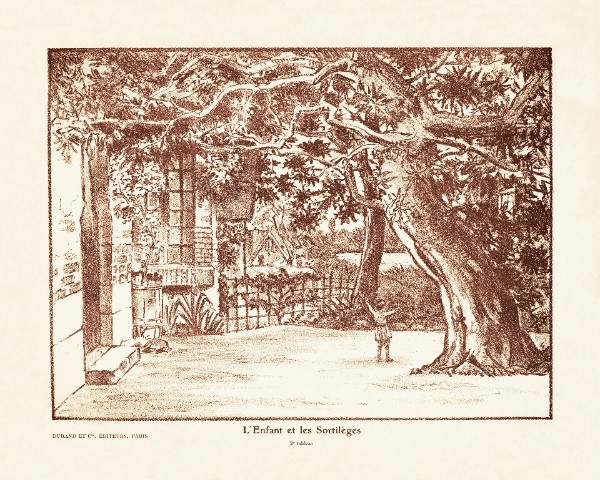
Maurice Ravel’s L’enfant et les sortilèges second scene
The terrified child now flees into the garden and is immediately confronted by nature. Trees groan from the wounds he has inflicted, and a dragonfly mourns its lost mate. Suffering creatures surround the child, now feeling abandoned and alone. For the first time, he calls out for his mother.
All the animals enraged by his earlier cruelty now attack him, and in the chaos injure one another. A wounded squirrel falls beside him, and the child’s heart changes. He bandages the squirrel’s wound, and the animals see that the child is bleeding too.
Seeing his compassion, the animals recognise his transformation. Softly echoing his early cry for his mother, they lead him back towards the house. A radiant final chorus affirms the child’s newfound goodness and wisdom, as he calls once more for his mother.
Maurice Ravel: L’enfant et les sortileges – Oui, c’est Elle, ta Princess enchantee (The Princess, L’Enfant) (Annick Massis, soprano; Magdalena Kožená, mezzo-soprano; Berlin Philharmonic Orchestra; Simon Rattle, cond.)
Melody Above All
In explaining his approach to the music in this work, Ravel placed the entire emphasis on melody. “I am for melody. Yes, melody, bel canto, vocalises, vocal virtuosity, this is for me the point of departure…This lyric fantasy calls for melody, nothing but melody…The score is a very smooth blending of all styles from all epochs, from Bach up to…Ravel!” (Orenstein, A Ravel Reader, 1990)
The composer rightfully told his friend Hélène Jourdan-Morhange that L’enfant contained everything, from Massenet, Puccini, Monteverdi to American musical comedy. And he apparently added that the fantasy of the poem would have served no purpose had it not been sustained and accentuated by the fantasy of the music.
We can’t go into a detailed analysis of the entire opera, but we can present a few examples of the stylistic blending mentioned by Ravel. The duet for the Black Wedgwood teapot and the China cup is a foxtrot, taken from American jazz. Meanwhile the cup sings her solo to a pastiche of mainly pentatonic vocal and orchestral sounds.
Maurice Ravel: L’enfant et les sortileges – Deux robinets coulent dans un reservoir! (Arithmetic Man, L’Enfant, The White Cat, The Black Cat, Chorus) (Magdalena Kožená, mezzo-soprano; Sophie Koch, mezzo-soprano; José Van Dam, baritone; François Le Roux, baritone; Berlin Radio Choir; Berlin Philharmonic Orchestra; Simon Rattle, cond.)
Layers of Meaning
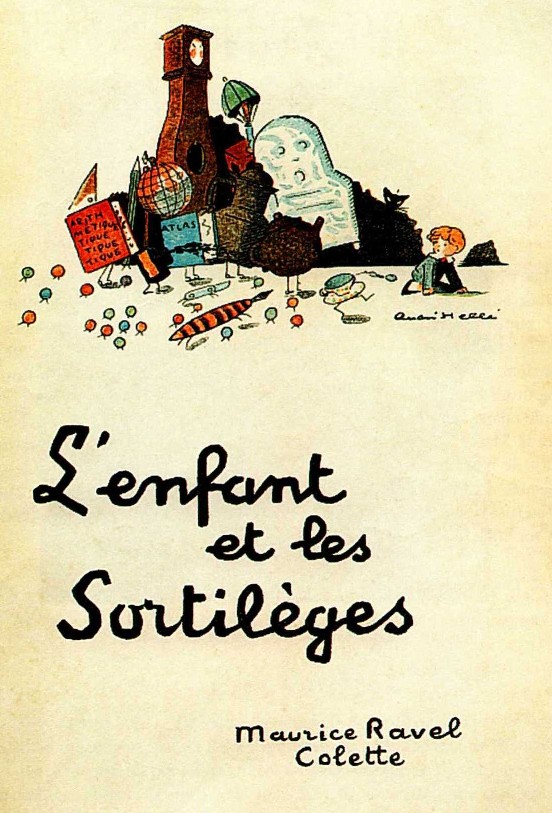
André Hellé – title page of L’enfant et les sortilèges
The “Dance of the Fire” sounds like a parody of 19th-century opera and the style of Rossini, complete with trills, melismatic lines and plenty of high notes over a very simple accompaniment. We even find the obligatory unaccompanied cadenza.
“The Princess’s Lament” appears to be a self-parody, as this duet features the flute as the only accompanying instrument. The “Child’s Lament at the departure of the Princess” is an unmistakable homage to Jules Massenet, with the famous soprano aria from Manon as the inspiration.
We also find some literary borrowing in the “Chorus of Frogs and Insects,” as the chorus pays homage to Aristophanes’ comic play The Frogs. It has also been suggested that Colette injected many layers of meaning that get quite personal.
Maurice Ravel: L’enfant et les sortileges – Sauve-toi, sotte! Et la cage? La cage? (The Squirrel, The Frog, L’Enfant) (Sophie Koch, mezzo-soprano; Jean-Paul Fouchécourt, tenor; Magdalena Kožená, mezzo-soprano; Berlin Philharmonic Orchestra; Simon Rattle, cond.)
The relationship between the armchair and the sofa is said to reflect the bitter relationship that existed between Colette and her first husband, Henri Gauthier-Villars. In the grotesque dance for the Armchair (Gauthier-Villars) and the petite sofa (Colette), the Armchair is always leading the dance and the conversation. The sofa only answers dutifully in short and incomplete phrases.
“The Arithmetic Man” satirises an episode from Colette’s semi-autobiographic novel, and “The Complaint of the Squirrel” makes reference to Colette’s feeling of entrapment during her first marriage. (Massingham, Performer’s Guide)
Maurice Ravel: L’enfant et les sortileges – Ah! C’est l’enfant au couteau! (L’Enfant, Chorus) (Magdalena Kožená, mezzo-soprano; Berlin Radio Choir; Berlin Philharmonic Orchestra; Simon Rattle, cond.)
A Tale of Music and Morality
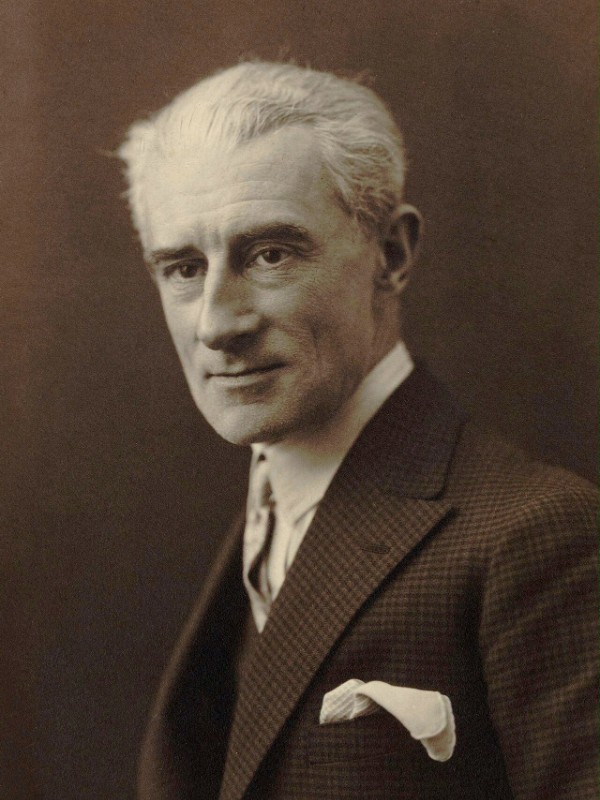
Maurice Ravel in 1925
What appears, on the surface, as a charming fairytale, contains layers upon layers of musical and textual meanings. To be sure, Ravel mirrors this complexity with astonishing stylistic fluidity. This kaleidoscope of styles is not purely artificial, but becomes the expressive language of objects and creatures.
L’enfant is difficult to stage as it features a number of complexities. Ravel calls for a large orchestra, a mixed chorus of adults and children, and eight soloists who each play several of a total of thirty characters.
A number of critics dismissed the opera as decorative entertainment. Yet, beyond the theatrical brilliance lies the humane message that empathy is learned through confrontation with the suffering of others.
For more of the best in classical music, sign up for our E-Newsletter