When cultural historians describe the development of eighteenth-century European arts, they often speak of the middle decades as a battleground between the elegance of the Rococo and the rising emotional force of Romanticism.
Nowhere is this transitional turbulence more audible than in the music of Carl Philipp Emanuel Bach (1714–1788). Although later generations remembered him primarily as the bridge between J.S. Bach and Haydn, C.P.E. Bach was in fact a revolutionary in his own right.
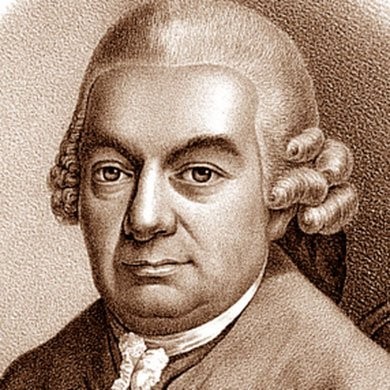
Carl Philipp Emanuel Bach
To commemorate his passing on 14 December 1788, let us explore his keyboard sonatas, works that are deeply immersed in the idea of “Empfindsamkeit,” and that subsequently also connect to the “Storm and Stress” movement that overtook German literature in the 1760s and 1770s.
C.P. E Bach: Keyboard Sonata in C minor, Wq. 59/4 “Rondo”
Atmosphere of Rebellion
The connection is more than a matter of chronology or coincidence. Many of C.P.E. Bach’s later sonatas employ structural fragmentation, abrupt contrasts, and psychological volatility that mirror the literary works of Klinger, Lenz, Goethe, and Herder.
These writers sought to break open the Enlightenment ideal of reason and legitimise emotional extremity as a mode of truth. Though the composer himself never claimed to be part of a literary circle, his music seems to breathe the same atmosphere of challenge, rebellion, and inward agitation.
Indeed, the aesthetic of “Empfindsamkeit” (sentimentality) with which C.P.E. Bach is commonly associated overlaps substantially with the emotional rawness that would soon be labelled “Sturm und Drang.” His sonatas therefore stand as sonic embodiments of a broader cultural phenomenon, one that placed the expressive self at the centre of artistic creation.
C.P.E. Bach: Keyboard Sonata in A minor, Wq 49/1
Emotional Revolt
In order to get closer to C.P.E. Bach’s sonatas, we need to understand what the literary movement sought to achieve. The term “Sturm und Drang,” comes from Friedrich Maximilian Klinger’s 1776 drama of the same name, though the aesthetic was already in place.
Reacting against the perceived rigidity of French classicism and the Enlightenment’s unwavering faith in rational order, young German writers advocated for emotional intensity over decorum. They espoused subjective truth over universal norms and celebrated nature, passion, and individuality.
Writers and poets advocated the disruption of inherited forms, with Goethe’s Götz von Berlichingen and the early drafts of Werther exemplifying this revolt. These works feature sudden shifts of mood, explosive anger, interior monologue, and depictions of psychological crisis.
Carl Philipp Emanuel Bach: Keyboard Sonata in B Minor, Wq. 49/6, H. 36, “Wurttemberg Sonata No. 6” (Bruno Procopio, harpsichord)
New Expressive Doctrine
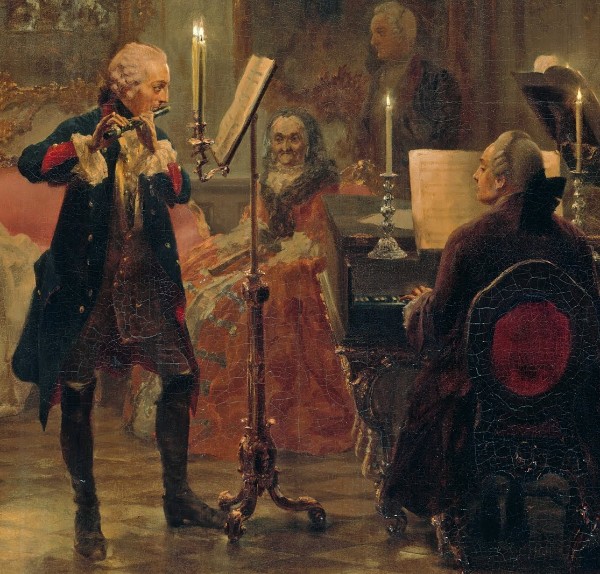
C.P.E. Bach with Frederick the Great
C.P.E. Bach, working in Berlin and later Hamburg at precisely this cultural moment, breathed the same air of intellectual upheaval. His treatise Versuch über die wahre Art das Clavier zu spielen (Essay on the True Art of Playing the Keyboard) set forth an aesthetic that was decidedly anti-mechanistic.
Music, he insisted, should “move the listener,” should be capable of “astonishing,” “terrifying,” and “arousing” emotions. Reason might guide composition, but the aim was always affective immediacy.
This doctrine made his sonatas fertile ground for the new sensibility. He was not a follower of Sturm und Drang in the deliberate sense, yet his artistic priorities anticipate and embody its principles. To be sure, his keyboard sonatas differ from the balanced, symmetrical works of the later Classical period in nearly every respect.
Carl Philipp Emanuel Bach: Keyboard Sonata in F Minor, Wq. 57/6, H. 173 (Tini Mathot, fortepiano)
Fragmentation as Emotional Drama
C.P.E. Bach’s keyboard sonatas are unpredictable, highly rhetorical, and full of jagged turns. What makes them current, however, is not merely their deviation from norms but how they enact psychological drama.
One of the hallmark gestures of Sturm und Drang literature is the fragment, a form that privileges discontinuity and emotional eruption. In works such as his F-minor Sonata, phrases begin and stop mid-gesture, sequences veer off course, and sudden dynamic or harmonic changes function almost like the screamed interjections in the plays of Jakob Michael Lenz.
This fragmentation in C.P.E’s music does not signal instability for its own sake. It conveys inner agitation, a hallmark of the literary movement’s emotional storms.
Carl Philipp Emanuel Bach: Keyboard Sonata in E Minor, Wq. 49/3, H. 33, “Wurttemberg Sonata No. 3” (Miklós Spányi, clavichord)
Modulation as Emotional Crisis
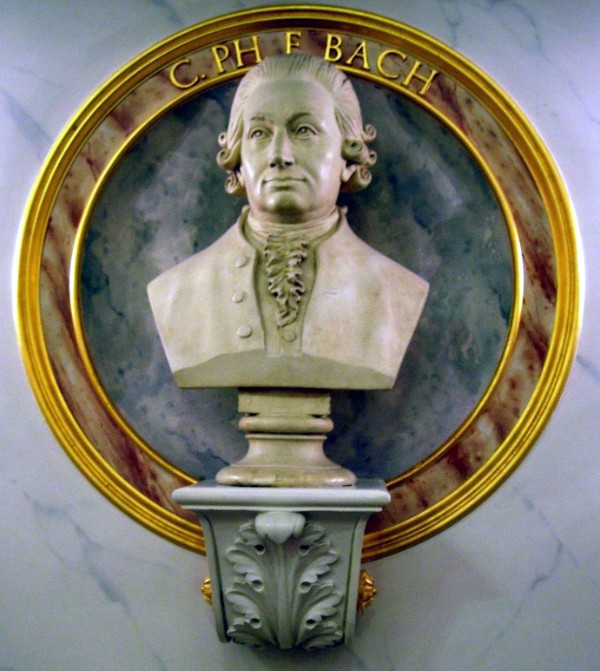
C.P.E. Bach
While J.S. Bach used chromaticism as part of a grand architectural design, C.P.E. Bach deploys unusual modulations as expressive shocks. The C-minor Sonata offers striking examples.
Diminished-seventh chords appear like flashes of lightning, the tonic slips away unexpectedly, and minor-key explorations give the music a brooding, unsettled character.
Such harmonic turbulence mirrors the literary fascination with psychological darkness, despair, and existential crisis. It is the same sentiment expressed in the tormented Werther or the haunted monologues of Lenz.
Carl Philipp Emanuel Bach: Keyboard Sonata in F Minor, Wq. 63/6, H. 75 (Elisabeth Katzenellenbogen, fortepiano)
Empfindsamkeit
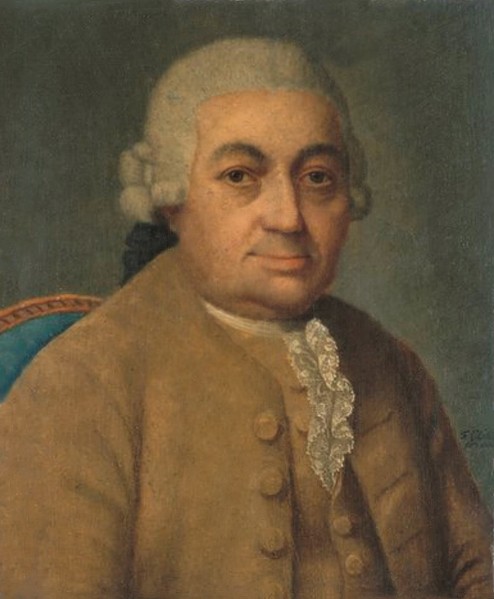
C.P.E. Bach
Although distinct from Sturm und Drang, Empfindsamkeit or the “sensitive style” provides the language through which C.P.E. Bach expressed his version of emotional intensity. Its characteristic features include delicate ornamentations that mimic speech.
Also expressing emotional directness and vulnerability, these qualities parallel literary tendencies toward intimacy, confession, and interiority, all part of Sturm und Drang.
Writers like Herder emphasised the authenticity of unfiltered emotional expression, and C.P.E. Bach’s sonatas offer exactly such expressive transparency.
Carl Philipp Emanuel Bach: Keyboard Sonata in B Minor, Wq. 55/3, H. 245 (Miklós Spányi, clavichord)
Emotional Topography
C.P.E. Bach’s sonatas reveal a striking alignment with these currents through their volatile gestures, fractured rhetoric, and emotionally charged harmonic language. The F minor Sonatas already anticipate the movement with its jagged openings, breathless phrase structure, and destabilised tonal landscape.
Syncopations, sforzandi, and sudden harmonic plunges into remote minor areas evoke an atmosphere of agitation and narrative turmoil. The A-minor Sonata Wq 49/1 intensifies these traits. Its musical fabric is dominated by angular melodic tension, abrupt rests that feel like psychological interruptions, and explosive dynamic outbursts.
The movement unfolds as a chain of emotional ruptures, musical analogues to the literary fascination with breaking points and extreme states of mind. Across the “Württemberg” Sonatas, Bach refines this idiom into a more systematic expressive language.
Their bold modulations, fragmented thematic units, and chromatic descent lines create a palette of instability, lament, and foreboding. The rhetoric of contrast becomes structural, with motives behaving like shifting emotional voices, and the harmonic daring prefigures the turbulence later associated with Haydn’s 1770s symphonies.
The late Hamburg sonatas push these qualities even further. They inhabit a sound-world of chromatic melancholy and stark textural contrasts, oscillating between near-silence and eruptive abandon. Their mood is deeply introspective, often conveying psychological unease, aligning with the later Sturm-und-Drang turn toward inward crisis and societal critique.
Underlying all of these works is a shared set of rhetorical techniques, including abrupt exclamations, sudden emotional reversals, and monologue-like pacing. These musical devices parallel the literary movement’s broken syntax, sharp tonal shifts, and emotionally volatile characters.
C.P.E. Bach: Keyboard Sonata in G minor, Wq. 65/17
Confession and Authenticity
In “Sturm und Drang,” the individual becomes the measure of truth. Personal suffering or passion is no longer a private matter, as it becomes the source of artistic authenticity.
C.P.E. Bach’s sonatas embody this shift. Their intimate, sometimes confessional tone reflects the composer speaking through the keyboard, not as an abstract craftsman but as a self-dramatising artist.
Just as literary works of the period loosened the constraints of neoclassical rules, C.P.E. Bach relaxed the boundaries of strict sonata form. Movements veer off in unexpected paths, often prioritising expressive necessity over structural predictability. This approach paved the way for Haydn and Beethoven, whose own Sturm und Drang moments owe a debt to C.P.E. Bach’s formal freedom.
During his lifetime, C.P.E. Bach was regarded as one of the most inventive composers in Europe. Haydn acknowledged him as a formative influence, and his sonatas were widely circulated. Yet, as later generations canonised the “Classical style,” C.P.E. Bach’s works seemed to fall outside the neat teleology from J.S. Bach to Mozart.
C.P.E. Bach: Keyboard Sonata in C minor, Wq. 65/31
Inward Storms
The twentieth-century rediscovery of Sturm und Drang music led scholars to recognise the affinity between C.P.E. Bach’s sonatas and the movement’s literary aesthetics. Many now argue that he provided the earliest and most personal musical expression of that turbulent cultural moment.
The case is compelling. Though he did not participate directly in literary salons, he moved in intellectual circles sympathetic to Herder and other early Romantics. His Hamburg years coincided with a period of growing unease about rationalism, and his treatise’s claims about the musician’s ability to “move passions” place him ideologically alongside the literary rebels.
In retrospect, it seems almost inevitable that C.P.E. Bach’s sonatas would become emblematic of the Sturm und Drang aesthetic. They are filled with the same contradictions, the same intensity, and the same inwardness that animated the writers of the movement. His music oscillates between vulnerability and violence, clarity and obscurity, poise and rupture. It enacts emotional drama not through words but through gesture, harmony, and silence.
Current scholarship as expressed by Darrell Berg, David Schulenberg, Tobias Plebuch, and Richard Kramer asserts that Empfindsamkeit and Sturm und Drang are related but distinct phenomena. Empfindsamkeit is earlier, more intimate, and more focused on refined sensibility and melancholy, whereas Sturm und Drang is more violent, titanic, and socially rebellious.
C.P.E. Bach: Keyboard Sonata in A minor, Wq. 57/2
Volatility as Vision
The very unpredictability that caused nineteenth-century commentators to undervalue his sonatas is precisely what makes them so vividly modern today. They speak with an honesty and immediacy that resonates across centuries, reminding us that the artistic revolutions of the eighteenth century were not merely stylistic but existential.
C.P.E. Bach never declared allegiance to Sturm und Drang, yet his sonatas redefined what it meant to feel, to create, and to be human.
His sonatas stand as musical testimonies to a world in transformation. In their volatility, we hear the echoes of a new artistic epoch, one that still resonates every time his music breaks into a sudden cry, plunges into unexpected darkness, or whispers its fragile confessions.
For more of the best in classical music, sign up for our E-Newsletter