Many classical musicians play the great composers’ works without knowing which musicians inspired them.
Which is a shame, because so many great composers were directly inspired or influenced by great performing musicians!
Some influential musicians even inspired multiple great works by multiple great composers.
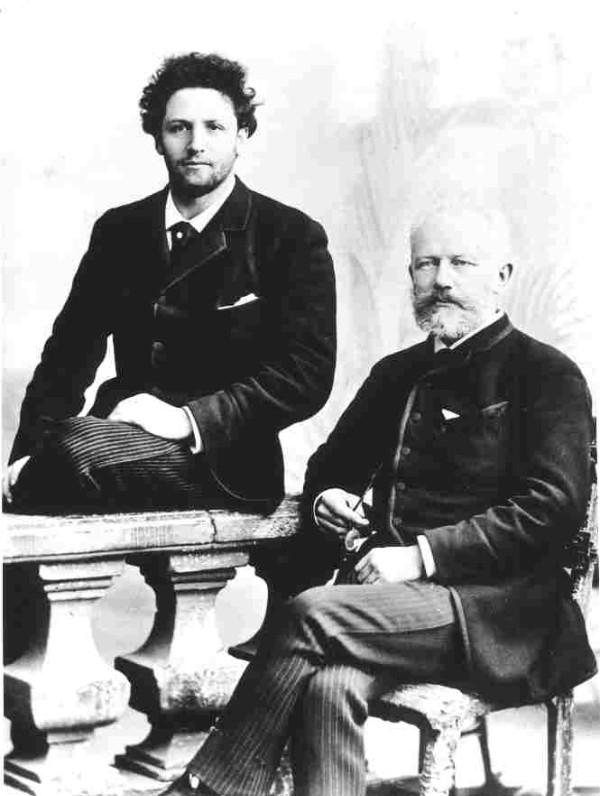
Anatoliy Brandukov and Pyotr Ilyich Tchaikovsky
Such was the case with genial (and genius) Russian cellist Anatoliy Brandukov.
Today, we’re looking at the composers, works, and students he inspired, including Tchaikovsky and Rachmaninoff.
Brandukov’s Family Background
Anatoliy Brandukov was born on 6 January 1859 in Moscow.
His father died shortly after his birth, and he was raised by his mother and his aunt.
His family was artistic. His sister danced at the legendary Bolshoi Theater and watching her perform at the lavish theater as a boy was a deeply formative experience.
His love of orchestral music was sparked around his eighth birthday, when he heard Hector Berlioz conduct a performance of Beethoven’s Fifth Symphony in Moscow.
Between his sister’s performance and Berlioz’s interpretation of Beethoven, he knew he wanted to make a life in music.
Brandukov’s Studies
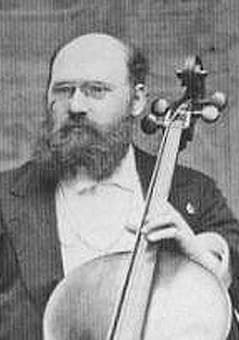
Wilhelm Fitzenhagen
At eight, he began his cello studies, enrolling in the Moscow Conservatory.
He joined the class of German cellist Wilhelm Fitzenhagen, the man to whom Tchaikovsky dedicated his Rococo Variations.
He also worked with Tchaikovsky, who was teaching theory at the Moscow Conservatory.
Upon his graduation in 1877, at the age of eighteen, he won the Conservatory’s Gold Medal: a distinct honour, and a harbinger of a major career.
Beginning His Career
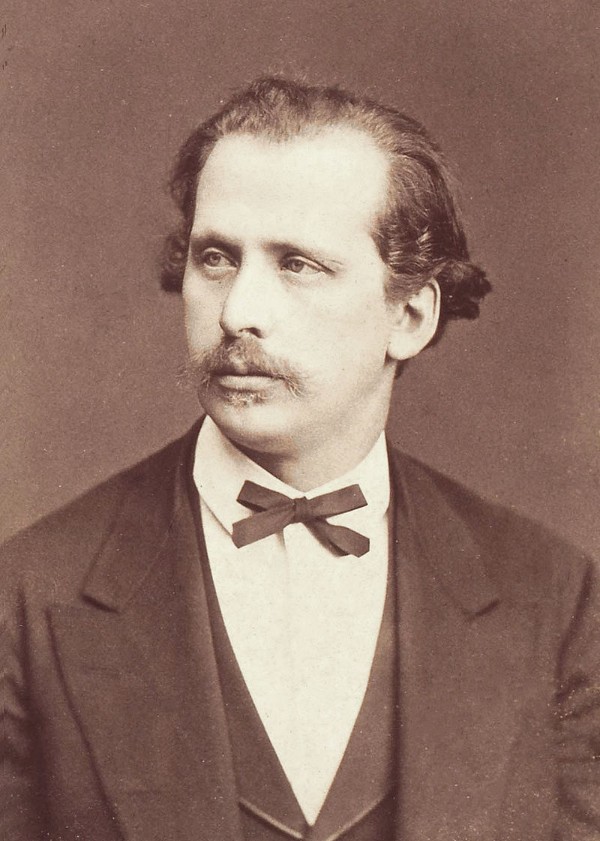
Nikolai Rubinstein
Brandukov made his concert debut in the spring of 1878, sponsored by Nikolai Rubinstein, the founder of the Moscow Conservatory.
As a young man, he decided to relocate to Paris to try his hand at a career there. During the 1880s, he made Paris his home base. He befriended a number of people in the Parisian arts scene while traveling to give occasional performances in London and Switzerland.
At one of his most noteworthy appearances, he played Camille Saint-Saëns’s first cello concerto with Saint-Saëns himself conducting!
Saint-Saëns: Cello Concerto No. 1
Tchaikovsky’s Pezzo Capriccioso
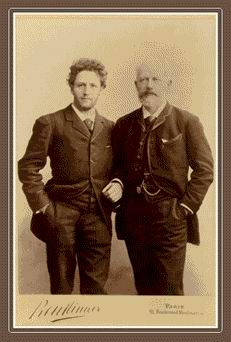
Anatoliy Brandukov and Pyotr Ilyich Tchaikovsky
In the summer of 1887, Tchaikovsky sent Brandukov the score of his somber, newly-composed cello work “Pezzo capriccioso.” (He’d written it in just a week, saddened by a friend’s syphilis-related decline.)
Tchaikovsky wrote sarcastically to Brandukov in August:
Tolya! Write to me about when you’re staying in Paris, as I have some business with you and would very much like to see you.
I’ve written a small cello piece and want you to look through and ruin the cello part.
Of course, you are an extremely feeble and bad cellist — but what’s to be done, there’s no-one else at hand! Answer me at once, dear fellow!
The duo performed a cello and piano version of it in February 1888 in Paris, at a private home.
Brandukov also premiered the cello and orchestra version in November 1889 in Moscow, with Tchaikovsky on the podium.
Mstislav Rostropovich – Benjamin Britten- Tchaikovsky Pezzo capriccioso op.62
As a sign of his deep respect for Brandukov, Tchaikovsky also made arrangements of a few of his other works for cello, just so he could conduct him in more of his works!
Encouraging Rachmaninoff
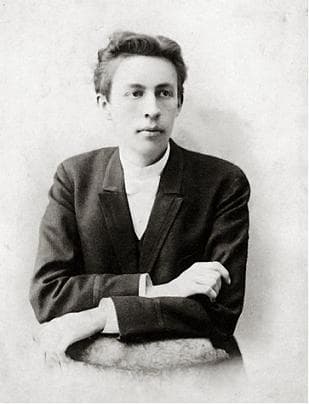
Sergei Rachmaninoff
In 1890, Brandukov’s former teacher, Wilhelm Fitzenhagen, passed away, and Tchaikovsky lobbied for Brandukov to get the spot that opened up on the Moscow Conservatory faculty. However, the school administration passed him over, feeling that he was too young for the job at the time.
Another noteworthy appearance came in February 1892, when he appeared at Sergei Rachmaninoff’s first independent concert.
Brandukov played cello in Rachmaninoff’s Trio elégiaque No. 1 and the Prélude from the Prélude et Danse orientale.
Rachmaninoff: Trio élégiaque No. 1 in G minor
It was meaningful encouragement, given that Rachmaninoff was just nineteen at the time, whereas Brandukov was 33 and a well-established artist.
In December 1901, Brandukov became the dedicatee of Rachmaninoff’s cello sonata. (He also gave the premiere.)
Yuja Wang & Gautier Capuçon play Rachmaninoff – Sonata for cello and piano in G minor op.19
A few months later, Rachmaninoff chose Brandukov to be the best man at his wedding, which took place at a military chapel.
His Legacy as a Teacher and Musician
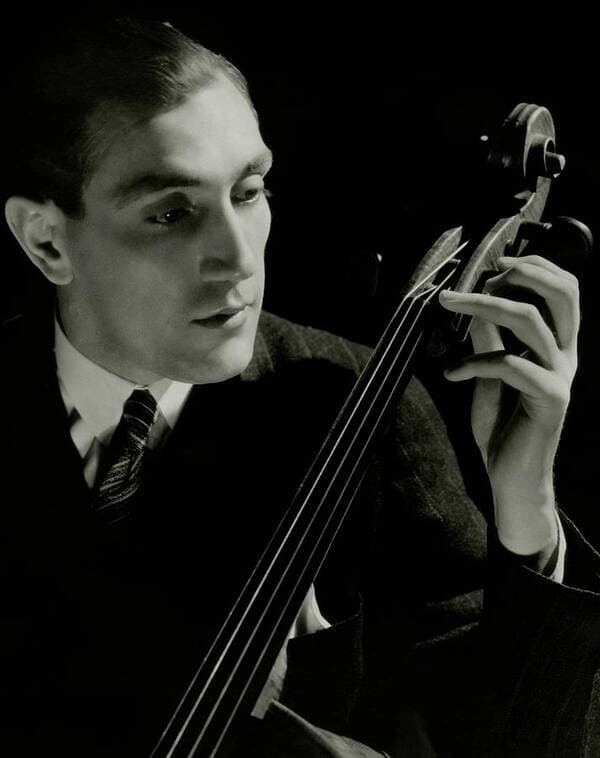
Frances McLaughlin-Gill: Gregor Piatigorsky
In 1906, at the age of 47, Brandukov was hired to teach at the Moscow Philharmonic School of Music and Drama.
A decade earlier, Tchaikovsky had urged the leaders of the Moscow Conservatory to hire him as a professor, but they’d felt he was too young. However, Brandukov did eventually join the Moscow Conservatory faculty in 1921.
During his time there, he would teach Gregor Piatigorsky, one of the twentieth century’s greatest cellists.
Piatigorsky plays Saint-Saens allegro appassionato
Brandukov was beloved by his friends, colleagues, and students for his personality and generosity.
One cello student wrote, “Brandukov was not a teacher in the conventional sense. This was a close friend, generously spreading his spiritual wealth, whose lessons became a revelation…”
He also felt deeply about his cello. Pianist Heinrich Neuhaus later remembered that one day in 1919, Brandukov slipped on the ice and fell on his cello. When he opened its case, he cried and embraced it, as if the instrument had been a person.
Up until the time Brandukov died, he was giving lectures and performing. He died on 16 February 1930, having inspired several of the greatest composers and performers of his generation.
For more of the best in classical music, sign up for our E-Newsletter