Pianist Eileen Joyce was one of the twentieth century’s most glamorous pianists, famous for her designer wardrobe, appearances on film soundtracks, and marathon four-concerto concert performances.
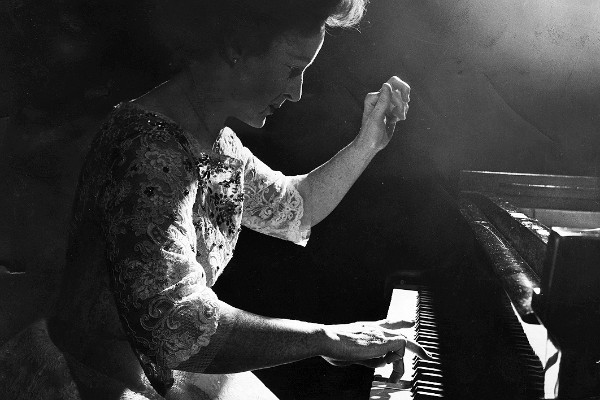
Eileen Joyce
However, she came from modest beginnings, born to impoverished parents in Western Australia. Raw talent, relentless hard work, savvy self-marketing, and sheer good luck elevated her to the top of her field.
Today, we’re looking at Eileen Joyce’s story and how she became one of the most fascinating pianists of the twentieth century.
Eileen Joyce’s Impoverished Background
Eileen Joyce was born in 1908 in the mining town of Zeehan, Tasmania, to a poor Irish-Australian family. Later in her life, she would remember a childhood spent in a series of tents.
When she was a little girl, the Joyces moved to Boulder, Western Australia, a small town a few hundred miles to the east of Perth.
Her uncle owned a pub in Boulder, and inside the pub was an old piano. Her father bought the instrument and hauled it to their home. It wasn’t long before his daughter fell in love with it.
Eileen Joyce Falls in Love With the Piano
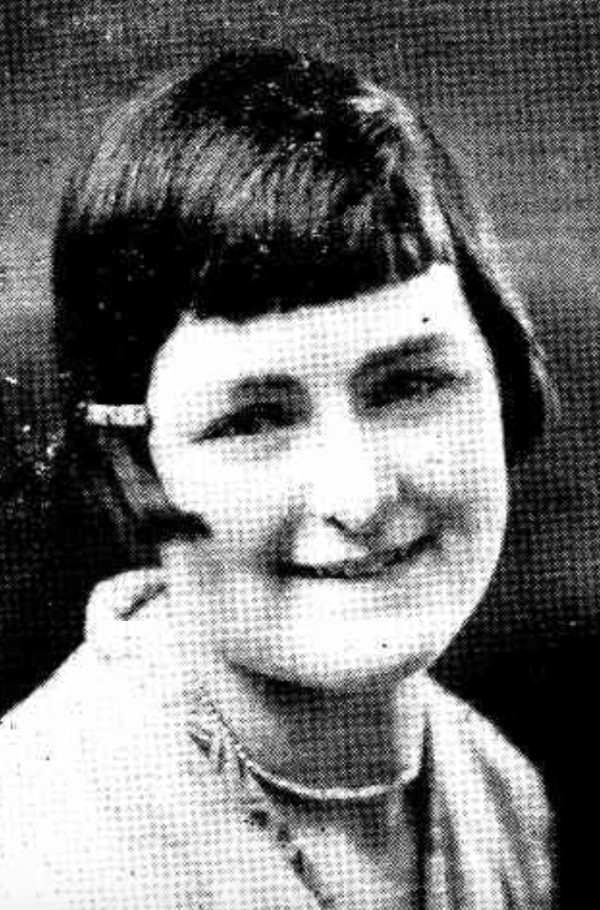
Eileen Joyce, 1926
Eileen became fascinated by that piano.
“In those days, I used to get up very early and practice, right home from school, I just couldn’t stop. It hypnotised me,” she remembered in a later interview.
She began her music studies in Boulder at the local convent school. Later, she continued them under a woman named Sister John More in Perth.
A traveling music examiner noted her talent and wrote a letter to the Perth newspapers, imploring readers to support this homegrown talent.
In 1926, the “Eileen Joyce Fund” was begun in Western Australia by the Premier, Philip Collier.
Her cause was given a boost when composer and pianist Percy Grainger passed through Perth to listen to her play. He gave a rousing endorsement of her talents:
I have heard Eileen Joyce play and have no hesitation in saying that she is in every way the most transcendentally gifted young piano student I have heard in the last twenty-five years.
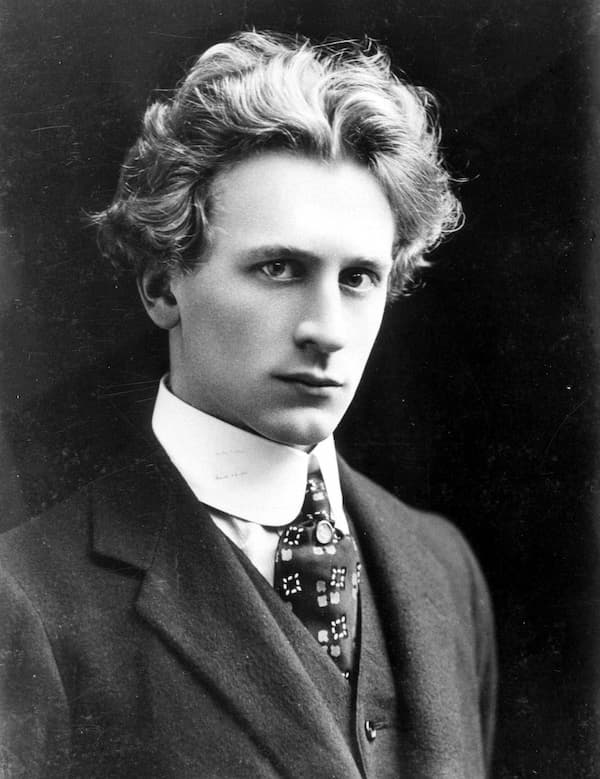
Percy Grainger
The fundraising push was successful, and she left for Europe in December 1926 at the age of eighteen.
Joyce being interviewed later in life
Studying in Europe and Settling in London
Between 1927 and 1929, she studied in Leipzig with Max von Pauer and Robert Teichmüller.
Afterwards, she moved to London, where she studied with composer and pianist Tobias Matthay, and, briefly, Adelina de Lara, who had been a student of Clara Schumann.
She began her extraordinary British career in the late summer of 1930, when she played Prokofiev’s third piano concerto at a Proms concert.
Her solo recital debut followed in March 1931.
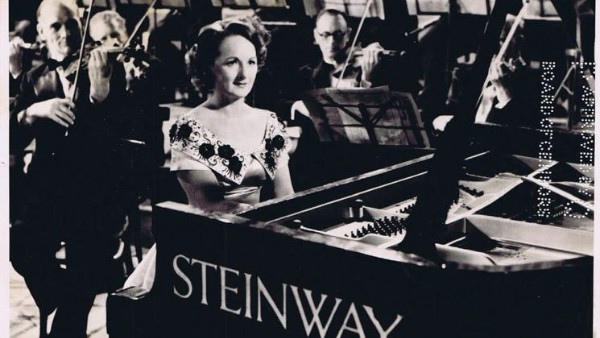
Eileen Joyce
By 1933, she was making recordings and becoming a special favourite at the BBC. Her recording of the demanding Schlözer Etude in A flat Opus 1 No. 2 is especially well-known.
Eileen Joyce plays Paul de Schlözer – Etude in A flat Opus 1 No. 2
Joyce developed a massive repertoire (over seventy concertos alone), and enjoyed playing unusual or infrequently heard works.
She also performed contemporary works, including Shostakovich’s piano concertos. In 1936, she became the first person, male or female, to perform a Shostakovich piano concerto publicly in Britain.
Becoming a Stylish Piano Star
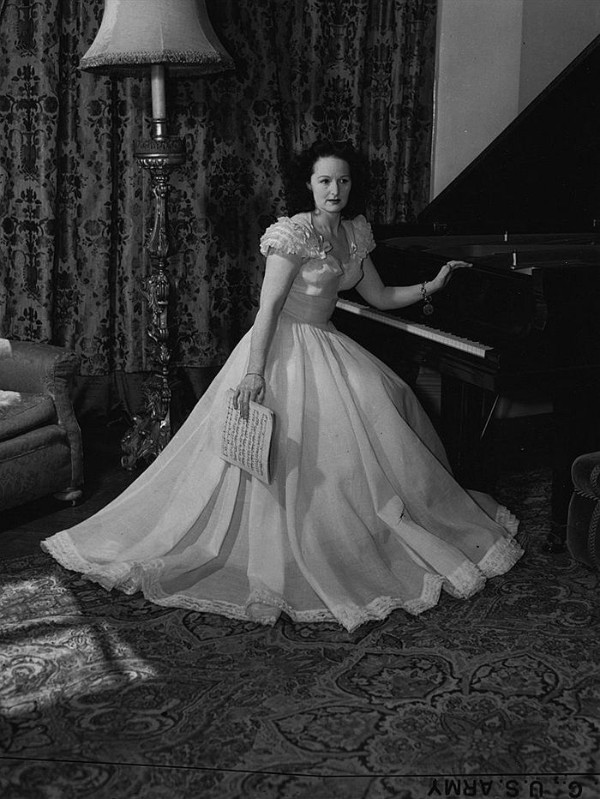
Eileen Joyce
Joyce’s fame grew throughout the 1930s and into the 1940s.
She enjoyed using her beauty to engage audiences. She designed her own gowns and enjoyed experimenting with low necklines and backless dress patterns.
Eventually, she hired Norman Hartnell, a designer beloved by the British royal family, to create her show-stopping dresses.
She had very specific ideas about what colours suited which composers. She wore blue while playing Beethoven, green playing Chopin, lilac for Liszt, and red and gold for Schumann.
She also did her hair differently for each composer. She pulled it up or back for Mozart and Beethoven, but let it flow free during more Romantic repertoire.
A 1946 newsreel about Eileen Joyce
Her Marriages and Family
In September 1937, she married stockbroker Douglas Legh Barratt. Unfortunately, the marriage was unhappy.
Together, they had a son named John, who was born two years later, the same week that World War II began.
Barratt joined the British Navy and died in the sinking of the HMS Gossamer off the coast of Norway in 1942.
Soon after Barratt’s death, Joyce began a romantic relationship with film executive Christopher Mann, moving in with him within months of her husband’s death.
The two were romantic partners for decades. They claimed they were married, but were never actually officially wed until shortly before Mann passed away.
Mann was wealthy, and Joyce never had to worry about money again. He also served as her concert agent.
Unfortunately, lifelong tension developed between Mann and Joyce’s son John Barratt, who spent most of his childhood in boarding school. Mother and son became estranged, and Joyce left nothing to her son in her will, only her grandson.
Eileen Joyce’s Movie Career
Thanks to Mann’s connections to the film industry, she made appearances in a number of films.
In 1945, her recording of Rachmaninoff’s second piano concerto was used extensively in the British film Brief Encounter, widely considered to be one of the greatest films of the decade.
A trailer for Brief Encounter
Her performance of Rachmaninoff’s second concerto served as a heartbreaking accompaniment to the female protagonist’s interior life, as she narrates her affair with a married man.
She also played piano for the film The Seventh Veil, a melodrama about a concert pianist who undergoes hypnosis, although, unlike in Brief Encounter, she was never credited.
The Seventh Veil 1945 Trailer
Life During World War II
World War II had a major effect on Joyce’s career.
She was a frequent guest artist with the London Philharmonic Orchestra, which would often play in bombed-out areas.
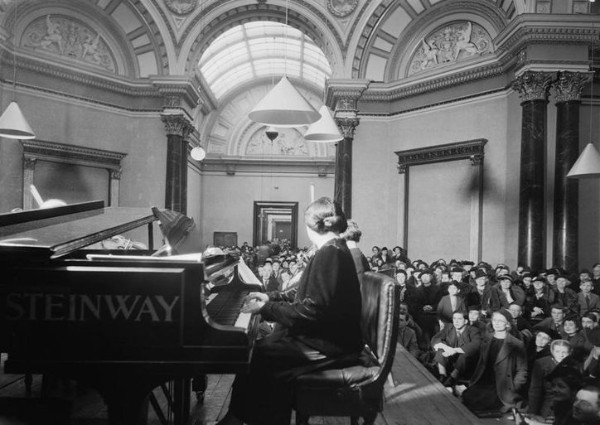
Myra Hess performing at the National Gallery
She also appeared at Dame Myra Hess’s iconic wartime concert series. Concert halls had to be blacked out at night to avoid being bombed, so Hess oversaw years of lunchtime concerts held at London’s National Gallery.
In August 1940, Joyce volunteered to be a firewatcher. This position necessitated working at night to spot evidence of the Nazis’ incendiary bombs. The work was both dangerous and physically demanding.
Joyce suffered from chronic pain (labeled rheumatism and sciatica in the 1940s). In order to perform concertos during this time, she needed to wear a plaster cast on her shoulder and back.
Of course, she continued to wear glamorous gowns, now specifically constructed to hide the cast.
An excerpt of a Joyce performance of the Grieg piano concerto
Grieg | Piano Concerto, Op.16 | Eileen Joyce, LPO, Warwick Braithwaite (1943)
Life After the War
After the war, she continued an international career, performing not only in Europe but also in America, Africa, Asia, and Australia, making her one of the best-travelled soloists of the era.
However, her star shone brightest in London. In 1948 alone, she appeared at Royal Albert Hall seventeen times, a record for any artist.
Ever savvy about publicity, she began to pull off an extraordinary artistic and physical feat: what became known as her Marathon Concerts.
During her Marathon Concert performances, she would play four works for piano and orchestra (with different outfits for each).
At one especially memorable performance, she played Chopin’s first piano concerto, Rachmaninoff’s second piano concerto, John Ireland’s piano concerto, and Beethoven’s fifth piano concerto…all in a single evening.
Eileen Joyce’s Later Career
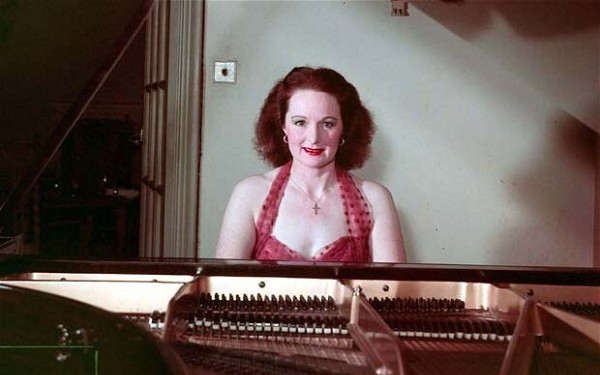
Eileen Joyce
Not surprisingly, given her penchant for overworking herself, in the 1950s she struggled with her mental health. She also felt guilty that she hadn’t been more present in her son’s life.
She made a retirement announcement in 1960 and gave her final solo recital in Scotland in the spring of 1960.
However, she continued playing, and over the decades, she did occasionally make scattered appearances.
Her final concerto performance was at the Royal Albert Hall in 1967. She played Rachmaninoff’s second piano concerto, the work that she had performed for the soundtrack of Brief Encounter.
She also supported various musical causes and charity, and became an enthusiastic promoter of the harpsichord, an instrument just then coming back in vogue due to the rise of historically informed performance practice.
Eileen Joyce’s Legacy
Joyce struggled with dementia as she aged. In 1991, she fell and fractured her hip, and died a few years later.
Her ashes are buried next to conductor Sir Thomas Beecham’s.
In Richard Davis’s biography of her, celebrated pianist Stephen Hough wrote in the introduction that he remains puzzled as to why Joyce hasn’t become a better-known artist:
She displayed all the dazzle and scintillating virtuosity of many great players… She has to be added to the list of great pianists from the past.
Perhaps a day is coming when the extraordinary talent behind her glamour can be more fully appreciated.
For more of the best in classical music, sign up for our E-Newsletter