The violin is one of the most recognisable instruments in the world – but it is far from the only instrument of its kind.
Across cultures and centuries, musicians have developed bowed string instruments that share the violin’s basic logic: strings, a resonating body, and a bow.
Some of these instruments predate the violin; others were built to solve problems the violin couldn’t. All of them are worth knowing.
Here are six violin-like instruments from around the world.
Stroh Violin
The Stroh violin was invented by electrical engineer Johannes Matthias Augustus Stroh in 1899.
Unlike a traditional violin, it replaces the wooden body with a metal diaphragm and attached horn, which amplify the sound and project it outward.
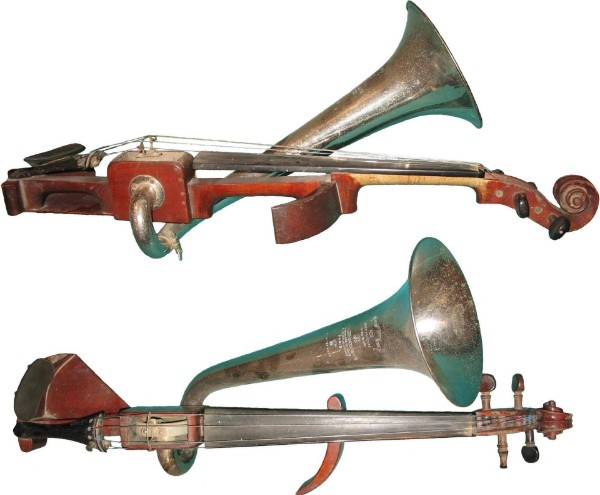
Stroh violin or Horn-violin
This made it perfect for the early recording era, when it was difficult for recording equipment to capture the sound of acoustic string instruments.
However, it was more expensive to manufacture than a traditional violin, and once recording technology advanced, the instrument became obsolete.
The Stroh violin is largely forgotten today, but is still admired as a historical curiosity.
Electric Violin
Electric violins are violins equipped with an electronic pickup that transmits sound to an amplifier.
The pickup is attached to the bridge, body, or fingerboard.
Electric violins don’t need to hew to traditional designs, and many don’t. It’s common to see instruments with five or more strings, frets, or carbon fibre bodies – enough differences to differentiate the electric violin as a separate instrument from its acoustic counterpart.
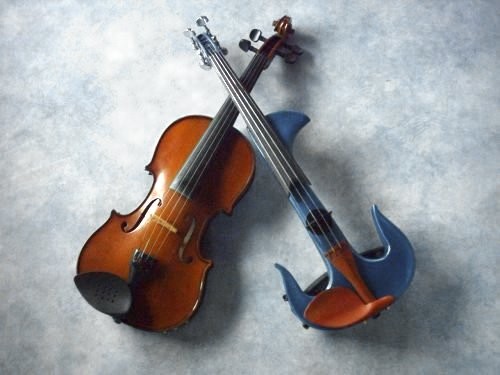
A traditional acoustic violin and a modern electronic violin from Marc Capuano
The electric violin’s roots stretch back to the 1920s. Jazz violinist Stuff Smith (1909-1967) was among the first to bring the electric violin to prominence. By the 1930s, they were being sold commercially.
Apache Fiddle
The Apache are indigenous people native to the southwestern United States.
One of their musical instruments is called the “tsii’ edo’a’tl”, which, translated literally, means “wood that sings.” However, it is better known in English as the Apache fiddle.
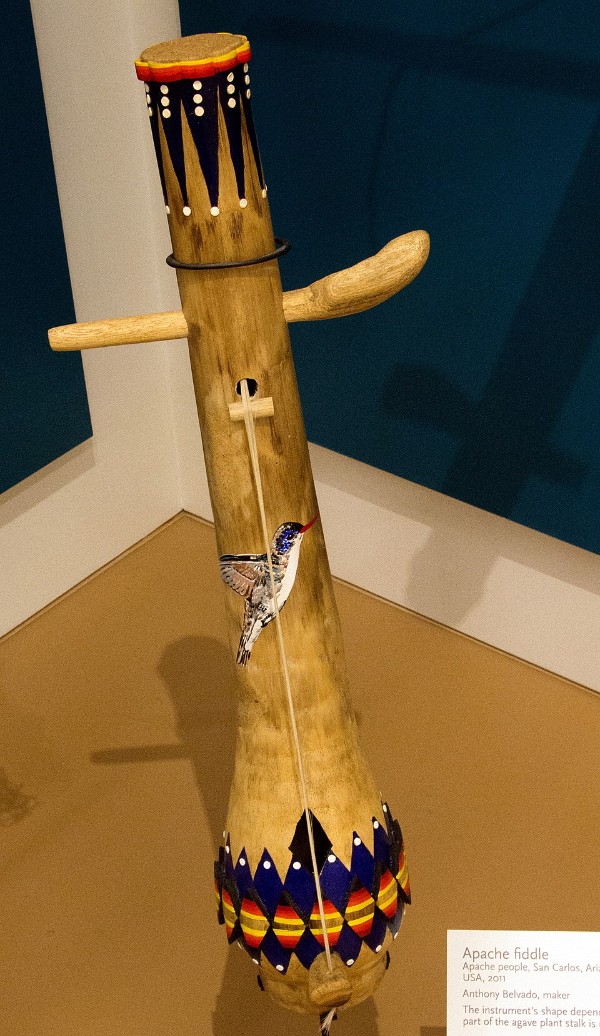
Arizona Apache fiddle, from the Musical Instrument Museum – Phoenix, Arizona
The Apache fiddle is made from the stem of a thick-stalked plant, such as agave.
One or two strands of natural material – such as horsehair – serve as strings. The player stops the strings with their fingers and draws a bow across them.
To create more friction between the string and the bow, the player might apply sticky pine pitch onto the bow – similar to how rosin is used for violin bows.
Historically, the instrument is known for its role in Apache courtship rituals.
Pochette
We wrote a whole article on the pochette here: https://interlude.hk/the-violin-in-your-pocket/
Pochettes (French for “pockets”) were miniature violin-like instruments that first appeared in the 1400s. They were favoured by dancing masters due to their portability.
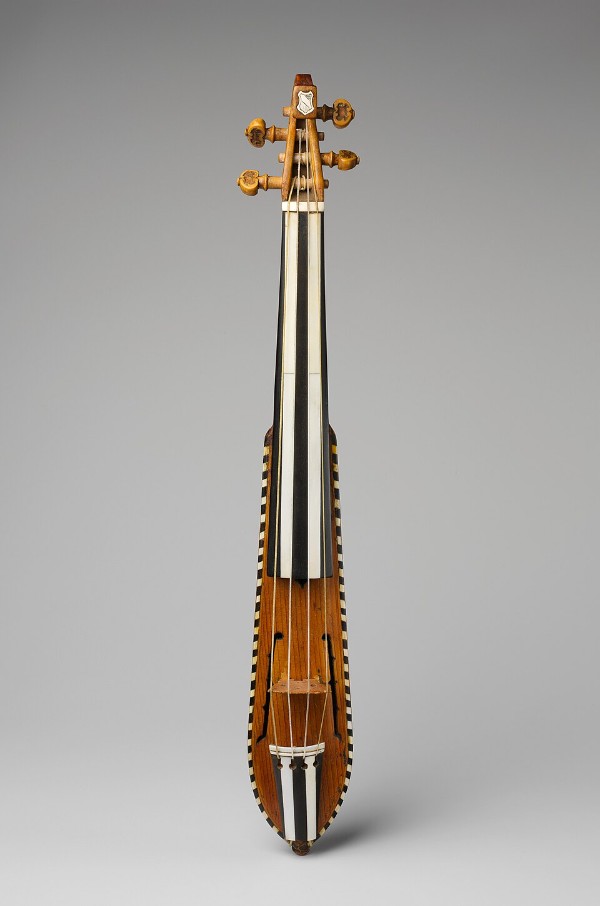
Decorated pochette
The instrument is played tucked onto the player’s chest.
The pochette is usually tuned one octave above a violin’s range, and its sound is shriller. Its range is also notably smaller; in fact, a player can’t shift above third or fifth position without running out of string to stop.
Erhu
An erhu is an ancient two-stringed Chinese instrument. Its predecessor instruments first appeared during the Tang Dynasty (600–900 CE).
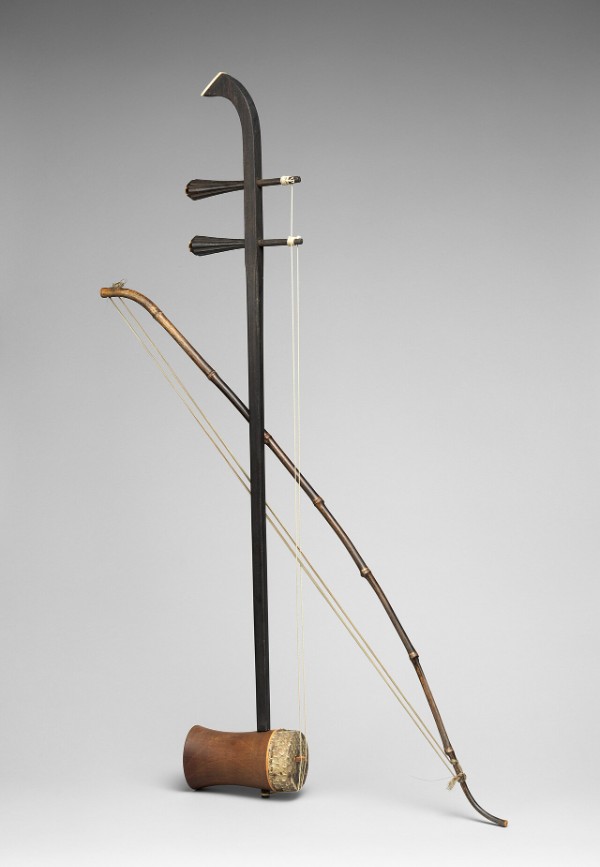
Erhu in the Mets
Over the following centuries, the erhu evolved into a folk instrument most often seen in southern China.
An accomplished erhu player, Liu Tianhua, introduced the erhu to Beijing in the 1920s, updating the instrument and composing new music for it.
The bodies of many erhus are covered with python skin. In 2005, new regulations were put in place in China requiring documentation of the origins of the skin; today, erhu python skins must come from farm-raised pythons rather than endangered wild specimens.
The player vibrates the skin by bowing the two strings. The two strings are tuned to A and D – interestingly, the same pitches as the middle two strings of a violin.
Hardanger fiddle
The national instrument of Norway, the Hardanger fiddle has inspired generations of composers, from Edvard Grieg to film composer Howard Shore.
The earliest surviving Hardanger fiddle was built in 1651 by maker Ole Jonsen Jaastad, who lived in the town of Hardanger, Norway.
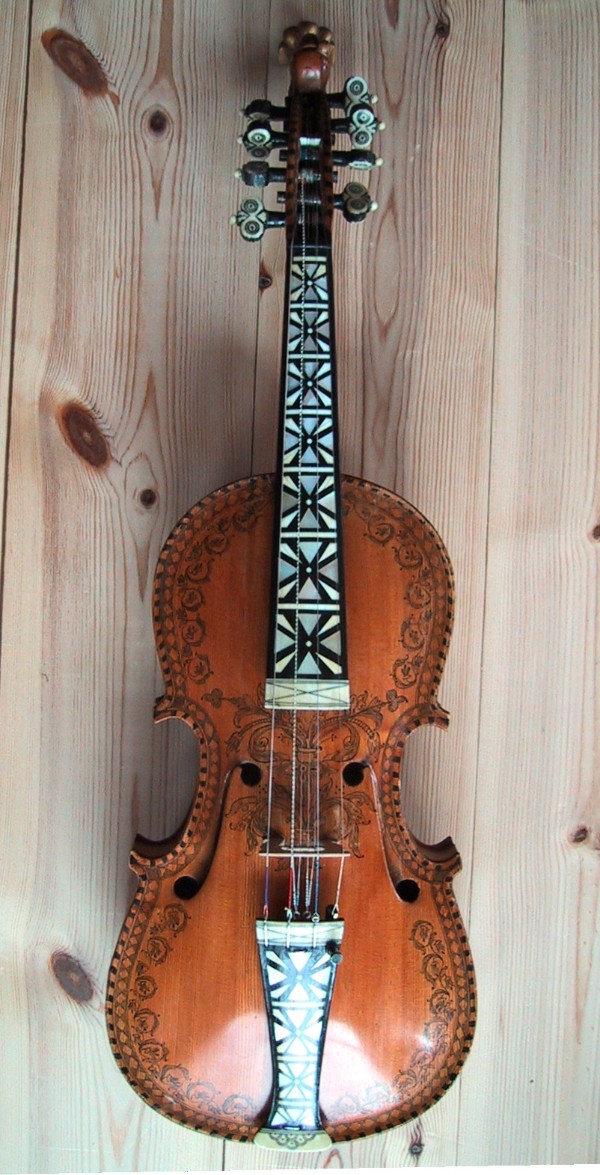
A Hardanger fiddle made by Knut Gunnarsson Helland. Owned by Monica Skaro, who inherited it from her grandfather Knut Skaro from Geilo, Norway
Although at first glance a Hardanger fiddle looks similar to a modern violin, there are some noteworthy differences.
The fiddle has four main strings like a violin, as well as secondary strings that vibrate sympathetically when particular pitches are played.
A Hardanger fiddle also has a longer scroll and more tuning pegs (to account for the extra strings), a larger bridge designed to facilitate playing on two strings at once, and folk-inspired decorations.
The Hardanger fiddle, like many European folk instruments, has long been associated with the devil. In fact, during religious revivals of the 1800s, many Hardanger fiddles were destroyed.
In 2023, we wrote about the history of the Hardanger fiddle and how Grieg was inspired by it: https://interlude.hk/finding-home-griegs-violin-sonata-no-1/
Conclusion
From the Apache fiddle’s agave stem to the Hardanger fiddle’s sympathetic strings, these six instruments represent just a fraction of the world’s bowed string traditions.
The violin may be the version most familiar to Western ears – but as these instruments attest, the instinct to draw a bow across a string to make it sing is very nearly universal.
For more of the best in classical music, sign up for our E-Newsletter